





Related: Will Future Trucks Be Powered by Batteries or Fuel Cells?
Hyundai Considers Hydrogen Tractor for North America
Hyundai offered a sneak-peek at a futuristic, hydrogen-powered Class 8 tractor at the North American Commercial Vehicle Show and confirmed it is considering entering the North American Class 8 market with the vehicle.
October 29, 2019
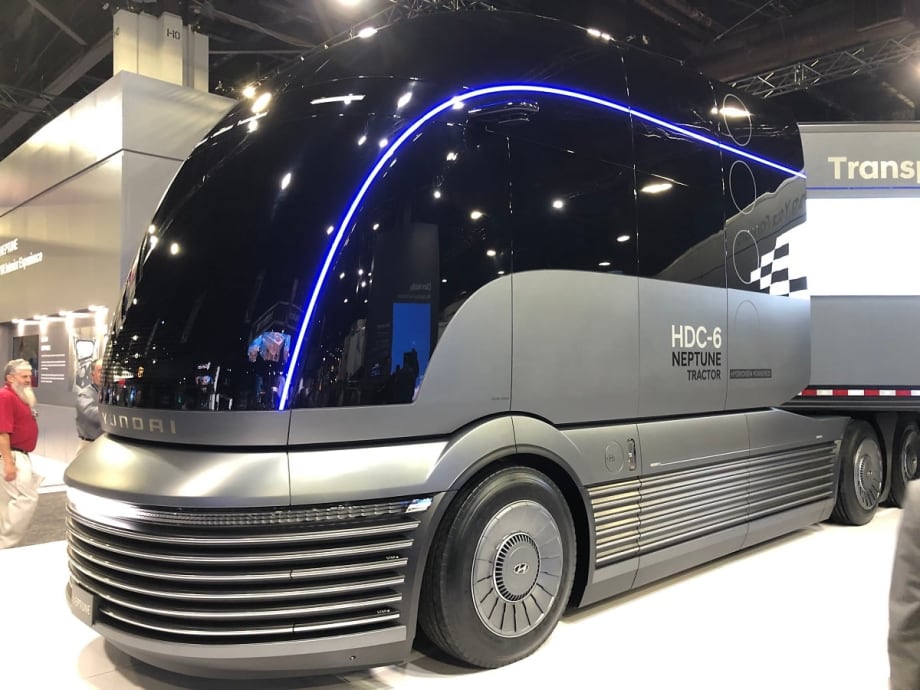
Hyundai offered a sneak-peek at a futuristic, hydrogen-powered Class 8 tractor at the North American Commercial Vehicle Show and confirmed it is considering entering the North American Class 8 market with the vehicle.
Photo: Jack Roberts
4 min to read
Atlanta — The North American truck market is notoriously hard for foreign OEMs to crack. Many have tried, and failed, over the years. While others, like Volvo and Daimler, chose to acquire already established American OEMs and then slowly assimilate their own technology and components into the vehicles over time.
Hyundai has been rumored to be interested in getting into the North American Class 8 market for years now. And now, it appears that the Korean car, truck and bus builder sees an opening in the wave of new and disruptive technology sweeping the industry.
At the North American Commercial Vehicle Show (NACV) in Atlanta on Oct. 29, Hyundai’s Commercial Truck division unveiled a futuristic-looking Class 8 tractor it calls the HDC-6 Neptune concept vehicle.
Featuring a highly aerodynamic design inspired by 1930s Art Deco locomotives, the Neptune is a hydrogen-powered truck with daily base range between 600 and 800 miles and a “Studio Space” cab with a modernistic take on driving and work, with amenities allowing drivers to cook, shower and sleep in comfort.
Edward Lee, head of Hyundai’s Commercial Vehicle Business, noted in remarks at a press conference during NACV that Hyundai has a long-established reputation as a global leader in fuel cell technology, going all the way back to its initial hydrogen commercial vehicle which debuted in Germany in 2006. In 2013, Lee noted, Hyundai launched the first mass-produced and commercially available fuel cell electric vehicle. In 2018, Hyundai launched the dedicated FCEV, NEXO. And December 2018, Hyundai invested $6.4 billion to accelerate the development of a hydrogen society, looking beyond passenger vehicles.
“Today at this show, by showing HDC-6 Neptune, the first hydrogen-only concept for Hyundai Motor Company’s commercial vehicles, we will start exploring opportunities in the United States commercial vehicle market,” Lee said. “Furthermore, we are willing to work with other partners to pave the way to establish a hydrogen ecosystem for CV.”
Hyundai feels fuel cells are the perfect alt fuel fit for heavy duty trucks and long driving distances due to higher drive range, higher payload, less refueling time and ultimately lower costs, Lee added. He also noted that Hyundai has already expanded its global leadership in fuel cell technology. Through its joint venture with H2 Energy, Hyundai is commercializing fuel cell electric trucks by providing 1,600 FCEV heavy-duty trucks to the Swiss commercial vehicle market, beginning 2019 through to 2023. With Hyundai’s commercial vehicle entry to the European market, the U.S. market is an important next phase of the company’s FCEV 2020 vision.
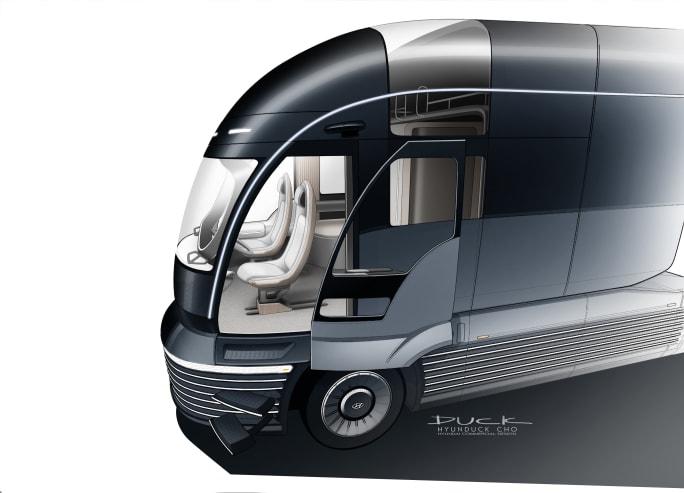
This graphic rendering shows the sliding driver-side door and gives a sense of the Neptune 6’s clean, modernistic interior design.
Image: Hyundai
A Futuristic Concept Truck
Like the great Art Deco trains of the 1930s, Hyundai engineers sought to give the Neptune 6 an “inspired, function-driven design,” while looking for new ways to combine both form and function to create an entirely unique new solution within the commercial vehicle industry, while offering a holistic global approach.
“The fuel cell powertrain gave us the opportunity to redefine the classical typology and architecture of the truck,” said Luc Donckerwolke, Chief Design Officer of Hyundai Motor Group. “The Hyundai Commercial Vehicles Design Team started with a white sheet of paper focusing on the new defined functionality resetting all standards in order to project commercial vehicles in the future.”
On HDC-6 NEPTUNE, the design team took packaging challenges and found new ways to combine both form and function. Due to increased cooling requirements, the grill of the concept commercial vehicle is applied as the theme across the entire lower portion of the Hyundai HDC-6 NEPTUNE. This creates a distinctive image while maximizing airflow. The grill concept also integrates the retractable steps, which are hidden in the side of the truck. Hyundai said the combination of both cab over engine and conventional truck formats achieves packaging efficiency and improved ergonomics.
Although access to the vehicle’s cab wasn’t permitted, Hyundai showed graphic renderings detailing a clean, modern interior with swivel seating, large, tablet-like display screens, brightly lit heads-up display images on the front windshield and a large, panoramic front windshield. The roomy, “studio-like” interior also has enough space to accommodate a small kitchen and bathroom area with shower, as well as comfortable sleeping arrangements, advancements Hyundai said would help fleets require and retain drivers.
Currently, Hyundai intends to continue refining the fuel technology on the Neptune 6, while evaluating its performance as well as reaction from fleets and potential buyers. To date, the company stresses it is only considering an eventual entry into the North American truck market, but declined to give a firm timeline for any decision on doing so.
More Fuel Smarts

How Volvo Updated Its D13 for EPA 2027 [Watch]
Volvo’s updated D13 promises lower emissions without sacrificing performance or fuel economy. Take a closer look at what changed inside the engine in this HDT Spotlight video.
Read More →
Diesel Price Spike Shortens Payback for Natural Gas Trucks, Report Says
Energy Vision estimates fleets could recover the higher purchase price of an RNG-fueled Class 8 tractor in 1.3 to 2.8 years under current fuel-price scenarios.
Read More →
Calstart Becomes Catalyst Mobility, Reflecting Broader Focus
Calstart is now Catalyst Mobility, reflecting the nonprofit’s growing national role in clean transportation, including zero-emission trucks, infrastructure and incentive programs.
Read More →

Record Diesel Prices Squeeze Trucking Fleets
Average U.S. diesel prices have climbed to nearly $6 a gallon, surpassing the 2022 record as tight refinery capacity and Middle East disruptions keep fuel costs elevated.
Read More →
Sponsored•September 9, 2026
How Fuel Delivery Shapes Engine Performance
Fuel delivery depends on more than what happens at the injector. For fleet, maintenance and technical professionals, looking at the full path from pump to injector can provide useful context for understanding engine performance.
Read More →
East Coast Port Launches $45M Electric Truck Push
The Port Authority of New York and New Jersey announced millions in incentives for zero-emission drayage trucks, yard tractors, and new charging hubs near the port.
Read More →
California Bill Could Shed Light on Electric Truck Prices
Why do battery-electric Class 8 trucks remain so expensive? A California bill headed to Gov. Gavin Newsom would give fleets and state agencies more visibility into what manufacturers charge.
Read More →
Detroit Opens Orders for EPA 2027 Engines
Detroit isn’t starting from scratch to meet EPA 2027 diesel emissions standards. Its Gen 6 DD13 and DD15 engines keep much of today’s platform while updating the fuel and aftertreatment systems.
Read More →
Zero-Emission Truck Corridor Planned for West Coast
California, Oregon, Washington, British Columbia and Baja California are coordinating plans for truck charging and hydrogen fueling from Canada to Mexico.
Read More →
A Closer Look at Kenworth’s Electric T880E Vocational Truck [Video]
Learn more about Kenworth's T880E battery-electric vocational truck at the Paccar Technical Center, including its range, applications, upfitting considerations, and PTO options, in this HDT Spotlight video.
Read More →