




Hyundai, Daimler, Toyota Announce Hydrogen Fuel Cell Initiatives
Three global vehicle makers have announced programs with major implications for hydrogen fuel cell technology, including in heavy-duty commercial vehicles.

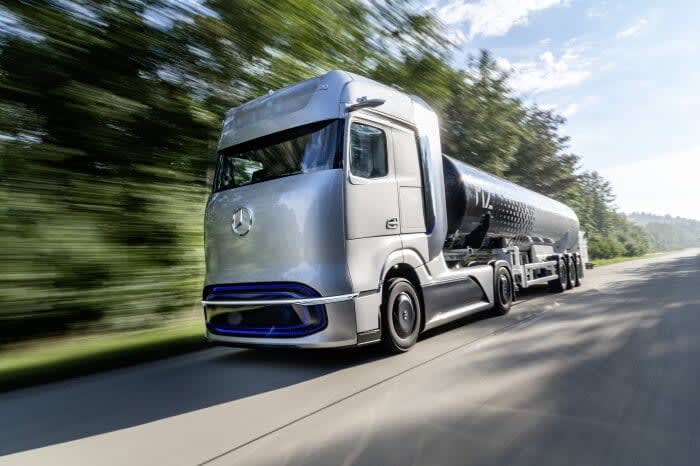
Daimler and Linde are teaming up to develop pilot hydrogen refueling stations in Germany.
Photo: Daimler AG
Hydrogen fuel cells have long been considered a dark horse zero-emissions fuel – one that held great potential, but with technical hurdles in its path toward implementation that would take decades to resolve.
But now, it appears that dark horse is coming up from behind as a viable fuel alternative for long-haul trucking applications. Just take as an example the headlines from Dec. 10 that three of the leading global car, truck and bus manufacturers are making major moves now to help set the stage for hydrogen-powered transportation.
Hyundai, which made a splash at the 2019 NACV Show in Atlanta with the unveiling of its HDC-6 Neptune Class 8 hydrogen fuel cell Class 8 cabover concept truck, is now launching its HTwo dedicated hydrogen fuel cell system brand, the South Korean OEM announced.
Hyundai Motor Group said 'HTwo is a new brand to represent the group's "world-leading" hydrogen fuel cell system, that will build on its 20-plus years of experience in hydrogen fuel cell technology.
According to Hyundai, HTwo stands for "H2," the hydrogen molecule, while also representing "hydrogen" and "humanity," the two main pillars of Hyundai's fuel cell business. The launch of the new fuel cell system brand will help facilitate Hyundai's global fuel cell business and grow the hydrogen ecosystem, the company said.
With HTwo, Hyundai said it is stepping up efforts for the development of a next-generation hydrogen fuel cell system. It aims to offer a highly efficient and diversified lineup of hydrogen-powered vehicles, including cars, truck, ocean vessels, trains, even flying drones and taxis. Not only will the next-generation fuel cell system be available for many different mobility products and services, it will also deliver enhanced performance and durability at an affordable price in a lighter architecture with enhanced energy density, according to the company.
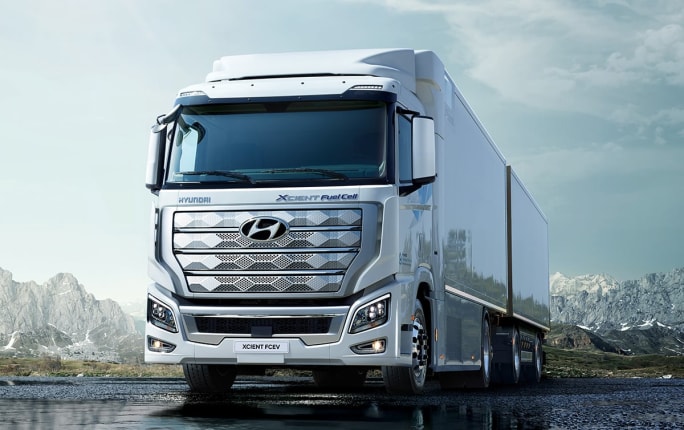
Hyundai has launched its HTWO brand, which will represent the OEM's hydrogen fuel cell system technology.
Photo: Hyundai USA
Through strategic partnerships with hydrogen, energy, and logistics companies around the world, Hyundai said it has expanded its fuel cell system business, accelerating development of a hydrogen society and laying the foundation for the company's HTwo brand, with initial focus on major hub regions – Korea, the United States, Europe and China.
Daimler, Linde to Partner on Hydrogen Refueling Stations
Global industrial gas producer Linde and Daimler Truck have signed an agreement to jointly develop next-generation liquid-hydrogen refueling technology for fuel-cell-powered trucks, the companies announced. With their collaboration, the partners aim to make the refueling process with hydrogen as easy and practical as possible, they said in a joint statement.
Together, the companies will focus on a new process for handling liquid hydrogen (“subcooled” liquid hydrogen, “sLH2 technology”). This approach allows for higher storage density, greater range, faster refueling and superior energy efficiency, the companies said, than the gaseous hydrogen being used by other manufacturers.
The new process will use higher-than-ambient pressure levels and special temperature control, which avoids so-called boil-off effects and “return gas” (gas from the vehicle’s tank returning to the filling station) during refueling and will not require complex data communication between the filling station and the truck during refueling. Overall, the technology thus allows simpler filling-station concepts, said the announcement. The higher pressure increases the hydrogen mass in the fuel tank for greater energy density.
The companies plan for the first refueling of a prototype vehicle at a pilot station in Germany in 2023. Linde and Daimler are planning for a high level of transparency and openness around the relevant interfaces of the jointly developed technologies. By enabling as many other companies as possible to develop their own refueling and vehicle technologies that apply the new liquid-hydrogen standard, a global mass market can be established for the new process, they said.
In a statement, Sven Ennerst, who heads up development for Daimler, said, “We at Daimler Truck AG are pursuing the vision of the CO2-neutral transportation of the future. The hydrogen-based fuel cell is a key technology of strategic importance in this context. With our collaboration with Linde as an expert in hydrogen refueling technology, we want to increase the viability and acceptance in the industry of fuel-cell trucks on the basis of hydrogen. The new process can further enhance the numerous advantages that liquid hydrogen offers.”
Toyota Founds Hydrogen-Focused European Business Group
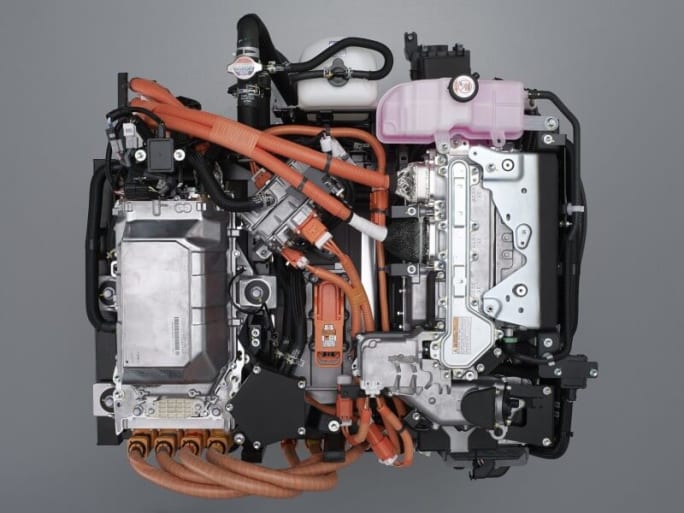
This overhead view shows Toyota's current hydrogen fuel cell technology for passenger cars.
Photo: Toyota
To maximize the opportunities for hydrogen in Europe, Toyota Motor Europe said it has established a Fuel Cell Business Group to oversee its hydrogen activities across the region.
Toyota is one of the first players in hydrogen technology, the company noted, having introduced the Mirai, the world’s first commercialized hydrogen fuel cell electric sedan, in 2014. Since then, development of the Toyota fuel cell system has continued, making it more compact, lighter and more energy-dense, according to the company.
Toyota said its hydrogen technology has the flexibility to be used not just in cars, but also to produce zero-emission power in multiple applications. It is already powering trucks, urban bus fleets, forklifts and generators. Tests are also underway for its use in boats and trains.
Based in Brussels, Belgium, the new business unit will work to strengthen the business case for hydrogen and support its introduction into mobility and other fields, making it accessible to new commercial partners. This will support the company’s long-term sustainability strategy, Toyota said.
“The benefits of hydrogen are clear,” said Thiebault Paquet, director of the Fuel Cell Business Group. “That’s why we expect our global sales of fuel cell systems to increase by a factor of 10 in the short term – and why we have dramatically increased our production capacity.”
Through the new Fuel Cell Business Group, Toyota said it intends to work closely with industry partners, national and regional governments, and organizations to stimulate the development of hydrogen eco-systems in more locations and enable progress toward hydrogen established as a leading transportation fuel around the world.
More Fuel Smarts

How Volvo Updated Its D13 for EPA 2027 [Watch]
Volvo’s updated D13 promises lower emissions without sacrificing performance or fuel economy. Take a closer look at what changed inside the engine in this HDT Spotlight video.
Read More →
Diesel Price Spike Shortens Payback for Natural Gas Trucks, Report Says
Energy Vision estimates fleets could recover the higher purchase price of an RNG-fueled Class 8 tractor in 1.3 to 2.8 years under current fuel-price scenarios.
Read More →
Calstart Becomes Catalyst Mobility, Reflecting Broader Focus
Calstart is now Catalyst Mobility, reflecting the nonprofit’s growing national role in clean transportation, including zero-emission trucks, infrastructure and incentive programs.
Read More →

Record Diesel Prices Squeeze Trucking Fleets
Average U.S. diesel prices have climbed to nearly $6 a gallon, surpassing the 2022 record as tight refinery capacity and Middle East disruptions keep fuel costs elevated.
Read More →
How Fuel Delivery Shapes Engine Performance
Fuel delivery depends on more than what happens at the injector. For fleet, maintenance and technical professionals, looking at the full path from pump to injector can provide useful context for understanding engine performance.
Read More →
East Coast Port Launches $45M Electric Truck Push
The Port Authority of New York and New Jersey announced millions in incentives for zero-emission drayage trucks, yard tractors, and new charging hubs near the port.
Read More →
California Bill Could Shed Light on Electric Truck Prices
Why do battery-electric Class 8 trucks remain so expensive? A California bill headed to Gov. Gavin Newsom would give fleets and state agencies more visibility into what manufacturers charge.
Read More →
Detroit Opens Orders for EPA 2027 Engines
Detroit isn’t starting from scratch to meet EPA 2027 diesel emissions standards. Its Gen 6 DD13 and DD15 engines keep much of today’s platform while updating the fuel and aftertreatment systems.
Read More →
Zero-Emission Truck Corridor Planned for West Coast
California, Oregon, Washington, British Columbia and Baja California are coordinating plans for truck charging and hydrogen fueling from Canada to Mexico.
Read More →
A Closer Look at Kenworth’s Electric T880E Vocational Truck [Video]
Learn more about Kenworth's T880E battery-electric vocational truck at the Paccar Technical Center, including its range, applications, upfitting considerations, and PTO options, in this HDT Spotlight video.
Read More →