




Hyundai Completes its First Successful Truck Platooning Trial
Hyundai Motor Company successfully conducted its first platooning test involving two commercial trucks on the Yeoju Smart Highway in South Korea, while replicating real-world conditions.

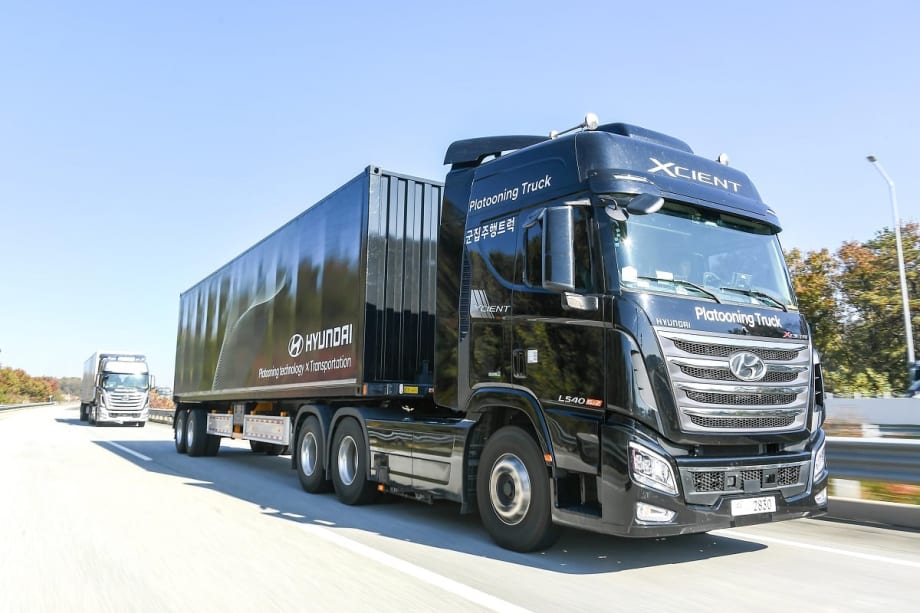
Hyundai Motor Company successfully conducted its first platooning test involving two commercial trucks on the Yeoju Smart Highway in South Korea, while replicating real-world conditions.
Photo: Hyundai
Hyundai Motor Company successfully conducted its first platooning test involving two commercial trucks on the Yeoju Smart Highway in South Korea, while replicating real-world conditions.
The Yeoju Smart Highway is a nearly 5-mile long testbed within the country’s central region expressway established by the Korean government for the development of autonomous driving research that is designed to replicate the conditions of an actual highway.
Hyundai Motor conducted the trial using two trailer-connected Xcient heavy-duty trucks.
The demonstration successfully featured vehicles platooning while under different conditions, including vehicles cutting in and out of the platoon and with simultaneous emergency braking. The test also made use of vehicle to vehicle communication tech. The tests were conducted at 37 mph for safety purposes.
“We are confident that our industry leading autonomous driving technology in commercial vehicles showcased in this platooning truck demonstration will lead into a revolutionary paradigm shift in the freight and logistics industry,” said Jihan Ryu, head of Hyundai Motor’s Commercial Vehicle Electronics Control Engineering Group. “We will strive to create constructive synergy by sharing our knowhow and experiences of developing autonomous driving technology between commercial vehicle and passenger vehicle sectors to expedite level-5 autonomous driving technology.”
While platooning, the vehicles maintained a gap of around 55 feet with real-time fine tuning based on the leading vehicle’s acceleration and deceleration. When cutoff by a vehicle, the trucks automatically extended the gap to a minimum of 82 feet.
The V2V communication system used by both trucks in the demonstration showcased how real-time information sharing between platooning vehicles can improve control over acceleration and deceleration and incorporate advanced driver assistance system information from sensors like cameras and radar.
The technology also included real-time frontal video sharing, which displays videos from the leading vehicle tow the following vehicle so that the driver in the secondary position can see the road ahead.
Hyundai’s goal is to achieve high-level platooning technology that will be able to work with tighter following distances and also implement traffic information for optimized travel in the future.
This demonstration is part of a project initiated by the South Korean Ministry of Land, Infrastructure and Transport (MOLIT). Since 2018, MOLIT has been working to support pioneering efforts for autonomous technology. Along with Hyundai Motor Company, this national project involved government, corporations, and academia.
More Equipment

How Volvo Updated Its D13 for EPA 2027 [Watch]
Volvo’s updated D13 promises lower emissions without sacrificing performance or fuel economy. Take a closer look at what changed inside the engine in this HDT Spotlight video.
Read More →
Michelin Tire Improves Efficiency and Durability for Regional Fleets
The Michelin X Multi Energy D2 is a regional haul drive tire engineered to help fleets improve fuel efficiency, durability and traction in demanding stop-and-go operations.
Read More →
ZF Expands Commercial Vehicle Push in North America
ZF is expanding its North American commercial-vehicle presence with new transmission applications, electrification, trailer technology and autonomous-driving systems.
Read More →
Tesla Wants a Self-Driving Semi. Are Cameras Enough?
Could Tesla’s camera-only autonomous driving technology work on an 80,000-pound Semi? In this commentary, HDT's Deborah Lockridge takes a look at Tesla, Cybercab, and how autonomous trucks see the road.
Read More →
Kodiak: Driverless Long-Haul Truck Launch on Track for 2026
Kodiak AI says its driverless long-haul safety case is 93% complete and it remains on track to begin commercial operations by year-end 2026.
Read More →
What DOT’s Automated Vehicle Strategy Means for Trucking
The U.S. Department of Transportation issued a new automated-vehicle strategy that outlines plans for driverless-truck regulations, cross-state freight corridors, and federal safety standards.
Read More →
East Coast Port Launches $45M Electric Truck Push
The Port Authority of New York and New Jersey announced millions in incentives for zero-emission drayage trucks, yard tractors, and new charging hubs near the port.
Read More →
PlusAI Going Public to Fund Autonomous Truck Launch
A SPAC deal could provide PlusAI with up to $300 million as it works toward a 2027 commercial launch of factory-built autonomous trucks.
Read More →
NHTSA Moves to Rewrite Truck Fuel-Economy Rules
The National Highway Traffic Safety Administration says it lacks authority to regulate medium- and heavy-duty truck engines separately from complete vehicles, but the existing standards have not yet been eliminated.
Read More →
Detroit Opens Orders for EPA 2027 Engines
Detroit isn’t starting from scratch to meet EPA 2027 diesel emissions standards. Its Gen 6 DD13 and DD15 engines keep much of today’s platform while updating the fuel and aftertreatment systems.
Read More →