





Related: Record Year for Trailer Orders Despite Down December
Huge Backlog Slows Trailer Orders to Start 2019
January trailer order numbers were down to start the year as fleets and trailer makers are still dealing with the large amount of orders made in 2018.
February 20, 2019
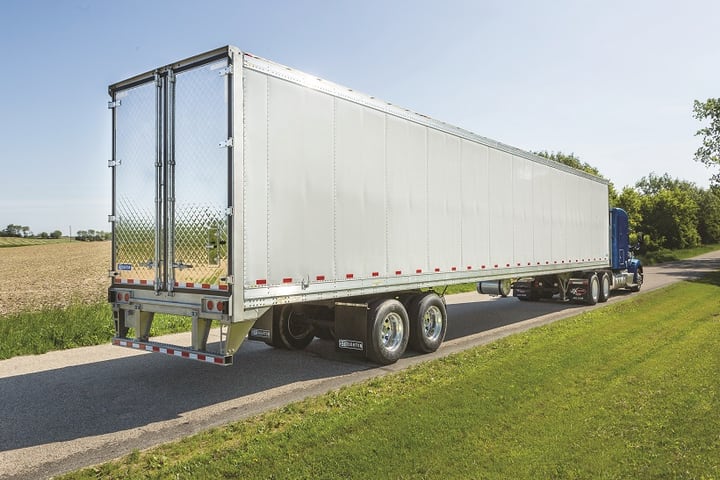
January trailer order numbers were down to start the year, though the volume still beat expectations.
Photo via Stoughton Trailer
2 min to read
January trailer order numbers were down to start the year as fleets and OEMs are still dealing with the large amount of orders made in 2018.
Analysts at FTR pegged the final number of orders for the month at 26,300 units, down 5% from December and 39% compared to the previous January. However, orders still beat FTR’s expectations, and much of the year-over-year decline in orders is simply due to the tremendous boom in equipment ordering in 2018.
“This was still a positive month for trailer orders considering how many orders are already in the backlog,” said Don Ake, FTR vice president of commercial vehicles. “All trailer segments are expected to start off 2019 with momentum, which is good news for the industry and general economy.”
ACT Research has not yet released its final trailer order volume for February, but its preliminary estimates indicate the same trend. ACT’s prediction of 25,800 units is off 7% from December 2018 and 35% year-over-year. Part of the slowdown was attributed to an all-time record backlog of orders with build slots full throughout 2019.
“Slower dry van and reefer trailer volume contributed to the declines,” said Frank Maly, ACT’s director of commercial vehicle transportation analysis and research. “Indications are lower orders were not the result of weak fleet demand, as some OEMs report unwillingness to accept additional orders that would extend orderboards that, according to some reports, already fill available 2019 build slots.”
January also had the highest number of order cancellations since August 2016. FTR attributed this to fleets shifting orders around to better suit their needs.
“The business uncertainty and more subdued economic indicators have not impacted the trailer market as of yet,” said Ake. “We do expect the market to cool slightly in the second half of the year as freight growth moderates, but for now, there is still a huge demand for new trailers across most segments.”
More Equipment

How Volvo Updated Its D13 for EPA 2027 [Watch]
Volvo’s updated D13 promises lower emissions without sacrificing performance or fuel economy. Take a closer look at what changed inside the engine in this HDT Spotlight video.
Read More →
Michelin Tire Improves Efficiency and Durability for Regional Fleets
The Michelin X Multi Energy D2 is a regional haul drive tire engineered to help fleets improve fuel efficiency, durability and traction in demanding stop-and-go operations.
Read More →
ZF Expands Commercial Vehicle Push in North America
ZF is expanding its North American commercial-vehicle presence with new transmission applications, electrification, trailer technology and autonomous-driving systems.
Read More →
Tesla Wants a Self-Driving Semi. Are Cameras Enough?
Could Tesla’s camera-only autonomous driving technology work on an 80,000-pound Semi? In this commentary, HDT's Deborah Lockridge takes a look at Tesla, Cybercab, and how autonomous trucks see the road.
Read More →
Kodiak: Driverless Long-Haul Truck Launch on Track for 2026
Kodiak AI says its driverless long-haul safety case is 93% complete and it remains on track to begin commercial operations by year-end 2026.
Read More →
What DOT’s Automated Vehicle Strategy Means for Trucking
The U.S. Department of Transportation issued a new automated-vehicle strategy that outlines plans for driverless-truck regulations, cross-state freight corridors, and federal safety standards.
Read More →
East Coast Port Launches $45M Electric Truck Push
The Port Authority of New York and New Jersey announced millions in incentives for zero-emission drayage trucks, yard tractors, and new charging hubs near the port.
Read More →
PlusAI Going Public to Fund Autonomous Truck Launch
A SPAC deal could provide PlusAI with up to $300 million as it works toward a 2027 commercial launch of factory-built autonomous trucks.
Read More →
NHTSA Moves to Rewrite Truck Fuel-Economy Rules
The National Highway Traffic Safety Administration says it lacks authority to regulate medium- and heavy-duty truck engines separately from complete vehicles, but the existing standards have not yet been eliminated.
Read More →
Detroit Opens Orders for EPA 2027 Engines
Detroit isn’t starting from scratch to meet EPA 2027 diesel emissions standards. Its Gen 6 DD13 and DD15 engines keep much of today’s platform while updating the fuel and aftertreatment systems.
Read More →