




How Truck Automation May Change Roadside Inspections
What will happen during a roadside inspection when a truck is highly or fully automated? And how might a truly “driverless” truck be inspected at an accident scene? HDT Talks Trucking turns to CVSA to find out.
January 3, 2021

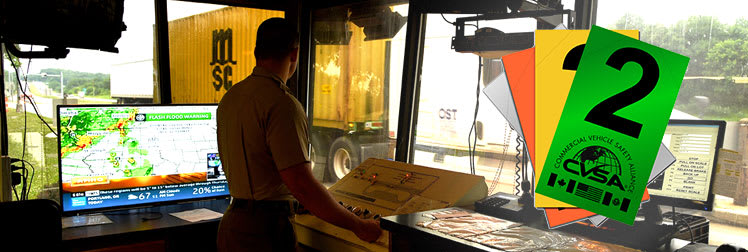
What will inspectors do when autonomous trucks come through the scales?
Photo: CVSA
3 min to read
Here’s an exercise in future think: You know what can happen now at a roadside inspection of one of your trucks. But what might happen in the perhaps-not-so-distant future at one of those routine occurrences when your truck is highly or fully automated? And how might a truly “driverless” truck be inspected at an accident scene?
To game this out, the HDT Talks Trucking podcast got on the line with Will Schaefer, director of safety programs for the Commercial Vehicle Safety Alliance. He knows whereof he speaks: Before joining CVSA in 2010, Schaefer worked as a federal regulatory research engineer at the National Highway Traffic Safety Administration; as technical policy representative at the American Trucking Associations and at the Truck Manufacturers Association, and as consultant to the Department of Energy.
Asked for his thoughts on how CVSA and the overall enforcement community is viewing the advent of highly automated and eventually fully automated (aka autonomous or “driverless”) trucks, Schaefer told HDT Talks Truckingthat “it’s a very fluid discussion. We established some recommendations for policy at the end of 2019. They're evolving. So, what we recommend might be a little different in the near future.
“In general,” he continued, “we break it down this way: There’s automation in the lower SAE levels where you still have a driver and the vehicle might be able to do certain things by itself, but not everything for extended periods. Then there are SAE automation levels four and five, where you could in theory remove the driver altogether from needing to be in the cab to drive the vehicle.”
Future of Truck Pre-Trip Inspections
Schaefer said that, especially once in the higher SAE levels, “we have an idea that there'll be some kind of enhanced pre-trip inspection, and then a remote screening or remote verification [attesting] that the vehicle was inspected at the beginning of its trip. That’s what we currently are thinking.”
He added that what may develop for automated trucks is “an enhanced pre trip slot, you know, somewhat above and beyond what we currently do for a pre-trip. One element we have suggested is that there be a diagnostic [system] that would need to be at least documented and available as the truck is passing a waystation or at a location where an inspection would typically occur for any non-automated vehicle.
“That truck could broadcast [that data] or electronically communicate it somehow. We know that there are technologies that can be used for communication to an officer at a weigh station, showing that this vehicle has gone through a pre-trip inspection; it currently has good status on XYZ, whatever those things are. And then there could be a credit to that company's, safety management score for the jurisdiction. But what we're most interested in is verifying that the vehicle is in good working order.”
Further Thoughts
Schaefer discussed a range of other topics touching on automated trucks. These include what lessons may have been learned from several recent accidents and incidents that involved autonomous vehicle operators that resulted in citations, including of all things, hours-of-service violations.
He also talked about the fluid state of safety legislation and rulemaking around autonomous vehicles and highway safety. Among other concerns he delved into is the devilish question of just how will roadside enforcement officers interact with a truck that has nobody behind the wheel to take instruction or answer questions?
Listen to this HDT Talks Trucking podcast episode hosted by Jim Park and other episodes on your favorite podcast platform or at www.truckinginfo.com/podcasts.
More Safety & Compliance

FMCSA Pauses Biennial-Update Enforcement Amid Motus Transition
Carriers whose updates were due on or after June 1 have more time, while FMCSA works to stabilize its new registration system and warns of phishing sites impersonating its new carrier registration system, Motus.
Read More →
ZF Expands Commercial Vehicle Push in North America
ZF is expanding its North American commercial-vehicle presence with new transmission applications, electrification, trailer technology and autonomous-driving systems.
Read More →
Truck Drivers Need More Than Another Alert
Fleets have more visibility into truck health, safety events, and driver activity than ever. The next challenge is turning all that information into useful guidance for the person who has to decide what to do next.
Read More →
Tesla Wants a Self-Driving Semi. Are Cameras Enough?
Could Tesla’s camera-only autonomous driving technology work on an 80,000-pound Semi? In this commentary, HDT's Deborah Lockridge takes a look at Tesla, Cybercab, and how autonomous trucks see the road.
Read More →
What DOT’s Automated Vehicle Strategy Means for Trucking
The U.S. Department of Transportation issued a new automated-vehicle strategy that outlines plans for driverless-truck regulations, cross-state freight corridors, and federal safety standards.
Read More →
NYC Expands Speed, Pedestrian Safety Tech Across Fleet
New York City is expanding intelligent speed assistance and pedestrian-alert systems across its municipal fleet, moving the technologies from pilot programs into vehicle procurement and retrofit requirements.
Read More →
FMCSA Removes 110 Truck Driver Training Schools from Certified ELDT List
Federal regulators also are targeting more than 160 additional training providers and launching a nationwide audit of third-party CDL skills testers as part of a broader crackdown on trucking fraud.
Read More →
Beyond DOT Compliance: What Makes a Trucking Fleet Truly Safe?
A trucking fleet can follow every rule and still make unsafe decisions. The real test comes when safety conflicts with freight, productivity, or cost.
Read More →
Hours of Service Pilot Programs: FMCSA Readies for 2027 Rollout
Two pilot programs could eventually reshape hours-of-service rules, giving truck drivers options to pause their 14-hour clock or use longer split sleeper rest periods.
Read More →
New Guide Offers Pet Safety Tips for Truck Drivers
Hundreds of thousands of pets travel in truck cabs. A new safety guide from Volvo Trucks and the Center for Pet Safety offers practical advice for truck drivers who bring dogs and cats along for the ride.
Read More →