




How to Realize Returns on Investing in Truck Upgrades
Here are four proven ways to realize returns on investment made to upgrade trucking equipment.
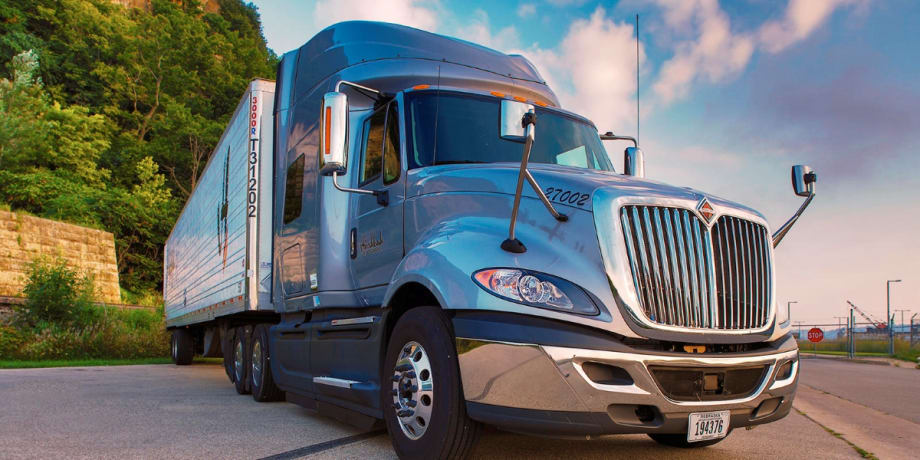
Hirschbach Motor Lines’ drivers pay for certain comfort upgrades and that approach has helped to ensure they get the most coveted features in their trucks.
Photo: Hirschbach Motor Lines
Every truck option comes at a cost, but with some careful planning those costs can transform into investments and deliver true financial returns.
Here are four ways to realize an ROI on truck-related investments, as shared during a panel discussion at February’s annual meeting of the Technology & Maintenance Council.
1. Ask Drivers to Contribute to Comfort Upgrades
Creature comforts don’t tend to deliver a direct financial return, but there’s no denying that they play a role in recruiting and retaining drivers. It’s why Hirschbach Motor Lines equips trucks with everything from high-speed internet to upgraded seats and premium mattresses.
However, Hirschbach’s drivers pay for such upgrades and that approach has helped to ensure they get the most coveted comfort-related features.
While the fleet had provided a satellite-based entertainment system, for example, 70% of the drivers admitted they would rather opt for internet service. A full 95% of those under 35 even see high-speed internet in the cab as a basic necessity.
“You can apply a small weekly fee,” said Nick Forte, vice president of maintenance. “Most people are happy to pay $10 a week, $5 a week.”
The shift has even led to $940,000 in annual savings for the fleet. About $400,000 comes in reduced maintenance costs because there are no satellite dishes to damage when coupling trailers. Satellite subscription fees are gone, too.
Money has also been saved by ordering sleepers without mattresses and letting drivers choose between a standard, premium, or elite mattress if they cover the costs of the more expensive offerings. The fleet, meanwhile, uses its buying power to secure preferred pricing.
Before the strategy was introduced, the fleet discovered that the majority of mattresses installed by OEMs were thrown away within six months.
“Mattresses are an individual preference,” Forte explained. “They want the option to pick what they sleep on. Makes sense.
“It’s well worth the investment – and in four months you have the cost of equipment covered,” he added, referring to the cost sharing.
2. Collect Quality Data
“Getting a real return on investment from fleet monitoring is all about increasing your visibility,” said Joshua Phillips, customer success manager at Fleetio, a supplier of fleet management software.
But some savings can be realized by automating and integrating the data stream, eliminating the man hours required to build reports.
It’s also important to focus on meaningful data, he said. “Do you have data paralysis? Is there too much data there that you couldn’t possibly do anything with it?”
“You get to make better decisions. You have all the data in front of you,” Philips continued, citing the example of big savings that can emerge when actions are based on scorecards that identify high-risk drivers.
Still, anyone involved in the data collection tools need to know how to use them, Phillips said. He also stressed that it’s important not to overestimate a fleet’s competence with data when deciding what information should be gathered. “You can always grow and expand on this but being honest about it now is going to help you get that money back.”
3. Tackle Idling yet Keep Drivers Comfortable
Fleets can adopt several strategies that limit idling but also keep drivers comfortable, said Dave Schaller, industry engagement director of the North American Council for Freight Efficiency. And a 10% annual reduction in idle time equates to about a 1% boost in fuel economy.
The anti-idling controls involve more than engine parameters, he explained. The need can also be eased by spec’ing the highest-available level of cab insulation, a diesel-fired heater, light paint colors, and engine start/stop systems. A dark-colored sleeper, for example, takes 20% more energy to cool.
“It’s not just one thing. It’s how do multiple items come together for the best solution.”
Granted, the returns are not all realized when it comes time to sell the truck. “Not all these items are perceived in the resale market as having a strong resale value,” he said.
4. Embrace Advanced Safety Systems
It’s difficult to calculate the financial return on something that doesn’t happen. But that’s one of the factors that comes into play when choosing vehicle safety technologies that are meant to prevent collisions.
“New features are likely going to dramatically increase the return on investment,” said Kevin Grove, senior research associate at the Virginia Tech Transportation Institute, referring to features such as automatic emergency braking. Lane departure warnings and lane keeping assist systems can reduce the risk of collisions caused when trucks run off the road, too.
He’s also a fan of video-based monitoring.
“The video data can be used to train or prevent crashes of almost any type,” he said. “This is very dependent on what your fleet is doing with the data.”
About one in three crashes are lane departure events, each averaging about $5,300, said Ananda Pandy, technical specialist for ADAS systems and autonomy at ZF Friedrichshafen AG.
“The more effective the system is, the more the savings is,” Pandy noted.
More Equipment

How Volvo Updated Its D13 for EPA 2027 [Watch]
Volvo’s updated D13 promises lower emissions without sacrificing performance or fuel economy. Take a closer look at what changed inside the engine in this HDT Spotlight video.
Read More →
Michelin Tire Improves Efficiency and Durability for Regional Fleets
The Michelin X Multi Energy D2 is a regional haul drive tire engineered to help fleets improve fuel efficiency, durability and traction in demanding stop-and-go operations.
Read More →
ZF Expands Commercial Vehicle Push in North America
ZF is expanding its North American commercial-vehicle presence with new transmission applications, electrification, trailer technology and autonomous-driving systems.
Read More →
Tesla Wants a Self-Driving Semi. Are Cameras Enough?
Could Tesla’s camera-only autonomous driving technology work on an 80,000-pound Semi? In this commentary, HDT's Deborah Lockridge takes a look at Tesla, Cybercab, and how autonomous trucks see the road.
Read More →
Kodiak: Driverless Long-Haul Truck Launch on Track for 2026
Kodiak AI says its driverless long-haul safety case is 93% complete and it remains on track to begin commercial operations by year-end 2026.
Read More →
What DOT’s Automated Vehicle Strategy Means for Trucking
The U.S. Department of Transportation issued a new automated-vehicle strategy that outlines plans for driverless-truck regulations, cross-state freight corridors, and federal safety standards.
Read More →
East Coast Port Launches $45M Electric Truck Push
The Port Authority of New York and New Jersey announced millions in incentives for zero-emission drayage trucks, yard tractors, and new charging hubs near the port.
Read More →
PlusAI Going Public to Fund Autonomous Truck Launch
A SPAC deal could provide PlusAI with up to $300 million as it works toward a 2027 commercial launch of factory-built autonomous trucks.
Read More →
NHTSA Moves to Rewrite Truck Fuel-Economy Rules
The National Highway Traffic Safety Administration says it lacks authority to regulate medium- and heavy-duty truck engines separately from complete vehicles, but the existing standards have not yet been eliminated.
Read More →
Detroit Opens Orders for EPA 2027 Engines
Detroit isn’t starting from scratch to meet EPA 2027 diesel emissions standards. Its Gen 6 DD13 and DD15 engines keep much of today’s platform while updating the fuel and aftertreatment systems.
Read More →