




How Automation, Technology Will Change Trucking in the Next Decade
The changes currently happening in technology and automation are likely to change trucking as profoundly as the development of the Interstate Highway System, predicted Noel Perry Thursday in FTR’s monthly State of Freight webinar.

The changes currently happening in technology and automation are likely to change trucking as profoundly as the development of the Interstate Highway System, predicted Noel Perry Thursday in FTR’s monthly State of Freight webinar.
“Most of the time, the future is not that much different, and the details of it are uncertain enough, that spending a lot of time worrying about what happens 10 years from now doesn’t make a lot of sense,” said Perry, an economist who has specialized in the transportation and logistics industry for decades.
In forecasting, he said, you concentrate on things that are both important to the industry and of a high probability. For a small fleet in the 1950s, the importance of highways that could halve transport times was evident. When President Eisenhower signed the bill establishing the Interstate Highway System, the probability of that change became not only high, but a virtual certainty.
Today, Perry said, “the explosion of digital calculating tools and automating tools will have an equally large effect on our business 10 years from now” as the highway system did on the business. “We see a lot of them being introduced and tested right now, so the likelihood is high.”
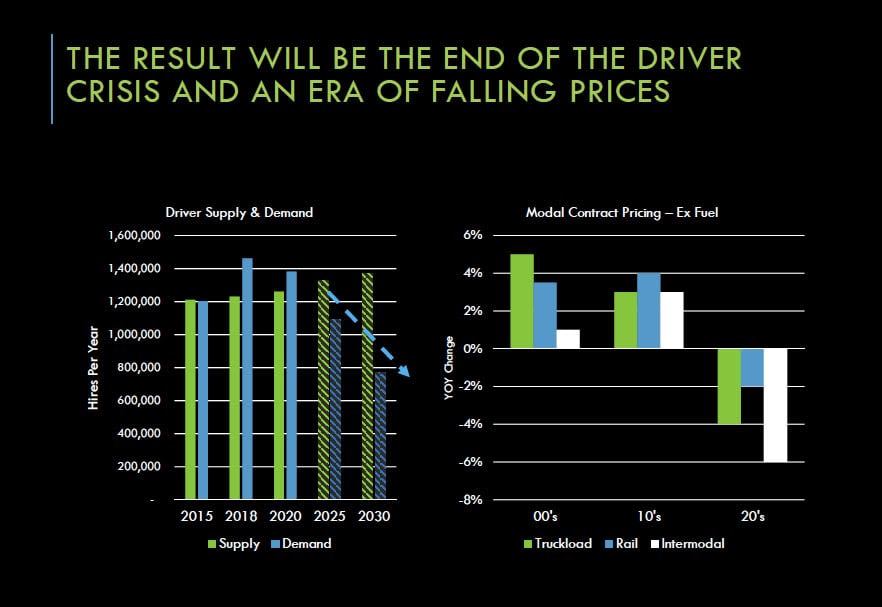
By the late 2020s, he said, we will no longer have a driver shortage, making it tough to get higher rates. Other costs will be lower. Yet taxes, he said, will be higher, as governments turn to trucking to not only pay for infrastructure but also for increasing social services for an aging population, and for the country’s rising debt and higher interest on that debt.
From an economic standpoint, however, a decade from now we’ll see that the explosion in automation “erases the advantage China has over us in labor costs and economies of scale.” Today’s automated manufacturing tools, he said, will be more affordable for smaller companies.
“That means the U.S., which has tremendous advantages in capital, logistics and materials, reverses its position as a high cost manufacturing location and becomes a low cost manufacturing location,” Perry said. “Even better than Mexico. A lot of the economic benefit we’ve lost overseas will come back. And it will just about offset the job losses from automation inside our manufacturing places.”
However, he said, these changes also will reduce the amount of transportation that’s required. As plants gain the ability to become smaller through automation, they can move closer to customers. We may see the re-opening of car factories in California, for instance. So length of haul goes down.
On top of that, he said, with automation comes less waste in the manufacturing sector.
“When you take waste and length of haul out, it’s very likely we’ll be moving fewer ton miles of freight than we do today. That’s great for the economy, very efficient; it’s not so good for us in transportation.
“The demand for transportation will change from a volume issue to a quality issue. These tools will require more precise transportation. It’s going to be about quality and service.”
Add to the increased efficiency and productivity of the manufacturing sector the potential for increased automation and “productivity” of transportation itself, and you could see the number of trucks needed reduced by as much as half, Perry projected.
“As we automate the construction and operation of our highways, capacity increases without changes in investment,” he said. If you just get everyone driving the same speed, for instance, you lose the inefficient “accordion effect” and reduce accidents. “If you put in some more sophisticated technology it’s possible to triple the capacity of any highway,” he said.
So other than increased taxes, he said, other costs will go down — driver costs, fuel costs, accident and insurance costs, etc.
Many of these technologies are already partially in play, he said. Look at navigation (“nobody carries maps anymore), automated paperwork in the form of electronic logs, automated lane management and following distance systems. Some fleets are already using these technologies, and some will be mandated. “So this stuff is coming at us very rapidly, more so than I thought originally.”
“When it happens, the driver shortage goes away,” Perry said. In 2018-2020, he said, we’ll still have a problem with the supply of drivers being less than demand because of regulatory problems.
“But once we get into the ‘20s and productivity goes up, supply will be higher and demand will be lower…. of course that has profound implications for pricing…. the only way we’re going to make money … is to emphasize quality.”
More Fleet Management

Why Private Fleets Are Taking More Freight
Private fleets are putting their own trucks on demanding customers and high-cost lanes as companies seek greater control over service, costs, and capacity.
Read More →
Color Match Smarter: Tools That Restore & Perform
For fleet managers and collision repair professionals keeping heavy-duty trucks on the road, getting the color right the first time isn't just about appearance — it's about efficiency, turnaround time, and bottom-line results. Discover how today's digital color tools are transforming the repair process from guesswork to precision.
Read More →
FMCSA Pauses Biennial-Update Enforcement Amid Motus Transition
Carriers whose updates were due on or after June 1 have more time, while FMCSA works to stabilize its new registration system and warns of phishing sites impersonating its new carrier registration system, Motus.
Read More →


2026 Blueprint for Countering Smarter Supply Chain Theft
Cargo theft is no longer just the cost of doing business. It's a multi-billion-dollar criminal enterprise exploiting vulnerabilities across your fleet, drivers, and supply chain.
Read More →
How Telematics Improves Visibility, Control, and Performance in Refrigerated Fleets
Explore how telematics help refrigerated fleets improve visibility, uptime, efficiency, compliance, and cargo protection across connected cold chain operations.
Read More →
What the U.S.-Canada Trade War Means for Trucking
Escalating U.S.-Canada tariffs could disrupt cross-border freight, reduce truck volumes, raise costs, and create new uncertainty for carriers on both sides of the border.
Read More →
What Are Trucking’s Top Concerns for 2026?
The American Transportation Research Institute wants to know what's worrying trucking fleet managers, drivers, and other stakeholders in its annual Industry Issues survey.
Read More →
American Trucking Associations Looks for a New Leader
ATA President and CEO Chris Spear abruptly left his job at the association on August 21, at a pivotal time for the trucking industry.
Read More →
Public Wi-Fi Cybersecurity Risks: How Truck Drivers and Fleets Can Protect Their Data
Public Wi-Fi can expose truck drivers and fleets to credential theft, malware, and other cyber threats. Here’s how to reduce the risk on the road.
Read More →
For Nicky Cupp, Fleet Innovation Starts With Frustration
HDT Truck Fleet Innovator Nicky Cupp turns everyday pain points at Fraley & Schilling into opportunities for better technology and smarter processes.
Read More →