




Related: Transpo Industry Pushes Back on 5.9-GHZ reallocation proposal
House Committee Criticizes FCC Effort to Open Up 5.9 GHz Spectrum
In a letter to the Federal Communication Commission, leaders and members of the House Committee on Transportation and Infrastructure criticized that agency’s effort to open up the 5.9-gigahertz wireless communication spectrum to non-transportation use.
by Sean Kilcarr, AASHTO
January 23, 2020
The FCC wants to reallocate half of the 5.9 GHZ band due to the “slow deployment” of dedicated short-range communications or DSRC technology.
Photo: DOT
3 min to read
In a Jan. 22 letter to all five members of the Federal Communication Commission, leaders and members of the House Committee on Transportation and Infrastructure strongly criticized that agency’s effort to open up the 5.9-gigahertz wireless communication spectrum to non-transportation use; especially as “there remain serious outstanding questions about the potential implications of this approach that could significantly undermine safety benefits to the driving public.”
The five-page letter – signed by House T&I Chairman Rep. Peter DeFazio, D-OR, Ranking Member Rep. Sam Graves, R-MO., and 36 committee members – strongly panned the FCC’s unanimously approved notice of proposed rulemaking that seeks to reallocate half of the 5.9 GHZ band due to the “slow deployment” of dedicated short-range communications or DSRC technology, the emergence of new transportation and other communication systems, and escalating demand for unlicensed operations like Wi-Fi.
“To understand the significance of this technology, safety advocates have compared this technology to the next seat belt or airbag in terms of saving lives and opening the door to safer self-driving cars that can effectively look around corners and through buildings,” the House T&I leaders and members said in their letter.
They added that recent actions by the FCC are exacerbating the problem and have “upended any progress being made” as well.
“On Dec. 19, the FCC announced a temporary freeze on acceptance and processing of 5.9 GHz license applications,” the House T&I members wrote.
“Additionally, the committee understands that the FCC has been sitting on approximately 500 applications for DSRC roadside unit licenses,” they said. “The committee remains deeply concerned with how the FCC’s actions have continued to create uncertainty for the private sector that this band will not be available in the future.”
The leaders of all 50 state departments of transportation, the District of Columbia, and Puerto Rico made a similar point in a letter sent to the FCC last August, stressing that “connected vehicles utilizing Vehicle-to-Everything (V2X) communication in the 5.9-GHz spectrum will save lives by creating a seamless, cooperative environment that significantly improves the safety of our transportation system.”
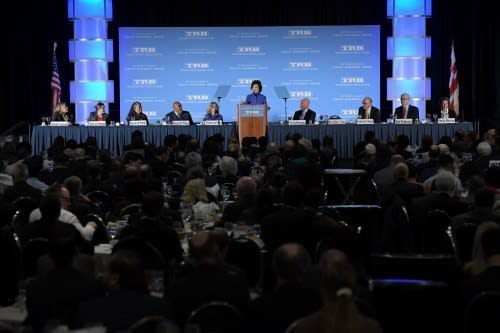
Transportation Secretary Elaine Chao also addressed the connected vehicles issue during her keynote speech at the annual Transportation Research Board meeting.
Photo: Transportation Research Board
Elaine Chao, U.S. Department of Transportation secretary, also emphasized that issue during her keynote speech at the annual Transportation Research Board meeting in Washington D.C.
“The potential appeal of AVs [autonomous vehicles] is their ability to save thousands of lives every year. AVs could also restore mobility for millions of people who face transportation challenges, such as the elderly and people with disabilities,” she explained on Jan. 15.
That’s why “we believe it is very important to retain this bandwidth for this purpose and the department is actively advocating the FCC to do so,” Chao said.
This story originally appeared in the AASHTO Journal, a weekly transportation news magazine of the American Association of State Highway and Transportation Officials. Used with permission.
More Safety & Compliance

FMCSA Pauses Biennial-Update Enforcement Amid Motus Transition
Carriers whose updates were due on or after June 1 have more time, while FMCSA works to stabilize its new registration system and warns of phishing sites impersonating its new carrier registration system, Motus.
Read More →
ZF Expands Commercial Vehicle Push in North America
ZF is expanding its North American commercial-vehicle presence with new transmission applications, electrification, trailer technology and autonomous-driving systems.
Read More →
Truck Drivers Need More Than Another Alert
Fleets have more visibility into truck health, safety events, and driver activity than ever. The next challenge is turning all that information into useful guidance for the person who has to decide what to do next.
Read More →
Tesla Wants a Self-Driving Semi. Are Cameras Enough?
Could Tesla’s camera-only autonomous driving technology work on an 80,000-pound Semi? In this commentary, HDT's Deborah Lockridge takes a look at Tesla, Cybercab, and how autonomous trucks see the road.
Read More →
What DOT’s Automated Vehicle Strategy Means for Trucking
The U.S. Department of Transportation issued a new automated-vehicle strategy that outlines plans for driverless-truck regulations, cross-state freight corridors, and federal safety standards.
Read More →
NYC Expands Speed, Pedestrian Safety Tech Across Fleet
New York City is expanding intelligent speed assistance and pedestrian-alert systems across its municipal fleet, moving the technologies from pilot programs into vehicle procurement and retrofit requirements.
Read More →
FMCSA Removes 110 Truck Driver Training Schools from Certified ELDT List
Federal regulators also are targeting more than 160 additional training providers and launching a nationwide audit of third-party CDL skills testers as part of a broader crackdown on trucking fraud.
Read More →
Beyond DOT Compliance: What Makes a Trucking Fleet Truly Safe?
A trucking fleet can follow every rule and still make unsafe decisions. The real test comes when safety conflicts with freight, productivity, or cost.
Read More →
Hours of Service Pilot Programs: FMCSA Readies for 2027 Rollout
Two pilot programs could eventually reshape hours-of-service rules, giving truck drivers options to pause their 14-hour clock or use longer split sleeper rest periods.
Read More →
New Guide Offers Pet Safety Tips for Truck Drivers
Hundreds of thousands of pets travel in truck cabs. A new safety guide from Volvo Trucks and the Center for Pet Safety offers practical advice for truck drivers who bring dogs and cats along for the ride.
Read More →