





Read More: Pilot's $1B Initiative to Remodel Travel Centers Nationwide
Historic Tennessean Travel Stop Rebuilds Bigger & Better
A new 25,000-square-foot building is planned for the iconic Tennessean Travel Stop about one year after the site's former building was destroyed by a grease fire.
August 31, 2022
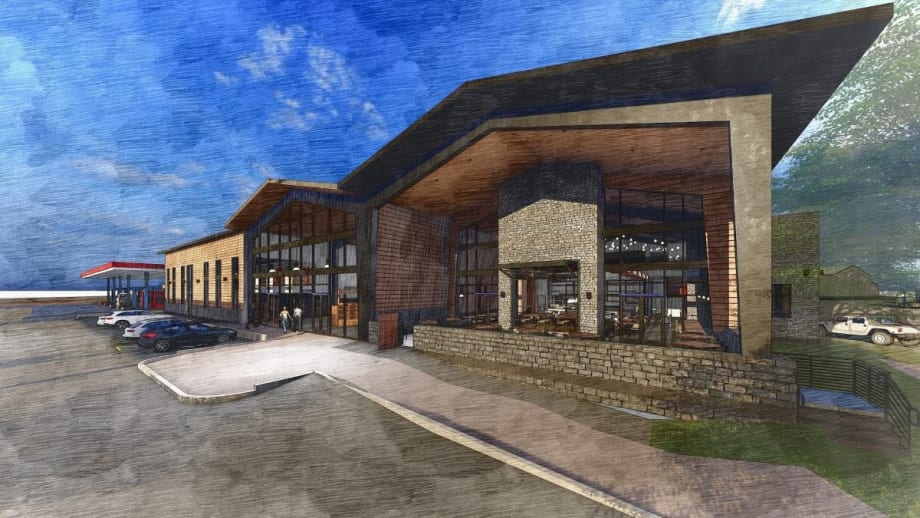
A rendering showcases the design of the new Tennessean Travel Stop, a project being built to replace the popular former travel facility that was destroyed in a fire last year.
Photo: The Tennessean Travel Stop
2 min to read
The historic Tennessean Travel Stop, located at I-65 and exit 22 (3686 Pulaski Hwy) in Cornersville, Tennessee, announced in a statement it has unveiled plans for its brand-new 25,000-square-foot building. A formal groundbreaking event was held on Friday, August 12, celebrating the start of construction on the site of the iconic fifty-year-old Tennessean Travel Stop, located roughly one hour south of Nashville.
The project's start comes roughly one year after the site's former building was destroyed by a grease fire started in the Tennessean's restaurant. Only one fueling station canopy was able to be salvaged from the existing facility, with all other features being designed and built from the ground up.
The Tennessean Travel Stop will showcase new amenities including a full-service cocktail bar, an ice cream shop with donuts and coffee, and a quick-service deli with pizza, wings, and sandwiches. In addition, the Tennessean BBQ restaurant will return to serving the same recipes and buffets as before, adding more outdoor seating and a rooftop deck adjacent to the 2nd-floor bar.
"We understand how important The Tennessean has been to the state of Tennessee, proudly serving national over-the-road truckers, travelers, and especially our incredibly loyal Cornersville community," said Gregory H. Sachs, owner of the Tennessean Travel Stop and founder and CEO of Sachs Capital Group in the statement. "I'm extremely proud to unveil the new Tennessean Travel Stop. Our dedicated team has been working diligently throughout this past year to design and plan a more expansive facility."
The architecture and interior design team at the Nashville-based firm Powell created a wide variety of space options for use by truckers, the local community, and those looking to take a break from their travel journeys. The construction, led by the team at Impetus, is slated to take approximately twelve months to complete.

The temporarily closed truckstop broke ground on Friday, August 12, celebrating the start of construction on the site of the iconic fifty-year-old Tennessean Travel Stop.
Photo: Deborah Lockridge
"We are really excited to be on board to bring the iconic Tennessean Travel Stop back to life," added Craig Floyd, the Nashville market leader for Impetus. "Our team has begun work on demolishing the former building and we will soon be underway with vertical construction in the weeks ahead. We will certainly be pressing forward quickly to deliver this project on a fast track for the benefit of the region, and for our clients at Sachs Capital Group."
More Fleet Management

Sponsored•September 16, 2026
Color Match Smarter: Tools That Restore & Perform
For fleet managers and collision repair professionals keeping heavy-duty trucks on the road, getting the color right the first time isn't just about appearance — it's about efficiency, turnaround time, and bottom-line results. Discover how today's digital color tools are transforming the repair process from guesswork to precision.
Read More →
FMCSA Pauses Biennial-Update Enforcement Amid Motus Transition
Carriers whose updates were due on or after June 1 have more time, while FMCSA works to stabilize its new registration system and warns of phishing sites impersonating its new carrier registration system, Motus.
Read More →
Sponsored•September 14, 2026
2026 Blueprint for Countering Smarter Supply Chain Theft
Cargo theft is no longer just the cost of doing business. It's a multi-billion-dollar criminal enterprise exploiting vulnerabilities across your fleet, drivers, and supply chain.
Read More →


Sponsored•September 1, 2026
How Telematics Improves Visibility, Control, and Performance in Refrigerated Fleets
Explore how telematics help refrigerated fleets improve visibility, uptime, efficiency, compliance, and cargo protection across connected cold chain operations.
Read More →
What the U.S.-Canada Trade War Means for Trucking
Escalating U.S.-Canada tariffs could disrupt cross-border freight, reduce truck volumes, raise costs, and create new uncertainty for carriers on both sides of the border.
Read More →
What Are Trucking’s Top Concerns for 2026?
The American Transportation Research Institute wants to know what's worrying trucking fleet managers, drivers, and other stakeholders in its annual Industry Issues survey.
Read More →
American Trucking Associations Looks for a New Leader
ATA President and CEO Chris Spear abruptly left his job at the association on August 21, at a pivotal time for the trucking industry.
Read More →
Public Wi-Fi Cybersecurity Risks: How Truck Drivers and Fleets Can Protect Their Data
Public Wi-Fi can expose truck drivers and fleets to credential theft, malware, and other cyber threats. Here’s how to reduce the risk on the road.
Read More →
For Nicky Cupp, Fleet Innovation Starts With Frustration
HDT Truck Fleet Innovator Nicky Cupp turns everyday pain points at Fraley & Schilling into opportunities for better technology and smarter processes.
Read More →
Adam Buttgenbach’s Approach to Electric Trucks: Start With Where They Fit
HDT Truck Fleet Innovator Adam Buttgenbach helped PepsiCo build one of North America’s largest EV fleets by focusing on where electric trucks make operational sense.
Read More →