




Highway Loss Data Institute: "Texting Bans Don't Reduce Crashes"
Researchers at the Highway Loss Data Institute in Arlington, Va., say laws prohibiting motorists from texting while driving are not bringing down crash rates. In fact, HLDI says crash rates tend to increase after a ban goes into effect
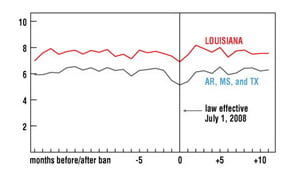
Louisiana -- Collision claims per 100 insured vehicle years, by month before and after texting law for all drivers, compared with Arkansas, Mississippi, and Texas. Courtesy HDLI.
Researchers at the Highway Loss Data Institute in Arlington, Va., say laws prohibiting motorists from texting while driving are not bringing down crash rates. In fact, HLDI says crash rates tend to increase after a ban goes into effect.
HDLI (an affiliate of the Insurance Institute for Highway Safety) released its findings at the annual meeting of the Governors Highway Safety Association, which took place Sept. 25-26 in Kansas City. HDLI's conclusions are based on comparisons of claims rates in four states before and after texting bans were enacted, compared with patterns of claims in nearby states.
HLDI researchers calculated rates of collision claims for vehicles up to nine years old during the months immediately before and after driver texting was banned in California (Jan. 2009), Louisiana (July 2008), Minnesota (Aug. 2008), and Washington (Jan. 2008). Comparable data were collected in nearby states where texting laws weren't substantially changed during the time span of the study. This controlled for possible changes in collision claim rates unrelated to the bans - changes in the number of miles driven due to the economy, seasonal changes in driving patterns, etc.
"Texting bans haven't reduced crashes at all. In a perverse twist, crashes increased in three of the four states we studied after bans were enacted. It's an indication that texting bans might even increase the risk of texting for drivers who continue to do so despite the laws," says Adrian Lund, president of both HLDI and the Insurance Institute for Highway Safety.
HLDI's new findings about texting, together with the organization's previous finding that hand-held phone bans didn't reduce crashes, "call into question the way policymakers are trying to address the problem of distracted driving crashes," Lund adds. "[The DOT] is focusing on a single manifestation of distracted driving and banning it. This ignores the endless sources of distraction and relies on banning one source or another to solve the whole problem."
U.S. Transportation Secretary Ray LaHood called the study misleading, and accused the Insurance Institute for Highway Safety and HLDI of working to discredit his national anti-distracted driving efforts over the last year. He also vowed to continue his campaign against distracted driving.
"This report is completely misleading," said LaHood. "Distracted driving-related crashes killed nearly 5,500 people in 2009 and injured almost half a million more. Lives are at stake, and all the reputable research we have says that tough laws, good enforcement and increased public awareness will help put a stop to the deadly epidemic of distracted driving on our roads."
The Research
HDLI's research found that month-to-month fluctuations in the rates of collision claims in HLDI's four study states with texting bans for all drivers didn't change much from before to after the bans were enacted. Nor did the patterns differ much from those in nearby states that didn't ban texting for all drivers during the study period. To the extent that the crash patterns did change in the study states, they went up, not down, after the bans took effect. Increases varied from one percent more crashes in Washington to about 9 percent more in Minnesota (the result in Washington isn't statistically significant).
"The point of texting bans is to reduce crashes, and by this essential measure the laws are ineffective," Lund says. He cautions that "finding no reduction in crashes, or even a small increase, doesn't mean it's safe to text and drive, though. There's a crash risk associated with doing this. It's just that bans aren't reducing this crash risk."
The Enforcement Question
LaHood says the HLDI-IIHS report fails to reconcile with previous research supported by HLDI-IIHS showing that drivers are four times as likely to crash if using a handheld device while driving. He also says it doesn't square with U.S. Department of Transportation research which shows deadly distracted driving behavior on the decline in cities where laws are coupled with tough enforcement.
"Tough laws are the first step and enforcement must be next," said LaHood. "We know that anti-distracted driving laws can be enforced effectively because two DOT pilot enforcement programs in Hartford and Syracuse prove it. In the last six months alone, hand-held cell phone use has dropped 56 percent in Hartford and 38 percent in Syracuse, and texting while driving has declined 68 percent in Hartford and 42 percent in Syracuse."
To date, police in Hartford have written approximately 4,128 tickets and Syracuse police have issued 4,446 tickets for violations involving drivers talking or texting on cell phones. LaHood did not provide crash frequency data from Hartford or Syracuse to indicate the bans were actually reducing crashes.
Lund says noncompliance is a likely reason texting bans aren't reducing crashes. Survey results indicate that many drivers, especially younger ones, shrug off these bans, he claims. Among 18-24 year-olds, the group most likely to text, 45 percent reported doing so anyway in states that bar all drivers from texting. This is just shy of the 48 percent of drivers who reported texting in states without bans. Many respondents who knew it was illegal to text said they didn't think police were strongly enforcing the bans.
"But this doesn't explain why crashes increased after texting bans," Lund points out. "If drivers were disregarding the bans, then the crash patterns should have remained steady. So clearly drivers did respond to the bans somehow, and what they might have been doing was moving their phones down and out of sight when they texted, in recognition that what they were doing was illegal. This could exacerbate the risk of texting by taking drivers' eyes further from the road and for a longer time."
Using a driving simulator, researchers at the University of Glasgow found a sharp decrease in crash likelihood when participants switched from head-down to head-up displays. This suggests that it might be more hazardous for a driver to text from a device that's hidden from view on the lap or vehicle seat.
Texting in general is on the increase, HDLI observes. Wireless phone subscriptions numbered 286 million as of December 2009, up 47 percent from 194 million in June 2005. Text messaging is increasing, too. It went up by about 60 percent in one year alone, from 1 trillion messages in 2008 to 1.6 trillion in 2009.
The District of Columbia was the first U.S. jurisdiction to ban all motorists from texting. This was in 2004, and since then 30 states have followed suit. Nearly half of these bans have been enacted in 2010.
To read more on HDLI's finding:
Status Report PDF file.
Highway Loss Data Institute Bulletin:Texting Laws and Collision Claim Frequencies
More Drivers

Samsara Launches Custom AI Agent Builder
Agent Studio lets fleets create AI tools for hours-of-service monitoring, reporting and driver support, including agents that communicate by phone.
Read More →
Trucker Path Expands Reserved Parking Network
Trucker Path has added close to 6,000 more truck parking spaces to its Trucker Path Reserved Parking Network with the addition of Safe Truck Parking.
Read More →
EEOC Sues Texas Trucking Company Over Driver Age Limits
The agency says Trancasa USA rejected applicants over 65 and applied tougher driving-record standards to those over 60.
Read More →
Nussbaum, Roehl Announce Second Driver Pay Increase This Year
This year has seen a swath of major truck driver pay increases as freight capacity has tightened.
Read More →
From One Generation to the Next: How Mentorship Builds Safer Truck Drivers
After three decades in trucking, Harold Perry shares what he's learned about driver safety, mentorship, and helping the next generation build confidence behind the wheel.
Read More →
Truck Drivers Need More Than Another Alert
Fleets have more visibility into truck health, safety events, and driver activity than ever. The next challenge is turning all that information into useful guidance for the person who has to decide what to do next.
Read More →
FMCSA Removes 110 Truck Driver Training Schools from Certified ELDT List
Federal regulators also are targeting more than 160 additional training providers and launching a nationwide audit of third-party CDL skills testers as part of a broader crackdown on trucking fraud.
Read More →
Hours of Service Pilot Programs: FMCSA Readies for 2027 Rollout
Two pilot programs could eventually reshape hours-of-service rules, giving truck drivers options to pause their 14-hour clock or use longer split sleeper rest periods.
Read More →
Medical Cards, English Proficiency Reshape Roadcheck Violations
Medical-card violations jumped to the top of the driver out-of-service list during CVSA’s 2026 International Roadcheck, while English-language proficiency violations appeared among the leading violations for the first time.
Read More →
Driver Trust Can Make or Break the Success of Fleet Safety Technology
New Teletrac Navman research suggests that onboarding, transparency about driver data, and positive feedback can play a significant role in how commercial drivers respond to safety and coaching technology.
Read More →