




Fuel-Price Dip Likely Only Temporary Reprieve
Retail fuel prices have never increased so quickly on a percentage basis over a three-week period, according to the Department of Energy.

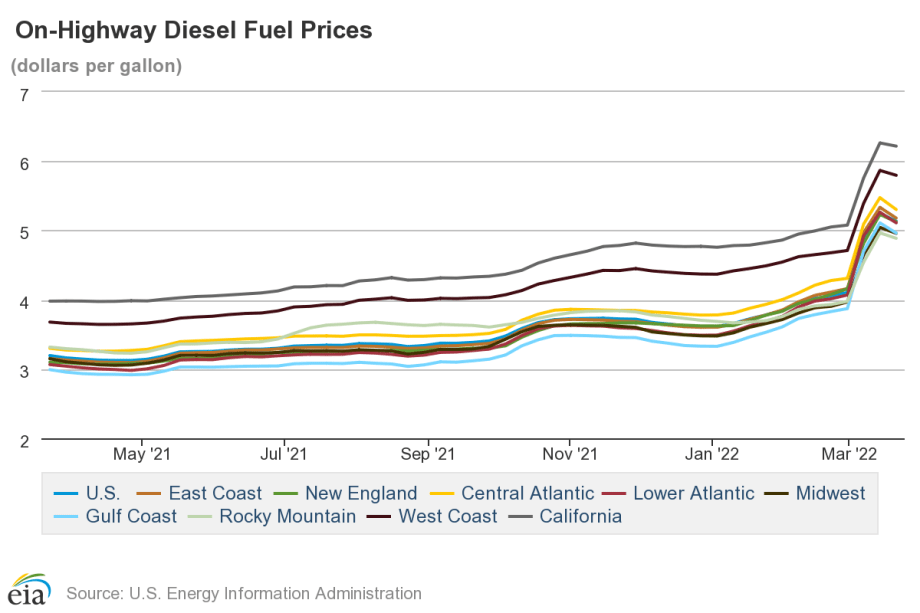
Fuel-industry experts don't expect last week's dip in diesel prices to continue.
Source: DOE's Energy Information Administration
Although retail diesel fuel prices took a slight dip last week after skyrocketing to record highs the past few weeks, that’s not likely a trend that will continue, as traders warn of global diesel shortages.
In just three weeks, the national average price of ultra-low-sulfur No. 2 diesel rose 29%, by $1.19 per gallon, from $4.06 per gallon on Feb. 14 to a record $5.25 on March 14, according to numbers from the Department of Energy. As usual, prices are even higher in California, where they hit $6.26.
Retail gasoline prices peaked on March 14 at $4.32 per gallon, a 22% increase from $3.53 on Feb. 21.
The DOE points out that when adjusted for inflation, prices are still lower than all-time highs in 2008. However, retail fuel prices have never increased so quickly on a percentage basis over a three-week period in the agency’s data, which for gasoline dates back to August 1990 and for diesel dates back to March 1994.
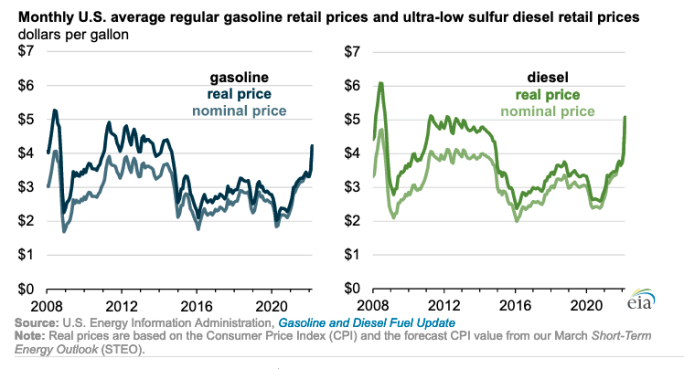
Adjusted for inflation, fuel prices are not quite at record highs.
Source: DOE's Energy Information Administration
The national average dropped slightly the following week to $5.13, but don’t expect that to last.
How High Will Fuel Prices Go?
Tom Kloza, global head of energy analysis at Oil Price Information Service, said in a tweet that Monday morning brought soaring wholesale prices for diesel, gasoline, and crude oil. Futures and wholesale numbers tend to be passed on to retail within 48 hours.
“No end in sight to diesel price inflation,” he said in another tweet. “Futures surpass $3.84 gal and nationwide average is $5.04 gal. CA average is $6.264 gal. I would not be surprised to see $5-$6.50 gal diesel prevail through 2nd, 3rd and 4th quarters.” California diesel could top $7.
Leaders from three of the largest commodity traders, speaking at a Financial Times Commodities Global Summit in Switzerland, warned that sanctions on Russia following its invasion of Ukraine mean global markets face a squeeze on diesel. A shortage that could lead to fuel rationing in Europe also could mean higher prices in the U.S. because of the way oil and diesel prices are tied to the global market.
“Diesel is not just a European problem, this is a global problem. It really is,” said Torbjorn Tornqvist, co-founder and chair of Geneva-headquartered Gunvor Group, according to a report in the Financial Times.
Another executive predicted that 2 million to 2.5 million barrels of Russian oil production would go missing from the global market, split between crude and refined products, according to that same report.
The situation led to the International Energy Agency on March 18 calling for emergency measures to cut global oil demand.
If fully carried out in advanced economies, it said, the measures recommended by the IEA’s new 10-Point Plan to Cut Oil Use would lower oil demand by 2.7 million barrels a day within four months — equivalent to the oil demand of all the cars in China.
Since the majority of oil demand comes from transport, the IEA’s plan focuses on how to use less oil getting people and goods from A to B. The short-term actions it proposes include lower speed limits, working from home, occasional limits on car access to city centers, cheaper public transport, more carpooling and other initiatives — and greater use of high-speed rail and virtual meetings instead of air travel.
“As a result of Russia’s appalling aggression against Ukraine, the world may well be facing its biggest oil supply shock in decades, with huge implications for our economies and societies,” said IEA Executive Director Fatih Birol.
More Fuel Smarts

How Volvo Updated Its D13 for EPA 2027 [Watch]
Volvo’s updated D13 promises lower emissions without sacrificing performance or fuel economy. Take a closer look at what changed inside the engine in this HDT Spotlight video.
Read More →
Diesel Price Spike Shortens Payback for Natural Gas Trucks, Report Says
Energy Vision estimates fleets could recover the higher purchase price of an RNG-fueled Class 8 tractor in 1.3 to 2.8 years under current fuel-price scenarios.
Read More →
Calstart Becomes Catalyst Mobility, Reflecting Broader Focus
Calstart is now Catalyst Mobility, reflecting the nonprofit’s growing national role in clean transportation, including zero-emission trucks, infrastructure and incentive programs.
Read More →

Record Diesel Prices Squeeze Trucking Fleets
Average U.S. diesel prices have climbed to nearly $6 a gallon, surpassing the 2022 record as tight refinery capacity and Middle East disruptions keep fuel costs elevated.
Read More →
How Fuel Delivery Shapes Engine Performance
Fuel delivery depends on more than what happens at the injector. For fleet, maintenance and technical professionals, looking at the full path from pump to injector can provide useful context for understanding engine performance.
Read More →
East Coast Port Launches $45M Electric Truck Push
The Port Authority of New York and New Jersey announced millions in incentives for zero-emission drayage trucks, yard tractors, and new charging hubs near the port.
Read More →
California Bill Could Shed Light on Electric Truck Prices
Why do battery-electric Class 8 trucks remain so expensive? A California bill headed to Gov. Gavin Newsom would give fleets and state agencies more visibility into what manufacturers charge.
Read More →
Detroit Opens Orders for EPA 2027 Engines
Detroit isn’t starting from scratch to meet EPA 2027 diesel emissions standards. Its Gen 6 DD13 and DD15 engines keep much of today’s platform while updating the fuel and aftertreatment systems.
Read More →
Zero-Emission Truck Corridor Planned for West Coast
California, Oregon, Washington, British Columbia and Baja California are coordinating plans for truck charging and hydrogen fueling from Canada to Mexico.
Read More →
A Closer Look at Kenworth’s Electric T880E Vocational Truck [Video]
Learn more about Kenworth's T880E battery-electric vocational truck at the Paccar Technical Center, including its range, applications, upfitting considerations, and PTO options, in this HDT Spotlight video.
Read More →