




Freight Shipments, Payments Increase After Two Monthly Declines
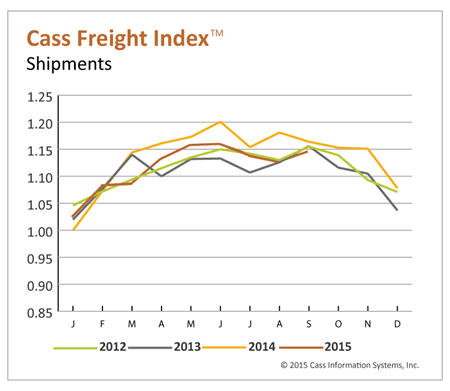
Freight shipments and payments rose in September following two straight monthly declines, according to the latest Cass Freight Index.

Freight shipments and payments rose in September following two straight monthly declines, according to the latest Cass Freight Index.
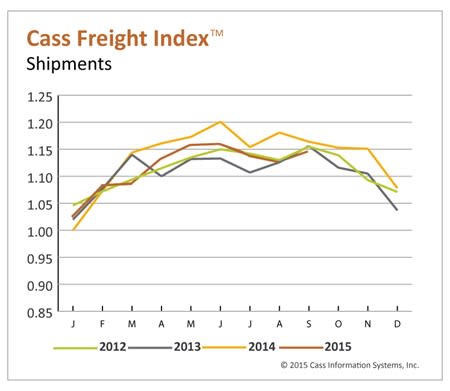
Shipments increased 1.7% while expenditures improved 2.4% from August, but were still down from a year earlier. Shipments fell 1.5% while expenditures showed a 6.6% decline.
The increase in shipments was expected and part of the usual holiday season increase, which coincides the higher freight payments, according to Rosalyn Wilson, supply chain expert, and senior business analyst with the management services firm Parsons, who provides analysis for the report.
“Spot prices have been lower because of adequate capacity during the slowdown in August,” Wilson wrote in the report. “Trucking companies are holding rate increases down, and offering capacity guarantees in exchange for higher rates. There has also been a steady growth in dedicated carriage agreements. We expect rate increases for the trucking sector to be modest through the end of the year.”
Wilson said many factors are affecting the current volume of freight, not the least of which is mounting inventory levels.
"All business inventories are continuing to grow, as are inventory‐to‐sales ratios, indicating that we are not at optimal levels given inventory turnover rates,” she said. “Low interest rates, favorable import prices and moderate storage costs have encouraged the buildup, but even a one percent rise in interest rates could fuel a 2.3% rise in total logistics costs at current inventory levels.”
Wilson noted with the Federal Reserve choosing not to raise interest rates at its recent meeting, but not ruling out an increase prior to year‐end, the potential for an uptick in consumer spending and a drawdown in inventory levels is uncertain.
Data within the Cass Freight Index includes all domestic freight modes and is derived from $26 billion in freight transactions processed by Cass Information System annually on behalf of its client base of hundreds of large shippers.
More Fleet Management

How Telematics Improves Visibility, Control, and Performance in Refrigerated Fleets
Explore how telematics help refrigerated fleets improve visibility, uptime, efficiency, compliance, and cargo protection across connected cold chain operations.
Read More →
What the U.S.-Canada Trade War Means for Trucking
Escalating U.S.-Canada tariffs could disrupt cross-border freight, reduce truck volumes, raise costs, and create new uncertainty for carriers on both sides of the border.
Read More →
What Are Trucking’s Top Concerns for 2026?
The American Transportation Research Institute wants to know what's worrying trucking fleet managers, drivers, and other stakeholders in its annual Industry Issues survey.
Read More →

American Trucking Associations Looks for a New Leader
ATA President and CEO Chris Spear abruptly left his job at the association on August 21, at a pivotal time for the trucking industry.
Read More →
Public Wi-Fi Cybersecurity Risks: How Truck Drivers and Fleets Can Protect Their Data
Public Wi-Fi can expose truck drivers and fleets to credential theft, malware, and other cyber threats. Here’s how to reduce the risk on the road.
Read More →
For Nicky Cupp, Fleet Innovation Starts With Frustration
HDT Truck Fleet Innovator Nicky Cupp turns everyday pain points at Fraley & Schilling into opportunities for better technology and smarter processes.
Read More →
Adam Buttgenbach’s Approach to Electric Trucks: Start With Where They Fit
HDT Truck Fleet Innovator Adam Buttgenbach helped PepsiCo build one of North America’s largest EV fleets by focusing on where electric trucks make operational sense.
Read More →
Deen Albert: Let Automation Do the Math, People Make the Decisions
HDT Truck Fleet Innovator Deen Albert makes sure people are still at the heart of operations at Grand Island Express, even while adopting artificial intelligence tools. AI-assisted dispatch helped boost revenue 25% with the same number of trucks.
Read More →
Trimble’s New AI Agent Takes Aim at Fleet Back-Office Busywork
Arc Agent works across Trimble TMS products to automate repetitive tasks such as freight orders, maintenance, invoices, fuel costs and more.
Read More →
How HDT’s 2026 Truck Fleet Innovators Are Rethinking Fleet Operations
Meet five trucking leaders who are challenging assumptions, solving operational problems, and putting innovative ideas to work.
Read More →