




Former FMCSA Administrator Gives Inside Look Into Trucking Regs
During a conference call hosted by Stifel Nicolaus Friday morning, Annette Sandberg, the former administrator of the Federal Motor Carrier Safety Administration, provided an insider's thoughts on some of the most influential and pressing regulatory issues facing the trucking industry
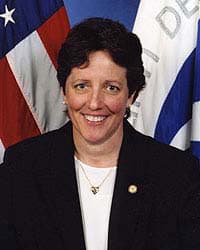
Annette Sandberg
During a conference call hosted by Stifel Nicolaus Friday morning, Annette Sandberg, the former administrator of the Federal Motor Carrier Safety Administration, provided an insider's thoughts on some of the most influential and pressing regulatory issues facing the trucking industry.
During the discussion, Sandberg, a principal at TransSafe Consulting, told listeners she would encourage officials at the FMCSA to provide carriers with a mechanism for seeing what their safety scores would look like under the Comprehensive Safety Analysis 2010. Sandberg said fleets need at least three to four months before CSA 2010 goes live to clean up their data.
"If they're not in a pilot state, they have no idea what they look like," she said.
While the FMCSA has been focused on the safety impacts of CSA 2010, it has not really been concerned about the financial impacts on fleets, Sandberg said. Particularly, there's the issue of whether brokers or shippers are going to be comfortable loading with a carrier that has a high score.
Under the new CSA 2010 system, carriers will be scored with additional scrutiny and under much more refined buckets, the seven Behavioral Analysis Safety Improvement Categories, or BASICs. As a result, carriers that had good scores under SafeStat are going to find themselves "deficient" in areas under CSA 2010.
The big question is, Sandberg said, "would [brokers and shippers] still load a carrier that has a deficient BASIC?"
EOBRs
Another regulation she commented on was the issue of electronic on-board recorders. A rule is currently in the White House, and Sandberg expects there to be a final rule on EOBRs this spring, if not summer. This rule would require recorders for carriers that fail to meet hours of service standards. It also will encourage voluntary use of recorders by various incentives, and will spell out new performance standards for the devices, taking into account the myriad technological developments that have occurred since the current voluntary rule was established in 1988.
For all carriers, "I believe that EOBRs will probably be mandated in the next five years, if not sooner," she said.
Sandberg said some owner-operators don't like EOBRs because they're expensive and they don't want to be monitored. However, she said so many in the industry already have GPS on their vehicles, and it's such a small step from GPS to EOBRs.
"It's going to be the minority that doesn't want them on," she said.
Hours of Service
Sandberg also touched on the controversial hours-of-service rule, something she joked as being a regulation that never ends. "I don't think we'll ever see hours of service end or finalized in my lifetime."
She believes the HOS rule won't be changed much, except for the split sleeper birth and rest breaks provisions. If the FMCSA mandates rest breaks, the question will be whether the break is inserted into the 14-hour allotment or whether the 14 hours is extended.
During "The Changing Regulatory Landscape and its Direct Impact on Trucking Industry Capacity" conference call, Sandberg tackled other regulatory concerns facing the trucking industry, including the reauthorization of the surface transportation bill, truck size and weight, the U.S.-Mexico border dispute, and driver health and drug testing. These are all issues that have been delayed or put on the back burner because of other legislative priorities.
More Drivers
Platform Science Adds Dispatch and Safety Tools
Four additions to PS Fleet help fleets monitor loads, manage driver coaching, share truck locations and adjust video system settings.
Read More →
When Language Stops the Truck: The Return of ELP Out-of-Service Orders
English language proficiency rules for commercial drivers aren’t new, but renewed out-of-service enforcement has raised the stakes. Here’s what carriers need to know before a driver reaches a roadside inspection.
Read More →
Samsara Launches Custom AI Agent Builder
Agent Studio lets fleets create AI tools for hours-of-service monitoring, reporting and driver support, including agents that communicate by phone.
Read More →
Trucker Path Expands Reserved Parking Network
Trucker Path has added close to 6,000 more truck parking spaces to its Trucker Path Reserved Parking Network with the addition of Safe Truck Parking.
Read More →
EEOC Sues Texas Trucking Company Over Driver Age Limits
The agency says Trancasa USA rejected applicants over 65 and applied tougher driving-record standards to those over 60.
Read More →
Nussbaum, Roehl Announce Second Driver Pay Increase This Year
This year has seen a swath of major truck driver pay increases as freight capacity has tightened.
Read More →
From One Generation to the Next: How Mentorship Builds Safer Truck Drivers
After three decades in trucking, Harold Perry shares what he's learned about driver safety, mentorship, and helping the next generation build confidence behind the wheel.
Read More →
Truck Drivers Need More Than Another Alert
Fleets have more visibility into truck health, safety events, and driver activity than ever. The next challenge is turning all that information into useful guidance for the person who has to decide what to do next.
Read More →
FMCSA Removes 110 Truck Driver Training Schools from Certified ELDT List
Federal regulators also are targeting more than 160 additional training providers and launching a nationwide audit of third-party CDL skills testers as part of a broader crackdown on trucking fraud.
Read More →
Hours of Service Pilot Programs: FMCSA Readies for 2027 Rollout
Two pilot programs could eventually reshape hours-of-service rules, giving truck drivers options to pause their 14-hour clock or use longer split sleeper rest periods.
Read More →