




Former Daimler Truck Head Renschler Headed to Volkswagen
The former head of Daimler Trucks, who left the company last month after less than a year of overseeing Mercedes Benz cars and vans at parent company Daimler AG, will be taking over responsibility for commercial vehicles at Volkswagen AG.

Andreas Renschler
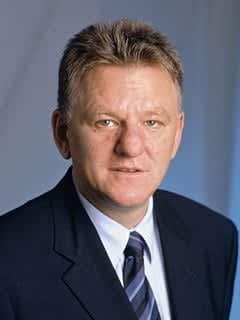
Andreas Renschler
The former head of Daimler Trucks, who left the company last month after less than a year of overseeing Mercedes Benz cars and vans at parent company Daimler AG, will be taking over responsibility for commercial vehicles at Volkswagen AG.
Andreas Renschler will become a member of VW's board of management effective Feb. 1, 2015, once a non-compete agreement with Daimler is over. He will take over for Dr. Leif Östling, who will continue to work with the commercial vehicles supervisory bodies in the Volkswagen Group. VW produces commercial vehicles under the Volkswagen name, as well as the Scania and MAN names overseas.
(Volkswagen also announced late Friday that it had made an offer to acquire the outstanding shares of the Swedish truck maker Scania it doesn’t already own for a cash deal of 6.7 billion euros, or about $9.2 billion.)
“We are very pleased we have been able to recruit Mr. Renschler to join our company, thanks to the initiative and efforts of Mr. Östling," said Prof. Dr. Ferdinand K. Piëch, chairman of the supervisory board of Volkswagen AG, in a statement. "We have found the ideal successor for Mr. Östling when he retires from the Board of Management next year. I am particularly pleased that Mr. Östling has agreed to contribute his experience to our commercial vehicles business in a supervisory board capacity."
The 55-year-old Renschler holds degrees in business engineering and business administration. He joined Daimler-Benz AG in 1988 and began setting up the production facility in Tuscaloosa, Ala., in 1993.
Renschler switched to the corporate headquarters in 1999, where he was responsible for executive management development at the former DaimlerChrysler corporation. He was appointed president of smart GmbH from 1999. He was named member of the Daimler AG board of management in 2004, holding responsibility for Daimler Trucks and Daimler Buses until March 2013, subsequently taking charge of manufacturing and procurement at Mercedes-Benz cars and the Mercedes-Benz vans business unit from April 2013.
Renschler left Daimler abruptly in January. He was seen as one of the top contenders to replace Dieter Zetsche, chairman of the board of management of Daimler AG and head of Mercedes-Benz cars, when he decides to retire.
More Equipment

How Volvo Updated Its D13 for EPA 2027 [Watch]
Volvo’s updated D13 promises lower emissions without sacrificing performance or fuel economy. Take a closer look at what changed inside the engine in this HDT Spotlight video.
Read More →
Michelin Tire Improves Efficiency and Durability for Regional Fleets
The Michelin X Multi Energy D2 is a regional haul drive tire engineered to help fleets improve fuel efficiency, durability and traction in demanding stop-and-go operations.
Read More →
ZF Expands Commercial Vehicle Push in North America
ZF is expanding its North American commercial-vehicle presence with new transmission applications, electrification, trailer technology and autonomous-driving systems.
Read More →
Tesla Wants a Self-Driving Semi. Are Cameras Enough?
Could Tesla’s camera-only autonomous driving technology work on an 80,000-pound Semi? In this commentary, HDT's Deborah Lockridge takes a look at Tesla, Cybercab, and how autonomous trucks see the road.
Read More →
Kodiak: Driverless Long-Haul Truck Launch on Track for 2026
Kodiak AI says its driverless long-haul safety case is 93% complete and it remains on track to begin commercial operations by year-end 2026.
Read More →
What DOT’s Automated Vehicle Strategy Means for Trucking
The U.S. Department of Transportation issued a new automated-vehicle strategy that outlines plans for driverless-truck regulations, cross-state freight corridors, and federal safety standards.
Read More →
East Coast Port Launches $45M Electric Truck Push
The Port Authority of New York and New Jersey announced millions in incentives for zero-emission drayage trucks, yard tractors, and new charging hubs near the port.
Read More →
PlusAI Going Public to Fund Autonomous Truck Launch
A SPAC deal could provide PlusAI with up to $300 million as it works toward a 2027 commercial launch of factory-built autonomous trucks.
Read More →
NHTSA Moves to Rewrite Truck Fuel-Economy Rules
The National Highway Traffic Safety Administration says it lacks authority to regulate medium- and heavy-duty truck engines separately from complete vehicles, but the existing standards have not yet been eliminated.
Read More →
Detroit Opens Orders for EPA 2027 Engines
Detroit isn’t starting from scratch to meet EPA 2027 diesel emissions standards. Its Gen 6 DD13 and DD15 engines keep much of today’s platform while updating the fuel and aftertreatment systems.
Read More →