




FMCSA Posts EOBR FAQ, Says it is Revisiting Cost-Benefit Analysis
The Federal Motor Carrier Safety Administration indicates it will re-examine the costs-vs-benefits of mandatory electronic onboard recorders in a new list of frequently asked questions it posted this week on its website
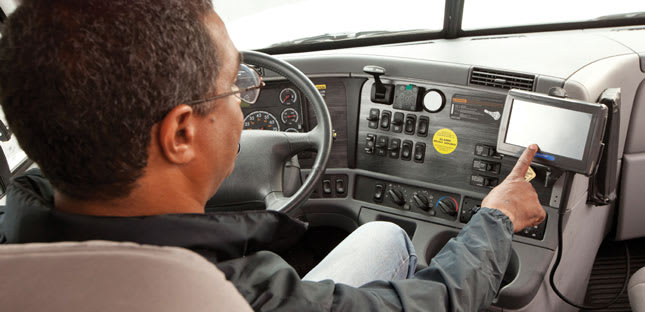
Newer devices such as Qualcomm's MCP 50 could lower the FMCSA's estimated cost of a mandatory electronic onboard recorder rule.
The Federal Motor Carrier Safety Administration indicates it will re-examine the costs-vs-benefits of mandatory electronic onboard recorders in a new list of frequently asked questions it posted this week on its website.
The Owner-Operator Independent Drivers Association has criticized the FMCSA's efforts to mandate automated driver hours-of-service logs, saying such a mandate would impose a $2 billion penalty on the trucking industry -- a cost small-business truckers can ill afford to pay, it says.
The FAQ notes that OOIDA's numbers are based on the agency's Regulatory Impact Analysis for the 2011 notice of proposed rulemaking on EOBRs, which estimated total costs of $2.377 billion per year.
However, the agency said in its FAQ that it believes costs for the devices has come down since it made that estimate.
The agency notes the same 2011 RIA estimated total benefits of $2.711 billion, resulting in an annual net benefit of $344 million. A significant portion of these benefits, the agency says, would come from $1.965 billion in annual paperwork reduction - a savings of $688 per driver each year - due to drivers no longer completing and submitting logbooks.
The FAQ goes on to say the agency is currently preparing a supplemental NPRM that will re-examine the estimated costs and benefits (both paperwork savings and safety) associated with an EOBR mandate for carriers using handwritten RODS.
The agency explains that that $2 billion-plus cost estimate was actually higher than the one in its 2010 final rule (which was subsequently vacated by the court), because the 2011 rule focused on the least expensive device determined to be compliant.
"The agency chose to base its calculations on the higher cost device in the 2011 NPRM because it did not believe that a sufficient number of the cheapest units would be available for a broad industry mandate, which would cover approximately 2 million units."
FMCSA used Qualcomm's Mobile Computing Platform 150, or MCP 150, to calculate that $2 billion cost in its 2011 proposed rule. It retails for approximately $1,775.
The agency now says it believes the market has changed since 2011, with new vendors entering the market with electronic logging devices without as many added bells and whistles that are useful for fleet management.
"The availability of these cheaper devices should significantly decrease the estimated cost of the rule compared to that of the 2011 RIA," the agency says.
For example, Qualcomm's new MCP 50 retails for about $900, the FAQ notes. "Other vendors are advertising EOBRs at even lower prices, although not yet in sufficient numbers to meet a broad industry mandate," including Continental's VDO Roadlog, which retails for about $500; a device from J.J. Keller available by lease for a $199 initial fee plus a monthly fee. Other smaller vendors offer EOBR devices that can run as an application on a smartphone.
In a hearing before the House Small Business Committee Wednesday about concerns on the FMCSA's CSA enforcement program, Rep. Jeff Landry, R-La., jumped on FMCSA Deputy Administrator Bill Bronrott for the agency's pending electronic onboard recorder mandate. Landry recently attached an amendment to a House appropriations bill that would not allow the DOT to spend money in fiscal year 2013 on event data recorders, sought by OOIDA.
Landry demanded a commitment from Bronrott that FMCSA will not move forward with the rule, a commitment the agency official was unable to make.
Landry said the rule will cost $2 billion. Bronrott replied that it will save at least that much, but Landry suggested that instead of requiring carriers to get recorders "maybe we should just pay those people not to get on the road."
Related Stories:
7/9/2012 EOBR Cut-Off Faces Opposition in Senate
5/23/2012 On the Road Blog: What this country needs is a good $300 electronic log
8/29/2011 Court Rejects EOBR Rule
More Drivers

EEOC Sues Texas Trucking Company Over Driver Age Limits
The agency says Trancasa USA rejected applicants over 65 and applied tougher driving-record standards to those over 60.
Read More →
Nussbaum, Roehl Announce Second Driver Pay Increase This Year
This year has seen a swath of major truck driver pay increases as freight capacity has tightened.
Read More →
From One Generation to the Next: How Mentorship Builds Safer Truck Drivers
After three decades in trucking, Harold Perry shares what he's learned about driver safety, mentorship, and helping the next generation build confidence behind the wheel.
Read More →
Truck Drivers Need More Than Another Alert
Fleets have more visibility into truck health, safety events, and driver activity than ever. The next challenge is turning all that information into useful guidance for the person who has to decide what to do next.
Read More →
FMCSA Removes 110 Truck Driver Training Schools from Certified ELDT List
Federal regulators also are targeting more than 160 additional training providers and launching a nationwide audit of third-party CDL skills testers as part of a broader crackdown on trucking fraud.
Read More →
Hours of Service Pilot Programs: FMCSA Readies for 2027 Rollout
Two pilot programs could eventually reshape hours-of-service rules, giving truck drivers options to pause their 14-hour clock or use longer split sleeper rest periods.
Read More →
Medical Cards, English Proficiency Reshape Roadcheck Violations
Medical-card violations jumped to the top of the driver out-of-service list during CVSA’s 2026 International Roadcheck, while English-language proficiency violations appeared among the leading violations for the first time.
Read More →
Driver Trust Can Make or Break the Success of Fleet Safety Technology
New Teletrac Navman research suggests that onboarding, transparency about driver data, and positive feedback can play a significant role in how commercial drivers respond to safety and coaching technology.
Read More →
EEOC Sues KLLM Over Alleged Sex Discrimination in Driver Training
KLLM is facing a federal sex-discrimination lawsuit over policies the EEOC alleges put female truck driver trainees at a disadvantage.
Read More →
FMCSA Moves to Codify English Language Requirements for Commercial Drivers
By changing regulations on English-language proficiency requirements for commercial drivers, rather than relying on a guidance memo, the FMCSA said future administrations won't be able to walk back the Trump administration's stricter enforcement with just a memo.
Read More →