




FMCSA Officials Get Input on EOBRs at Mid-America Trucking Show
LOUISVILLE, KY -- Officials with the Federal Motor Carrier Safety Administration got an earful Friday about a number of issues relating to hours of service, electronic onboard recorders, and how trucking companies use EOBRs and other in-cab technologies to harass drivers
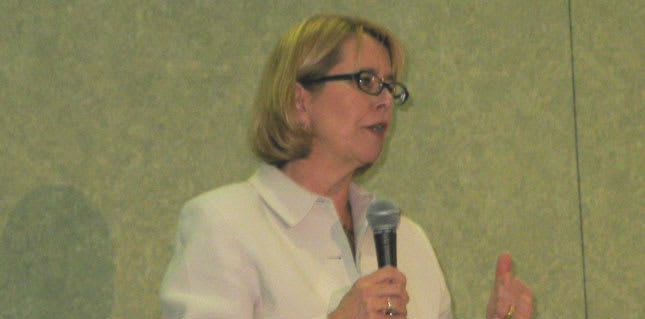
FMCSA Administrator Anne Ferro kicks off the EOBR listening session at the Mid-America Trucking Show.
LOUISVILLE, KY -- Officials with the Federal Motor Carrier Safety Administration got an earful Friday about a number of issues relating to hours of service, electronic onboard recorders, and how trucking companies use EOBRs and other in-cab technologies to harass drivers.
The listening session was held at the Mid-America Trucking Show in Louisville, Ky., specifically to get input from drivers, owner-operators and others on the topic of recording devices used to track driver hours of service, if and how they are used to harass truck drivers, and how that harassment may impact a driver's ability to operate safely.
"I'm very pleased to be here with an opportunity to hear from the folks who attend the truck show, to hear from drivers, to hear from those with experience in the areas we regulate, and tend to regulate quite a bit," said FMCSA Administrator Anne Ferro in opening the session.
The purpose of the session was to get "vital input" for the agency as it develops a "refined" rule on EOBRs. The FMCSA is currently drafting a supplemental notice of proposed rulemaking, or SNPRM, a "revisiting" of the NPRM on the street today, Ferro said.
The agency last month said it had decided to take a step back from its pending electronic onboard recorder rules and begin a supplemental process to resolve legal and technical problems.
A final rule that would have required frequent hours of service violators to use EOBRs starting next July, which also outlined the technical standards of the rule, was thrown out by an appeals court last August. The court agreed with the Owner-Operator Independent Drivers Association that the rule failed to prevent the use of EOBRs to harass drivers, as is required by law.
A second rulemaking, which is still in progress, proposes to expand the EOBR mandate to include practically all carriers, and is supposed to answer questions about the technical standards in the original rule. As the agency worked on this broader mandate, it realized that there were technical issues that still needed to be resolved.
So the agency now is holding public listening sessions on the harassment issue and on the technical questions before proposing a revised rule.
In opening the MATS session, Ferro explained, as she did at other speeches during the show, that the agency has three goals:
1. Raising the safety bar for those entering the industry
2. Making sure that those already in the industry are maintaining high safety standards
3. Getting the bad apples off the road and out of the industry, whether that's a driver, a company, a vehicle, or someone who credentials one of those three.
"For FMCSA's purposes, among the most fundamental factors of operating a commercial vehicle safely is a well-rested, alert, focused driver," Ferro said. "From the hours of service compliance side, we see recording devices as a core tool to improve compliance with the hours of service rule."
In addition to Ferro, who had to leave the session early to give another speech, the listening session featured Larry Minor, FMCSA's associate administrator for policy; Deborah Freund, FMCSA chief engineer and senior transportation specialist, and William Varga, a former truck driver and one of FMCSA's attorneys.
Tim Stewart, an owner-operator for Jones Motor, has been a driver since 1972 and says he'll quit the day he's forced to put an EOBR in his truck, noting that he has not had a single violation in those four decades.
Stewart shared some stories he had gathered from other drivers about how dispatchers are using electronic logs to harass drivers.
He said he recently talked to one driver in Florida who looked exhausted and explained that he couldn't get loaded on time and was now behind schedule. When Stewart asked him why he didn't take a nap, the driver complained that as soon as he did, the dispatcher would contact him via the in-cab computer and tell him to get moving. If the driver's rest period was up at 3 a.m., they would call the driver and expect him to get moving.
"You know when you need to stop and rest," Stewart said. "That dispatcher doesn't know, and that electronic device certainly does not know."
Jack McComb, an owner-operator for Landstar, used to drive for a company using an early version of electronic logs, and he told the FMCSA panel that it was not very accurate, and even worse, dispatchers definitely used it to harass drivers.
"Five minutes before your rest period was up, they would beep you on the Qualcomm to wake you up so they were sure you were ready to go when the time was up," he said. "In the middle of your rest period, the dispatcher would have a question about a load you delivered three days earlier and wake you up. What kind of rest is that?"
Debbie Freund, chief engineer and senior transportation specialist for FMCSA, sounded quite surprised by that, and by McComb's assertion that there was no way to mute the unit so drivers would not be awakened during their rest period.
Many of the drivers and owner-operators spoke not about EOBRs and harassment, but about how EOBRs would prevent them from continuing their current practice of "fudging" on their logs in order to deal with excessive loading and unloading times, being caught without a safe place to park when their hours ran out, or being just an hour away from home when that last hour of driving rolled by.
"My question is how the 14-hour rule non flexibility will play with the recorders," said Ray Hanna, a driver with Kennesaw Transportation.
Greg Petit, and owner-operator leased to McLeod Express in Decatur, Ill., loudly asked the agency representatives, "Why are you all so scared of the shippers and receivers? Why do you not take them on? Why is it so important to shove these EOBRs down our throats? We're not the problem!! I've sat in docks for 12, 14 hours. There's no reason for that. I've hauled everything known to man, and there's nothing that can't be loaded or unloaded in a two-hour period. I've gone in and seen warehouse staff doing everything but loading and unloading. Stop coming after us with all of this, speed limiters and cameras in our faces and sleep apnea!"
Petit's were not the only complaints about excessive time at shippers and receivers. It was a common complaint during the listening sessions held two years ago before the rewrite of the hours of service rule, and truckers at Friday's session complained that the agency had not responded to these complaints in its revised hours of service rules.
Ferro responded by telling the audience that the agency had indeed listened, and in fact is currently kicking off research on the impact of compensation on driver safety as well as on the impact of detention on driver safety. However, she noted, the agency does not currently have any authority to regulate shippers and receivers.
Ferro emphasized that the 14-hour workday has been in place since 2003. "My challenge for you is, how do you build in that flexibility and ensure compliance?" Ferro said. "Our research clearly demonstrated that the later into that 14-hour workday a professional is driving, the more their crash risk goes up."
"Do EOBRs or a recording device of some type provide a technology that may open the door for the flexibility you're asking for?" Ferro said. "I don't know."
More Drivers

When Language Stops the Truck: The Return of ELP Out-of-Service Orders
English language proficiency rules for commercial drivers aren’t new, but renewed out-of-service enforcement has raised the stakes. Here’s what carriers need to know before a driver reaches a roadside inspection.
Read More →
Samsara Launches Custom AI Agent Builder
Agent Studio lets fleets create AI tools for hours-of-service monitoring, reporting and driver support, including agents that communicate by phone.
Read More →
Trucker Path Expands Reserved Parking Network
Trucker Path has added close to 6,000 more truck parking spaces to its Trucker Path Reserved Parking Network with the addition of Safe Truck Parking.
Read More →
EEOC Sues Texas Trucking Company Over Driver Age Limits
The agency says Trancasa USA rejected applicants over 65 and applied tougher driving-record standards to those over 60.
Read More →
Nussbaum, Roehl Announce Second Driver Pay Increase This Year
This year has seen a swath of major truck driver pay increases as freight capacity has tightened.
Read More →
From One Generation to the Next: How Mentorship Builds Safer Truck Drivers
After three decades in trucking, Harold Perry shares what he's learned about driver safety, mentorship, and helping the next generation build confidence behind the wheel.
Read More →
Truck Drivers Need More Than Another Alert
Fleets have more visibility into truck health, safety events, and driver activity than ever. The next challenge is turning all that information into useful guidance for the person who has to decide what to do next.
Read More →
FMCSA Removes 110 Truck Driver Training Schools from Certified ELDT List
Federal regulators also are targeting more than 160 additional training providers and launching a nationwide audit of third-party CDL skills testers as part of a broader crackdown on trucking fraud.
Read More →
Hours of Service Pilot Programs: FMCSA Readies for 2027 Rollout
Two pilot programs could eventually reshape hours-of-service rules, giving truck drivers options to pause their 14-hour clock or use longer split sleeper rest periods.
Read More →
Medical Cards, English Proficiency Reshape Roadcheck Violations
Medical-card violations jumped to the top of the driver out-of-service list during CVSA’s 2026 International Roadcheck, while English-language proficiency violations appeared among the leading violations for the first time.
Read More →