




FMCSA Commences Hours of Service Review with First of Four Listening Sessions
The Federal Motor Carrier Safety Administration launched its review of the hours of service rule with a listening session in Washington, D.C., yesterday, the first of four it plans to hold around the country this month
The Federal Motor Carrier Safety Administration launched its review of the hours of service rule with a listening session in Washington, D.C., yesterday, the first of four it plans to hold around the country this month.
The event, which drew perhaps 100 people, not counting those who attended via audio conference, covered familiar territory: the balance of rest and duty time permitted under the rule, the utility of the 34-hour restart provision, loading and unloading practices in the industry and the sleeper berth provisions.
FMCSA Administrator Anne Ferro opened the meeting with a recitation of the agency's priorities: to raise standards for entry into the trucking business, to maintain high safety standards for those who get into the business, and to remove carriers and drivers who are not safe.
She said she wants these listening sessions to be open and constructive, quoting Dr. Martin Luther King, whose birthday was celebrated the day before: "Our lives begin to end the day we become silent about the things that matter."
This review was triggered by an agreement in October between the Department of Transportation and safety advocacy groups in which the groups have suspended their legal challenge of the hours of service rules pending completion of a new rule. The groups, including Public Citizen, Advocates for Auto and Highway Safety and the Teamsters union, were challenging the rules on several grounds, asserting for example that they permit too much driving time. Under the agreement, DOT has until next summer to draft a new proposed rule, and until the following summer to publish a final rule.
The opinions and impressions at yesterday's session were familiar fare from the long-running fight over hours of service.
Representing the safety advocacy community, Gerald Donaldson, Senior Research Director for Advocates for Highway and Auto Safety, said that the rules allow too much driving and work time. "It is appalling that well into the 21st century we are still using these workers as though they were 19th century laborers," he said.
David Osiecki, Senior Vice President of Policy and Regulatory Affairs at American Trucking Associations, said the rules are based on extensive research and analysis and should be kept as they are.
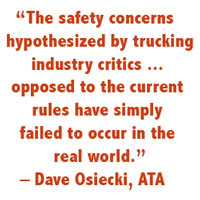
"The safety concerns hypothesized by trucking industry critics and those groups opposed to the current rules have simply failed to occur in the real world," he said in his statement. "In January 2009, in a comprehensive response to these organizations, FMCSA strongly refuted these hypotheses with data and rational explanations. Absent new data, these predictions must continue to be rejected by FMCSA and DOT and should, in no way, be a basis for any proposed changes. In rulemaking and in litigation, FMCSA and DOT have said repeatedly that facts, not perception, must support the rules."
Rod Nofziger, Director of Government Affairs for the Owner Operator Independent Drivers Association, called for more flexibility in the rules. Specifically, drivers should be allowed to take breaks without that time being counted against the daily limit on working hours, he said. He also reiterated OOIDA's longstanding concern about the need for compensating drivers for the time they spend waiting to be loaded or unloaded.
Steve Keppler, Interim Executive Director of the Commercial Vehicle Safety Alliance, said the current rules have the virtue of being easy to understand and enforce, and the agency should take care to preserve those characteristics should it make changes in the rule.
Yesterday's session did bring a new item to the hours of service debate: the safety data that has been accumulated since the new rule went into effect. Fatalities involving large trucks have dropped in each of the past three years, from 5,347 in 2006 to 4,229 in 2009. This, said Osiecki of ATA, disproves the contention of safety advocates that the rules would lead to worse safety performance.
The listening sessions will continue this Friday, January 22, in Dallas, Texas, and then move to El Segundo, Calif., on Monday, January 25, and Davenport, Iowa, on Tuesday, January 28. Anyone who is interested may participate via audio conference. For details, go to the FMCSA web site at www.fmcsa.dot.gov.
See the next issue of HDT for more detailed coverage of the opening session.
More Drivers

From One Generation to the Next: How Mentorship Builds Safer Truck Drivers
After three decades in trucking, Harold Perry shares what he's learned about driver safety, mentorship, and helping the next generation build confidence behind the wheel.
Read More →
Truck Drivers Need More Than Another Alert
Fleets have more visibility into truck health, safety events, and driver activity than ever. The next challenge is turning all that information into useful guidance for the person who has to decide what to do next.
Read More →
FMCSA Removes 110 Truck Driver Training Schools from Certified ELDT List
Federal regulators also are targeting more than 160 additional training providers and launching a nationwide audit of third-party CDL skills testers as part of a broader crackdown on trucking fraud.
Read More →
Hours of Service Pilot Programs: FMCSA Readies for 2027 Rollout
Two pilot programs could eventually reshape hours-of-service rules, giving truck drivers options to pause their 14-hour clock or use longer split sleeper rest periods.
Read More →
Medical Cards, English Proficiency Reshape Roadcheck Violations
Medical-card violations jumped to the top of the driver out-of-service list during CVSA’s 2026 International Roadcheck, while English-language proficiency violations appeared among the leading violations for the first time.
Read More →
Driver Trust Can Make or Break the Success of Fleet Safety Technology
New Teletrac Navman research suggests that onboarding, transparency about driver data, and positive feedback can play a significant role in how commercial drivers respond to safety and coaching technology.
Read More →
EEOC Sues KLLM Over Alleged Sex Discrimination in Driver Training
KLLM is facing a federal sex-discrimination lawsuit over policies the EEOC alleges put female truck driver trainees at a disadvantage.
Read More →
FMCSA Moves to Codify English Language Requirements for Commercial Drivers
By changing regulations on English-language proficiency requirements for commercial drivers, rather than relying on a guidance memo, the FMCSA said future administrations won't be able to walk back the Trump administration's stricter enforcement with just a memo.
Read More →
Drivers Put Western Star Trucks to the Test at Star Nation Experience
Watch to get an inside look at the Western Star trucks, technology, and community behind the Star Nation Experience 2026!
Read More →
Trump Administration Looks to Put More Veterans Behind the Wheel
The Freedom Haulers program pulls together existing and expanded programs at several federal agencies to recruit veterans to drive commercial heavy-duty trucks and cut the red tape for them to get a CDL, training, and employment.
Read More →