




FMCSA Advisory Committee to Make Recommendations on Sleep Apnea
The next step in the federal effort to address sleep apnea in truck drivers will come this summer, when the Federal Motor Carrier Safety Administration will ask a panel of advisers for recommendations on how it should proceed
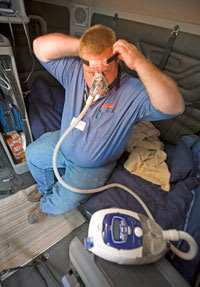
A driver for Schneider National, which has been an industry leader in sleep apnea testing, demonstrates the equipment used to treat the condition.
The next step in the federal effort to address sleep apnea in truck drivers will come this summer, when the Federal Motor Carrier Safety Administration will ask a panel of advisers for recommendations on how it should proceed.
The agency has scheduled an August meeting between its Medical Review Board, which has recommended tougher sleep apnea regulations, and its Motor Carrier Safety Advisory Committee, a panel of 19 officials from the industry, the enforcement community and labor and safety advocacy groups to which the agency turns for feedback and ideas on industry issues.
FMCSA will ask the committee for practical advice on how it might deal with the problem, said an agency official who spoke on background.
At the public meeting, tentatively scheduled for Aug. 29 in the Washington, D.C., area, the five medical doctors on the review board will present their latest thinking on sleep apnea to the advisory committee. The committee will then discuss the issue with the board and later come up with its recommendations for agency action, the official said.
The agency will consider the committee's recommendations in deciding whether or not to go ahead with a rulemaking, but it will not necessarily adopt them, the official said.
Advancing the issue
While this meeting does not necessarily signal imminent FMCSA action on sleep apnea, it does advance the issue.
The Medical Review Board has for several years supported stricter regulatory standards for the condition. In 2008 the Board recommended that the agency require all drivers to be screened for obstructive sleep apnea, a significant change from the current rules that do not explicitly require testing and treatment.
The board said that a diagnosis of sleep apnea should not necessarily bar a driver from certification, but that certification should be conditioned on the severity of the apnea and its impact on a driver's sleepiness, or on whether the driver is getting the treatment he needs.
It posted a long and detailed list of specific criteria for denying medical certification, including having been involved in a crash associated with falling asleep at the wheel and failing to comply with prescribed sleep apnea treatment.
The board also has recommendations regarding overweight drivers. Doctors say obesity can be an indicator of sleep apnea although it is not necessarily decisive - other factors such as age and blood pressure are also important. Studies show that a person's body mass index, a ratio of weight to height that measures obesity, can signal the possibility of sleep apnea. The board recommended that a BMI of 30 or greater be grounds for rejecting a driver's application pending the outcome of a sleep study.
The board will be reviewing more recent studies on the issue before it makes its presentation to the Advisory Committee in August, the agency official said.
Addressing confusion
Rob Abbott, vice president of safety policy at American Trucking Associations, applauded the move.
"I think that's a good idea," he said. He said there is confusion in the medical community about sleep apnea because the Medical Review Board made its recommendations several years ago and the agency has not yet acted on them. Some examiners have adopted the recommendations as requirements, while others are waiting for more explicit guidance from the agency, he said.
It's also a good idea for the sake of driver health, Abbott said. "We do think it's appropriate to begin to look at some of the Review Board recommendations and look at more meaningful and effective ways to address driver fatigue, rather than simply looking at hours of service limitations."
Getting unfit drivers off the road
The sleep apnea initiative is part of an ongoing, comprehensive revision of the agency's rules aimed at making it harder for unfit drivers to either get medical clearance or evade detection.
Several years ago the agency started the process of requiring medical certificate information to be integrated into the national commercial driver's license data base. That program is supposed to go into effect next year, but Abbott and Steve Keppler, executive director of the Commercial Vehicle Safety Alliance, noted that the states may not be able to meet that deadline.
Later this year the agency is scheduled to post a final rule establishing training and certification standards for medical examiners, and a national registry of Certified Medical Examiners. And the agency is working on a proposed rule for a new diabetes standard, scheduled for publication next year.
Meanwhile, the Medical Review Board continues its work producing recommendations on more than a dozen different driver health concerns, including cardiovascular disease, seizure disorders, renal disease and musculoskeletal disease, as well as sleep disorders and diabetes. The experts' recommendations on these issues, which are quite detailed, can be found on the FMCSA website (www.fmcsa.dot.gov, and go to the Medical Program Page).
More Drivers

Platform Science Adds Dispatch and Safety Tools
Four additions to PS Fleet help fleets monitor loads, manage driver coaching, share truck locations and adjust video system settings.
Read More →
When Language Stops the Truck: The Return of ELP Out-of-Service Orders
English language proficiency rules for commercial drivers aren’t new, but renewed out-of-service enforcement has raised the stakes. Here’s what carriers need to know before a driver reaches a roadside inspection.
Read More →
Samsara Launches Custom AI Agent Builder
Agent Studio lets fleets create AI tools for hours-of-service monitoring, reporting and driver support, including agents that communicate by phone.
Read More →
Trucker Path Expands Reserved Parking Network
Trucker Path has added close to 6,000 more truck parking spaces to its Trucker Path Reserved Parking Network with the addition of Safe Truck Parking.
Read More →
EEOC Sues Texas Trucking Company Over Driver Age Limits
The agency says Trancasa USA rejected applicants over 65 and applied tougher driving-record standards to those over 60.
Read More →
Nussbaum, Roehl Announce Second Driver Pay Increase This Year
This year has seen a swath of major truck driver pay increases as freight capacity has tightened.
Read More →
From One Generation to the Next: How Mentorship Builds Safer Truck Drivers
After three decades in trucking, Harold Perry shares what he's learned about driver safety, mentorship, and helping the next generation build confidence behind the wheel.
Read More →
Truck Drivers Need More Than Another Alert
Fleets have more visibility into truck health, safety events, and driver activity than ever. The next challenge is turning all that information into useful guidance for the person who has to decide what to do next.
Read More →
FMCSA Removes 110 Truck Driver Training Schools from Certified ELDT List
Federal regulators also are targeting more than 160 additional training providers and launching a nationwide audit of third-party CDL skills testers as part of a broader crackdown on trucking fraud.
Read More →
Hours of Service Pilot Programs: FMCSA Readies for 2027 Rollout
Two pilot programs could eventually reshape hours-of-service rules, giving truck drivers options to pause their 14-hour clock or use longer split sleeper rest periods.
Read More →