




EOBR Details Complex and Messy
It turns out that a rule requiring electronic onboard recorders to track hours of service is not a simple thing. Take the question of how the inspecting officer will read the driver's log information off of the machine
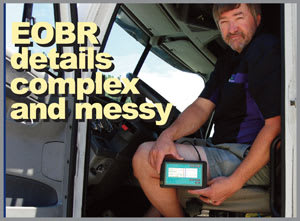
Just showing your EOBRs to enforcement officials this way is probably not in the cards.
It turns out that a rule requiring electronic onboard recorders to track hours of service is not a simple thing. Take the question of how the inspecting officer will read the driver's log information off of the machine.
Here's how the issue played out this week in deliberations among members of the Motor Carrier Safety Advisory Committee. The MCSAC has been working for months to come up with recommendations for the Federal Motor Carrier Safety Administration on how to resolve this and other difficult EOBR issues. The committee is a 19-member volunteer panel representing the interests of law enforcement, the trucking industry, independent drivers, safety advocates and the Teamsters union that the agency regularly asks for counsel and recommendations.
Police do not want to enter the cab in order to read a screen on the EOBR. They consider it unsafe for themselves and intrusive upon the driver, who may see the move as harassing.
Law enforcement budgets being tight, police do not want to have to buy a printer that the driver could plug in to the EOBR to print out a copy of the log. Not to mention the problem of finding a ruggedized printer that is compatible with all of the EOBR devices on the market, or the security risk of a computer bug being transferred from a police device to a driver's device, or vice versa.
So what the police want is a rule that would require the driver to either print out the log for the past seven days, or copy the information off of the EOBR onto a standard paper log sheet and certify that it truly represents what's on the EOBR.
Printers or paper logs
The practice among carriers that already use EOBRs, whether they have a printer or a digital read-out device that the driver can pass to the officer, does not necessarily point the way toward an industry-wide solution.
These carriers typically have an EOBR as a component of an overall management information system, a financial commitment that makes it easier to justify the cost of a printer or a digital read-out. But for many smaller carriers and independents, this kind of investment is simply out of reach.
It would be relatively simple and inexpensive to allow drivers to download their logs onto a USB device, such as a thumb drive, that they could hand over to the officer to plug into a laptop. But the security concerns surrounding this approach apparently are insurmountable. In fact, some states, such as California, have banned the use of USB devices for this sort of activity for fear that they cannot be protected against viruses or malware.
Requiring the driver to fill out a paper log by hand based on his EOBR readout runs counter to the point of using eobrs to improve accuracy and efficiency, pointed out Henry Jasny, general counsel for Advocates for Highway and Auto Safety. But, replied a law enforcement representative, it wouldn't happen that often, since most trucks are inspected no more than a couple of times a year.
And maybe that would be better than requiring the trucking industry to buy 8 million printers in order to comply with the rule, said Rob Abbott, vice president of safety policy at American Trucking Associations.
Some EOBR systems have integrated printers that add only $15 to the cost, but not all systems have that option. For instance, Qualcomm's current products have some printing capabilities, but they do not print QHOS logs at this time. Add-on printers can run up to $200 or more, said Brian McLaughlin, executive vice president and COO of PeopleNet, an EOBR system provider. "The pressure should be on law enforcement to make the investment rather than the carriers," he said.
So much for paperless
Some on the committee noted that a requirement that the driver fill out a paper log based on the EOBR readout could create an opportunity for an officer to harass a driver. Law enforcement representatives replied that they simply want to do their jobs and are not interested in harassing drivers.
ATA's Abbott noted that the overarching trend is toward a paperless business environment, and that giving an officer the option of requiring the driver to copy his EOBR is a step in the wrong direction. "The idea should be to drive resources where we want to go," he said.
All in all, not an easy call. And this is just one of 16 EOBR issues that advisory panel is thrashing through in its effort to deliver recommendations to the safety agency by the end of the year.
Among the other issues under consideration:
* security protocols for telematics and peer-to-peer data exchange;
* guidelines for transferring existing EOBR systems from trucks that are being rotated out of the fleet and plugged into new trucks;
* how to identify drivers without compromising privacy or security;
* how to define when a tractor is being used as a personal conveyance, as opposed to commercial operation.
More Drivers

Platform Science Adds Dispatch and Safety Tools
Four additions to PS Fleet help fleets monitor loads, manage driver coaching, share truck locations and adjust video system settings.
Read More →
When Language Stops the Truck: The Return of ELP Out-of-Service Orders
English language proficiency rules for commercial drivers aren’t new, but renewed out-of-service enforcement has raised the stakes. Here’s what carriers need to know before a driver reaches a roadside inspection.
Read More →
Samsara Launches Custom AI Agent Builder
Agent Studio lets fleets create AI tools for hours-of-service monitoring, reporting and driver support, including agents that communicate by phone.
Read More →
Trucker Path Expands Reserved Parking Network
Trucker Path has added close to 6,000 more truck parking spaces to its Trucker Path Reserved Parking Network with the addition of Safe Truck Parking.
Read More →
EEOC Sues Texas Trucking Company Over Driver Age Limits
The agency says Trancasa USA rejected applicants over 65 and applied tougher driving-record standards to those over 60.
Read More →
Nussbaum, Roehl Announce Second Driver Pay Increase This Year
This year has seen a swath of major truck driver pay increases as freight capacity has tightened.
Read More →
From One Generation to the Next: How Mentorship Builds Safer Truck Drivers
After three decades in trucking, Harold Perry shares what he's learned about driver safety, mentorship, and helping the next generation build confidence behind the wheel.
Read More →
Truck Drivers Need More Than Another Alert
Fleets have more visibility into truck health, safety events, and driver activity than ever. The next challenge is turning all that information into useful guidance for the person who has to decide what to do next.
Read More →
FMCSA Removes 110 Truck Driver Training Schools from Certified ELDT List
Federal regulators also are targeting more than 160 additional training providers and launching a nationwide audit of third-party CDL skills testers as part of a broader crackdown on trucking fraud.
Read More →
Hours of Service Pilot Programs: FMCSA Readies for 2027 Rollout
Two pilot programs could eventually reshape hours-of-service rules, giving truck drivers options to pause their 14-hour clock or use longer split sleeper rest periods.
Read More →