




Electric Transition Not Going to Be Easy
According to author Robert Bryce, the move away from diesel will take more than just a desire to reduce greenhouse gas emissions.

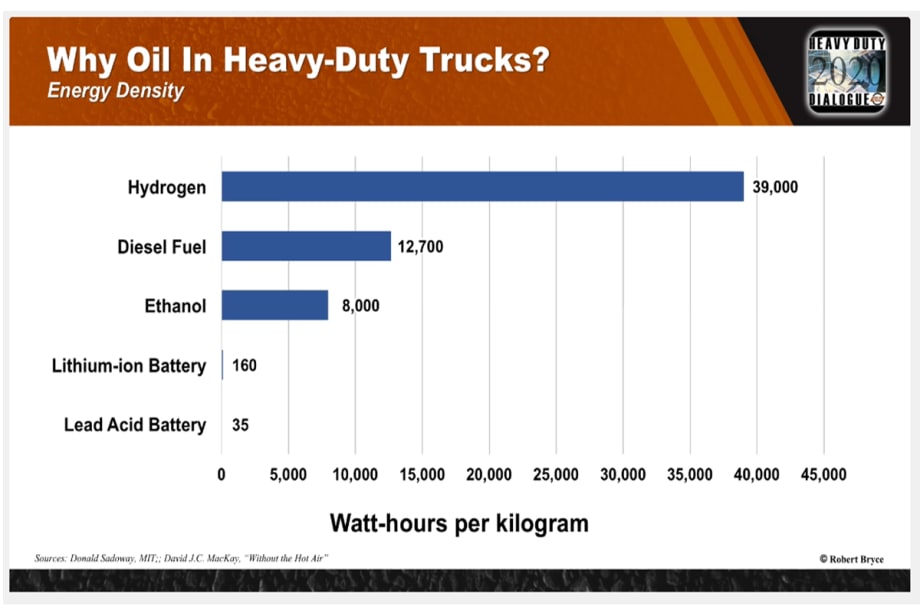
According to research presented by Robert Bryce, diesel fuel contains 12,700 watt-hours per kilogram, while lithium-ion batteries only contain 160, marking the need for a much larger (and heavier) amount of fuel storage in terms of batteries.
Source: HDD screenshot
According to author Robert Bryce, the move away from diesel will take more than just a desire to reduce greenhouse gas emissions.
“The idea that we can make a quick transition to renewables is ignoring their low power density and the need for a lot of land,” said Bryce, who highlighted this during his presentation at this year’s virtual Heavy Duty Dialogue. While wind and solar energy reduce overall emissions and are often sweetened by the availability of government subsides, they are not always the most popular choice, he added.
In fact, many of these projects are met with opposition from local residents. He cited protests on the Hawaiian island of Oahu, where more than 200 protestors were arrested while protesting a wind energy project being built near the small village of Kahuku.
“This friction is going to get even greater,” added Bryce, pointing to the fact that while many in the trucking industry are looking to electric as the next great hope, there are a number of roadblocks in the way. “Weight matters in trucks, and energy density is very important when you’re moving things around.”
For instance, in terms of energy density, diesel fuel contains 12,700 watt-hours per kilogram, while lithium-ion batteries only contain 160. In other words, you are going need a lot more storage space — and weight — to power a battery-electric truck than a diesel one.
Also, where is the energy going to come from? Infrastructure has always been an issue when it comes to the electric revolution, but, as Bryce pointed out during his presentation, it's not just the infrastructure, but the transmission of the power itself.
“In a grid where you’re already having blackouts, is this realistic?” asked Bryce, speaking specifically of California and its recent need to undergo rolling blackouts to reduce the possibility of over-taxing the power grid. “Any way you slice it, it’s going to be a lot of energy.”
According to Bryce, there is no short-term answer, pointing to the fact that even increasing development of nuclear power plants to support the increased need for electricity would take years. Currently, the U.S. has 98 operating nuclear power reactors in 30 states, with only two new plants currently being built. Compared to China and India, which are building 11 and 7 new plants, respectively, the U.S. is not moving in the right direction, added Bryce, who is pro-nuclear.
“We need politicians that are pro-nuclear and pro-government,” he added, explaining that to get more plants built, we need more government involvement, “and the problem is that Republicans are pro-nuclear but anti-government, and Democrats are pro-government but anti-nuclear.”
More Fuel Smarts

How Volvo Updated Its D13 for EPA 2027 [Watch]
Volvo’s updated D13 promises lower emissions without sacrificing performance or fuel economy. Take a closer look at what changed inside the engine in this HDT Spotlight video.
Read More →
Diesel Price Spike Shortens Payback for Natural Gas Trucks, Report Says
Energy Vision estimates fleets could recover the higher purchase price of an RNG-fueled Class 8 tractor in 1.3 to 2.8 years under current fuel-price scenarios.
Read More →
Calstart Becomes Catalyst Mobility, Reflecting Broader Focus
Calstart is now Catalyst Mobility, reflecting the nonprofit’s growing national role in clean transportation, including zero-emission trucks, infrastructure and incentive programs.
Read More →

Record Diesel Prices Squeeze Trucking Fleets
Average U.S. diesel prices have climbed to nearly $6 a gallon, surpassing the 2022 record as tight refinery capacity and Middle East disruptions keep fuel costs elevated.
Read More →
How Fuel Delivery Shapes Engine Performance
Fuel delivery depends on more than what happens at the injector. For fleet, maintenance and technical professionals, looking at the full path from pump to injector can provide useful context for understanding engine performance.
Read More →
East Coast Port Launches $45M Electric Truck Push
The Port Authority of New York and New Jersey announced millions in incentives for zero-emission drayage trucks, yard tractors, and new charging hubs near the port.
Read More →
California Bill Could Shed Light on Electric Truck Prices
Why do battery-electric Class 8 trucks remain so expensive? A California bill headed to Gov. Gavin Newsom would give fleets and state agencies more visibility into what manufacturers charge.
Read More →
Detroit Opens Orders for EPA 2027 Engines
Detroit isn’t starting from scratch to meet EPA 2027 diesel emissions standards. Its Gen 6 DD13 and DD15 engines keep much of today’s platform while updating the fuel and aftertreatment systems.
Read More →
Zero-Emission Truck Corridor Planned for West Coast
California, Oregon, Washington, British Columbia and Baja California are coordinating plans for truck charging and hydrogen fueling from Canada to Mexico.
Read More →
A Closer Look at Kenworth’s Electric T880E Vocational Truck [Video]
Learn more about Kenworth's T880E battery-electric vocational truck at the Paccar Technical Center, including its range, applications, upfitting considerations, and PTO options, in this HDT Spotlight video.
Read More →