




Einride Says First Self-Driving 'Pods' Available for Pre-Order
Einride is launching the next generation of its electric and self-driving ‘Pod’ cargo vehicle. Available on the global market for the first time, this series of Autonomous Electric Transport (AET) vehicles, ranging from AET 1 to AET 4, has been designed and developed for SAE Level 4 self-driving.

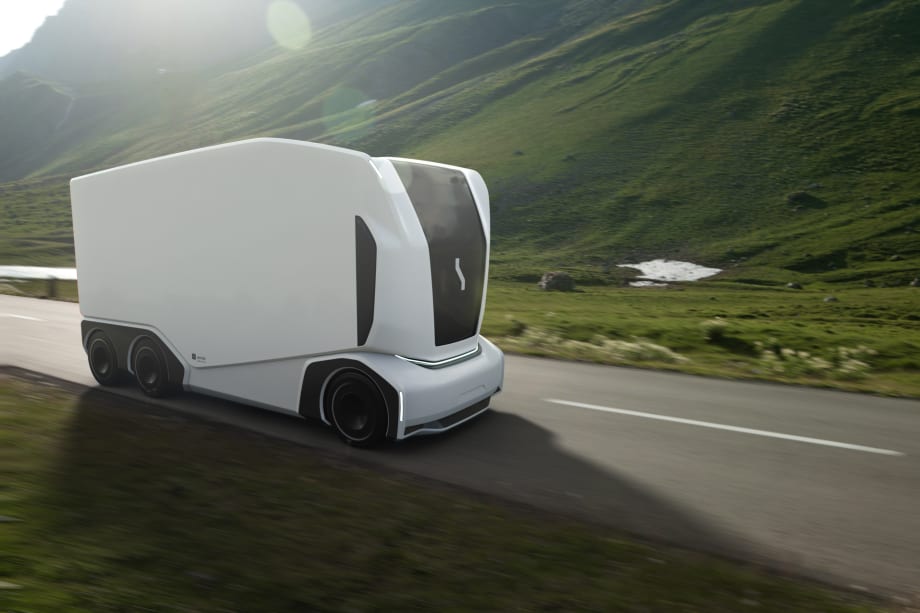
Einride's Autonomous Electric Transport (AET) "Pod" vehicles are designed for SAE Level 4 self-driving.
Photo: Einride
Einride is launching the next generation of its electric and self-driving ‘Pod’ cargo vehicle. Available on the global market for the first time, this series of Autonomous Electric Transport (AET) vehicles, ranging from AET 1 to AET 4, has been designed and developed for SAE Level 4 self-driving. The Swedish company said it will enable businesses to reduce transport costs by up to 60% and CO2 emissions by 90%.
The AET’s architecture and intelligent routing software allows for safe operations without a driver, with additional proprietary remote operations technology where one remote operator can supervise multiple Pods. In fact, the Pods do not have a space for a driver.
All four versions of the AET pods being introduced are a rigid 6x2 configuration with a 26-ton GVW, 16-ton payload capacity, and the ability to carry 15 pallets. They have an operating range of 130-180 km, or about 80-112 miles.
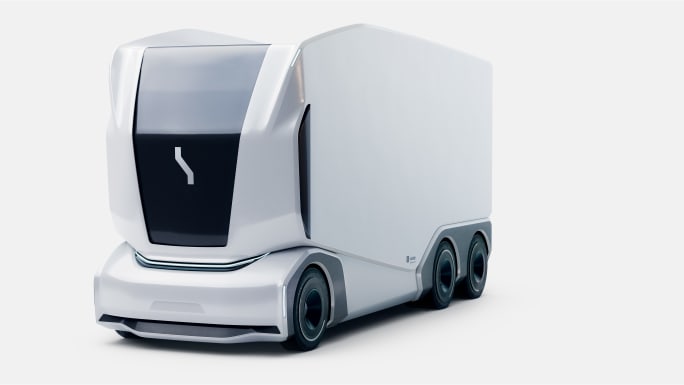
All four versions are a rigid 6x2 configuration with a 26-ton GVW.
Photo: Einride
AET 1 and 2 are available for pre-order now and expected to be available as soon as early 2021. AET 1 is suitable for closed, fenced facilities, while AET 2 is designed for “nearby” operations such as in harbors and on local public roads.
The AET 3 and 4, scheduled to be available starting in 2023, will boast high-speed functionality suited to long-distance highways and larger warehouses.
Einride called the Pod an environmentally and health-friendly alternative to diesel-powered trucks. Equipped with cameras, lidars and radars, it has 360-degree awareness of its surroundings, removing the need for a driver and resulting in no blind spots.
With this technology, the Pods can operate independently, do not require platooning, and are able to pull into and connect to charging stations along the routes on their own.
Earlier this year, Einride for the first time publicly demonstrated how remote operators can monitor and control multiple autonomous, electric Pods from a single remote drive station. As autonomous electric transport vehicles such as the Einride Pod are introduced into a freight network, Einride said at that time, transport managers will be able to employ operators who will monitor and control these driverless vehicles from a remote drive station, starting with two vehicles and eventually expanding up to as many as 10.
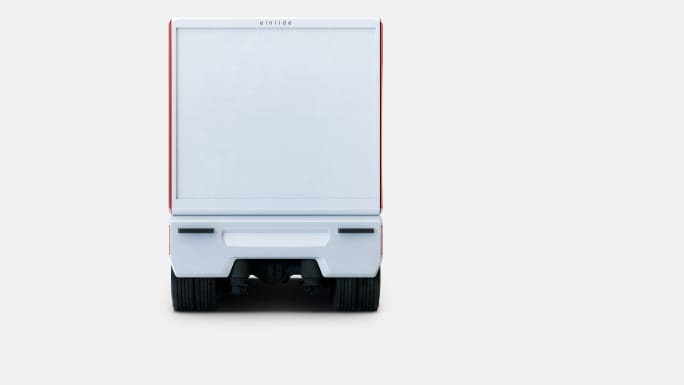
The AET Pods have a 16-ton payload capacity and the ability to carry 15 pallets.
Photo: Einride
Last year, Einride Pods started daily freight deliveries in a test with D.B. Schenker in Sweden.
Einride was founded in 2016 by Robert Falck, Linnéa Kornehed and Filip Lilja, and said it was the world’s first company to operate an autonomous, all-electric freight vehicle on a commercial route on a public road.
More Equipment

How Volvo Updated Its D13 for EPA 2027 [Watch]
Volvo’s updated D13 promises lower emissions without sacrificing performance or fuel economy. Take a closer look at what changed inside the engine in this HDT Spotlight video.
Read More →
Michelin Tire Improves Efficiency and Durability for Regional Fleets
The Michelin X Multi Energy D2 is a regional haul drive tire engineered to help fleets improve fuel efficiency, durability and traction in demanding stop-and-go operations.
Read More →
ZF Expands Commercial Vehicle Push in North America
ZF is expanding its North American commercial-vehicle presence with new transmission applications, electrification, trailer technology and autonomous-driving systems.
Read More →
Tesla Wants a Self-Driving Semi. Are Cameras Enough?
Could Tesla’s camera-only autonomous driving technology work on an 80,000-pound Semi? In this commentary, HDT's Deborah Lockridge takes a look at Tesla, Cybercab, and how autonomous trucks see the road.
Read More →
Kodiak: Driverless Long-Haul Truck Launch on Track for 2026
Kodiak AI says its driverless long-haul safety case is 93% complete and it remains on track to begin commercial operations by year-end 2026.
Read More →
What DOT’s Automated Vehicle Strategy Means for Trucking
The U.S. Department of Transportation issued a new automated-vehicle strategy that outlines plans for driverless-truck regulations, cross-state freight corridors, and federal safety standards.
Read More →
East Coast Port Launches $45M Electric Truck Push
The Port Authority of New York and New Jersey announced millions in incentives for zero-emission drayage trucks, yard tractors, and new charging hubs near the port.
Read More →
PlusAI Going Public to Fund Autonomous Truck Launch
A SPAC deal could provide PlusAI with up to $300 million as it works toward a 2027 commercial launch of factory-built autonomous trucks.
Read More →
NHTSA Moves to Rewrite Truck Fuel-Economy Rules
The National Highway Traffic Safety Administration says it lacks authority to regulate medium- and heavy-duty truck engines separately from complete vehicles, but the existing standards have not yet been eliminated.
Read More →
Detroit Opens Orders for EPA 2027 Engines
Detroit isn’t starting from scratch to meet EPA 2027 diesel emissions standards. Its Gen 6 DD13 and DD15 engines keep much of today’s platform while updating the fuel and aftertreatment systems.
Read More →