




Economic Watch: New Construction Jumps 13 Percent
New construction starts in the U.S. climbed 13% in November from the month before to an annual rate of $677.8 billion, according to industry data provider Dodge Data & Analytics.

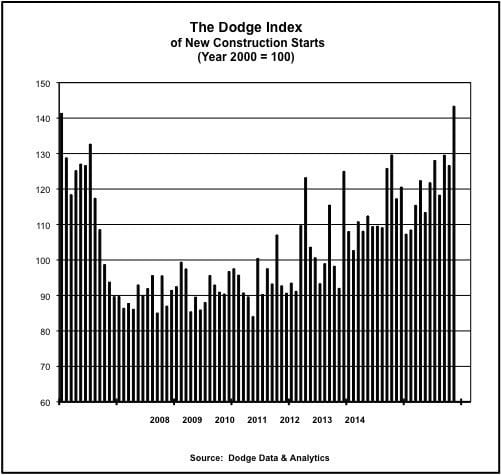
The Dodge Index of new construction starts. Graphic: Dodge Data & Analytics
The Dodge Index of new construction starts.Graphic: Dodge Data & Analytics
New construction starts in the U.S. climbed 13% in November from the month before to an annual rate of $677.8 billion, according to industry data provider Dodge Data & Analytics.
Nonresidential building had a particularly strong month while residential building retreated in November, as multifamily housing settled back from its brisk pace in October.
For the first eleven months of 2014, new construction starts increased 7% from the same time last year, totaling $530.8 billion. The hike at the national level during the first eleven months of 2014 showed gains for all five major regions, to varying degrees: the South Central, up 15%; the South Atlantic, up 10%; the West, up 6%; the Northeast, up 2%; and the Midwest, up 1%.
The November statistics raised the Dodge Index to 143, up from a revised 127 for October and marking the strongest month so far in 2014.
"After the sluggish activity witnessed at the outset of 2014, new construction starts have generally strengthened, showing an up-and-down pattern around a rising trend, with November coming in especially strong," said Robert A. Murray, chief economist for Dodge Data & Analytics. "While residential building has decelerated in 2014, due to the pause by single family housing, the nonresidential building sector has assumed the leading role in keeping the construction expansion going.”
Nonresidential building in November soared 32% to an annual rate of $256.7 billion. A substantial boost came from a 253% increase for the manufacturing plant category, maintaining the often volatile behavior that's been present this year, according to Dodge. During the first eleven months of 2014, nonresidential building climbed 17% compared to the same time a year ago.
Nonbuilding construction advanced 22% to an annual rate of $182.6 billion in November. The electric power and gas plant category provided most of the lift, jumping 363% Highway and bridge construction dropped 7%. For the January through November period nonbuilding construction decreased 4% from a year ago.
Residential building in November fell 6% to an annual rate of $238.5 billion. Multifamily housing retreated after its strong October performance, sliding 21% Single family housing in November edged up a slight 1%, essentially holding steady with the flat activity that's been present since the end of last year.
"While there are signs that the banking sector is beginning to improve access to home mortgages, as shown by lending survey results, there has yet to be a discernible positive impact on single family homebuilding,” said Murray.
During the first eleven months of 2014, residential building grew 7% compared to a year ago, a much smaller increase than the 26% gain reported for all of 2013. Single family housing was up only 2% year-to-date while multifamily housing revealed a much stronger year-to-date performance, climbing 25%.
More Fleet Management

How Telematics Improves Visibility, Control, and Performance in Refrigerated Fleets
Explore how telematics help refrigerated fleets improve visibility, uptime, efficiency, compliance, and cargo protection across connected cold chain operations.
Read More →
What the U.S.-Canada Trade War Means for Trucking
Escalating U.S.-Canada tariffs could disrupt cross-border freight, reduce truck volumes, raise costs, and create new uncertainty for carriers on both sides of the border.
Read More →
What Are Trucking’s Top Concerns for 2026?
The American Transportation Research Institute wants to know what's worrying trucking fleet managers, drivers, and other stakeholders in its annual Industry Issues survey.
Read More →

American Trucking Associations Looks for a New Leader
ATA President and CEO Chris Spear abruptly left his job at the association on August 21, at a pivotal time for the trucking industry.
Read More →
Public Wi-Fi Cybersecurity Risks: How Truck Drivers and Fleets Can Protect Their Data
Public Wi-Fi can expose truck drivers and fleets to credential theft, malware, and other cyber threats. Here’s how to reduce the risk on the road.
Read More →
For Nicky Cupp, Fleet Innovation Starts With Frustration
HDT Truck Fleet Innovator Nicky Cupp turns everyday pain points at Fraley & Schilling into opportunities for better technology and smarter processes.
Read More →
Adam Buttgenbach’s Approach to Electric Trucks: Start With Where They Fit
HDT Truck Fleet Innovator Adam Buttgenbach helped PepsiCo build one of North America’s largest EV fleets by focusing on where electric trucks make operational sense.
Read More →
Deen Albert: Let Automation Do the Math, People Make the Decisions
HDT Truck Fleet Innovator Deen Albert makes sure people are still at the heart of operations at Grand Island Express, even while adopting artificial intelligence tools. AI-assisted dispatch helped boost revenue 25% with the same number of trucks.
Read More →
Trimble’s New AI Agent Takes Aim at Fleet Back-Office Busywork
Arc Agent works across Trimble TMS products to automate repetitive tasks such as freight orders, maintenance, invoices, fuel costs and more.
Read More →
How HDT’s 2026 Truck Fleet Innovators Are Rethinking Fleet Operations
Meet five trucking leaders who are challenging assumptions, solving operational problems, and putting innovative ideas to work.
Read More →