




From the HDT Archives (October 2015): What Happens to Trucking When Interest Rates (Finally) Rise?
Economic Watch: Fed Pushes Interest Rates Higher Amid Improving Signs
The Federal Reserve on Wednesday increased the nation’s benchmark interest rate for the third time since its first hike in nearly a decade in December 2015, amid evidence of a steady economy and indications of more interest rate increases later this year.

Evan Lockridge・Former Business Contributing Editor
4 min to read
The Federal Reserve on Wednesday increased the nation’s benchmark interest rate for the third time since its first hike in nearly a decade in December 2015, amid evidence of a steady economy and indications of more interest rate increases later this year.
The 0.25% jump in the federal funds rate (the interest rate banks charge each other for overnight loans to meet reserve requirements), pushes its target to 0.75%-1% following the previous hike in December 2016.
According to the Federal Reserve, information received since the Federal Open Market Committee met in February indicates that the labor market has continued to strengthen, that economic activity has continued to expand at a moderate pace, and that job gains have remained solid with little change in unemployment.
“Household spending has continued to rise moderately while business fixed investment appears to have firmed somewhat,” the statement said. “Inflation has increased in recent quarters, moving close to the committee's 2% longer-run objective. Excluding energy and food prices, inflation was little changed and continued to run somewhat below 2%.”
The central bank is forecasting two more rate hikes this year, three in 2018 and at least three in 2019, to bring the federal funds rate to 3%, slightly earlier than its previous goal of 2020. Earlier some analysts were predicting there could be as many as four rate hikes in 2017.
The Fed also left its total economic growth GDP forecast nearly unchanged at 2.1% for this year and 1.9% for 2019, while projecting an unemployment rate of 4.5% for the next three years.
When asked what this and other rates hikes mean for trucking, American Trucking Associations Chief Economist Bob Costello said, “Obviously financing costs will rise with the rise in interest rates, including for equipment and loans for expansions.” But he also noted there are positives.
“Two of the biggest for trucking, include: It will give savers, including retired people, more money and thus more purchasing power. Second, it will increase margins on bank lending, and thus lenders will be more likely to boost credit for businesses and people. This in turn will spur economic activity,” he explained.
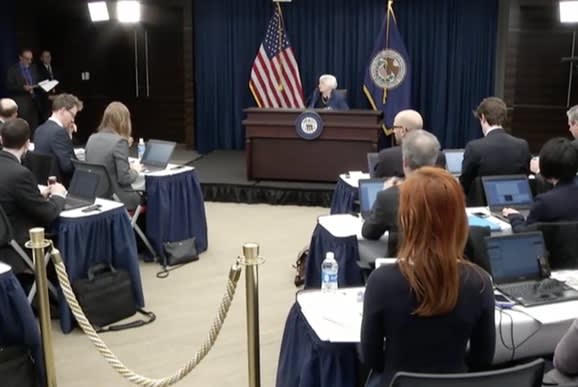
Federal Reserve Chair Janet Yellen talking with reporters follwing Wednesday's Fed announcement it is increasing interest rates.Photo: Evan Lockridge via FOMC website.
Fed Chair Janet Yellen said during a press conference following the announcement that the central bank wanted to avoid rapid rate increases.
"I remember when rates were raised at every meeting, I think people thought that was a gradual pace, measured pace, and we’re certainly not envisioning something like that," she said, referring to 2004 to 2006 when the Fed raised rates at nearly every meeting.
This news follows economic reports earlier in the week.
Retail sales
One showed retail sales in February increased by the smallest amount in six months, though analysts generally agree there are signs signs the economy is expanding, most likely better than it was in the final quarter of last year.
The 0.1% increase in retail sales from the month before, according to the Commerce Department, followed a upwardly revised 0.6% rise in January, with the latest performance matching a consensus estimate from analysts. That followed the prior month’s 0.8% jump. The February level is 5.7% higher than the same time a year ago.
So called “core sales,” which exclude categories such as food services, auto dealers, home-improvement stores and service stations, rose 0.1%, while sales at non-store retailers, which includes online shopping, jumped 1.2% in February from January and 13% from the same time a year ago.
Part of the reason for the slowing of retail sales may be due to tax refunds from the IRS going out more slowly than usual. Some filers weren't expected to get them until the last week of February, according to Bloomberg.
Inflation
A separate Labor Department report Wednesday showed retail inflation is slowly returning. The Consumer Price Index rose 2.7% in February from the same time a year ago, the biggest year-over-year gain since March 2012.
While last month’s level moved up just 0.1% from the month before, the smallest gain since July, it follows a 0.6% increase in January from December. This February increase matched a consensus estimate from Wall Street analysts.
The increase in headline CPI was once again largely an energy story, according to Josh Nye, economist at RBC Economics Research.
“The now-inflationary impact of energy prices is expected to prove transitory. Beneath the higher headline reading, core inflation edged down from its post-recession high, but there was some evidence of firming domestic price pressure, and a tight labor market and rising wages should support underlying inflation going forward,” he said.
Meantime, prices at the wholesale level also moved higher in February, according to Labor Department report from Tuesday. The Producer Price Index moved a solid 0.3% higher from the month before, more than analysts’ expectations, following a 0.6% jump in January.
Over the past year the PPI has gained 2.2%, the biggest year-over-year advance since March 2012.
Its measure of "core prices,” which exclude food, energy and trade services, increased in February by 0.3%, signaling some acceleration in the underlying trend of core inflation – although most of last month’s hike was due to price increases in the services sector, according to analysts at Well Fargo Securities.
More Fleet Management

Sponsored•September 16, 2026
Color Match Smarter: Tools That Restore & Perform
For fleet managers and collision repair professionals keeping heavy-duty trucks on the road, getting the color right the first time isn't just about appearance — it's about efficiency, turnaround time, and bottom-line results. Discover how today's digital color tools are transforming the repair process from guesswork to precision.
Read More →
FMCSA Pauses Biennial-Update Enforcement Amid Motus Transition
Carriers whose updates were due on or after June 1 have more time, while FMCSA works to stabilize its new registration system and warns of phishing sites impersonating its new carrier registration system, Motus.
Read More →
Sponsored•September 14, 2026
2026 Blueprint for Countering Smarter Supply Chain Theft
Cargo theft is no longer just the cost of doing business. It's a multi-billion-dollar criminal enterprise exploiting vulnerabilities across your fleet, drivers, and supply chain.
Read More →


Sponsored•September 1, 2026
How Telematics Improves Visibility, Control, and Performance in Refrigerated Fleets
Explore how telematics help refrigerated fleets improve visibility, uptime, efficiency, compliance, and cargo protection across connected cold chain operations.
Read More →
What the U.S.-Canada Trade War Means for Trucking
Escalating U.S.-Canada tariffs could disrupt cross-border freight, reduce truck volumes, raise costs, and create new uncertainty for carriers on both sides of the border.
Read More →
What Are Trucking’s Top Concerns for 2026?
The American Transportation Research Institute wants to know what's worrying trucking fleet managers, drivers, and other stakeholders in its annual Industry Issues survey.
Read More →
American Trucking Associations Looks for a New Leader
ATA President and CEO Chris Spear abruptly left his job at the association on August 21, at a pivotal time for the trucking industry.
Read More →
Public Wi-Fi Cybersecurity Risks: How Truck Drivers and Fleets Can Protect Their Data
Public Wi-Fi can expose truck drivers and fleets to credential theft, malware, and other cyber threats. Here’s how to reduce the risk on the road.
Read More →
For Nicky Cupp, Fleet Innovation Starts With Frustration
HDT Truck Fleet Innovator Nicky Cupp turns everyday pain points at Fraley & Schilling into opportunities for better technology and smarter processes.
Read More →
Adam Buttgenbach’s Approach to Electric Trucks: Start With Where They Fit
HDT Truck Fleet Innovator Adam Buttgenbach helped PepsiCo build one of North America’s largest EV fleets by focusing on where electric trucks make operational sense.
Read More →