




ECanter Truck Project to Demonstrate Swappable Battery Modules for EVs
Mitsubishi Fuso is starting an electric-truck battery-swapping demonstration in Japan this month, using its eCanter battery-electric truck.

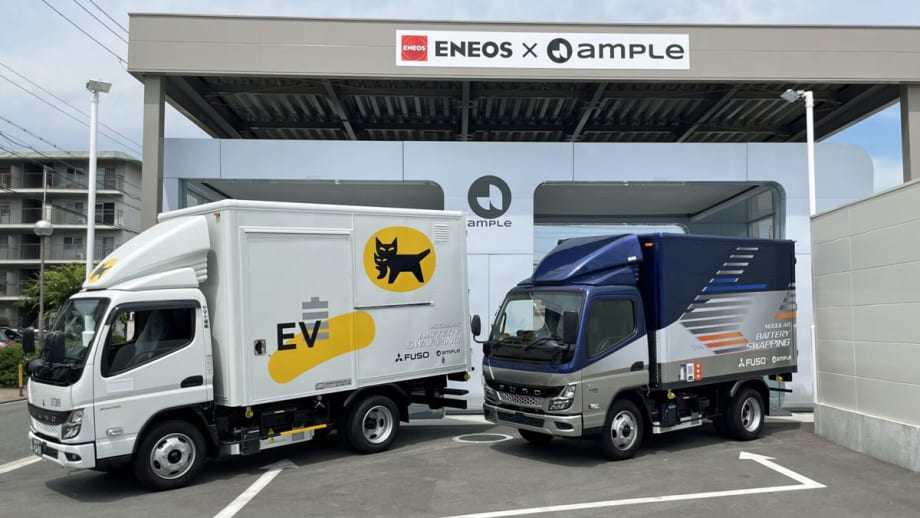
The eCanter battery-swapping model, used by Yamato Transport, and Ample’s automated battery-swapping station.
Photo: MFTBC
Mitsubishi Fuso Truck and Bus Corp. will start an electric-truck battery-swapping demonstration on public roads in Japan this month.
MFTBC’s electric light-duty eCanter truck will be equipped with swappable battery modules from Ample, which is headquartered in San Francisco.
The eCanter’s batteries will be swapped at Ample’s battery swapping stations, deployed in Kyoto City in collaboration with Japan’s ENEOS Holdings Inc.
Tokyo-based Yamato Transport will trial the battery-swapping eCanter on public roads for collection and delivery operations in Kyoto City.
How the Electric-Truck Battery-Swapping Demo Will Work
When the eCanter enters the Ample fully automated swapping station, robots automatically exchange batteries within the target time of five minutes.
This technique was previously demonstrated to the public at the Japan Mobility Show in 2023, and MFTBC is taking the next step in bringing this technology to public roads.
The project will help MFTBC and the other participating companies to identify the benefits and challenges of battery swapping and investigate the scalability of the technology with future practical use in Japan in mind.
MFTBC said this joint demonstration is an important step towards MFTBC’s ambition to drive EV truck expansion.
The company launched the original eCanter in 2017 and it has already accumulated over 12 million kilometers of mileage in customer hands worldwide. (It’s no longer offered in the U.S.)
The next step for MFTBC is to commercialize a battery-swapping EV truck. This would give more customers the chance to transition to carbon-neutral logistics by providing a range of options comparable to that available for conventional diesel models.
The New eCanter
Launched in March 2023, MFTBC’s new generation eCanter offers selectable driving ranges with three battery sizes, and 28 models in Japan that can accommodate a variety of bodywork and applications.
Having battery-swapping EV trucks would further expand the possibilities of EV trucks, by addressing worries about driving range, extending applications and significantly shortening the downtime of vehicles. In addition, by introducing the latest swappable batteries as technology evolves, users can always have access to the most up-to-date battery technology.
Furthermore, this verification will also study a complete business model for battery-swapping EV trucks with the leasing product for eCanter, Fuso Green Lease, provided by Daimler Truck Financial Service Asia.
This lease provides a comprehensive financial solution that includes maintenance, insurance, a unified contract between parties, operational expertise with truck registration, and monthly invoicing.
Battery-Swapping for Passenger Car EVs
The companies are also collaborating in accumulating operational experience necessary to popularize fully automated battery swapping stations for EVs as a new energy infrastructure. Ample’s fully automated battery swapping stations are fitted with the capability of swapping batteries not only for EV trucks, but also for passenger cars.
More Fuel Smarts

New California Law Could Shed Light on Electric Truck Prices
Why do battery-electric Class 8 trucks remain so expensive? A California bill signed by Gov. Gavin Newsom would give fleets and state agencies more visibility into what manufacturers charge.
Read More →
How Volvo Updated Its D13 for EPA 2027 [Watch]
Volvo’s updated D13 promises lower emissions without sacrificing performance or fuel economy. Take a closer look at what changed inside the engine in this HDT Spotlight video.
Read More →
Diesel Price Spike Shortens Payback for Natural Gas Trucks, Report Says
Energy Vision estimates fleets could recover the higher purchase price of an RNG-fueled Class 8 tractor in 1.3 to 2.8 years under current fuel-price scenarios.
Read More →

Calstart Becomes Catalyst Mobility, Reflecting Broader Focus
Calstart is now Catalyst Mobility, reflecting the nonprofit’s growing national role in clean transportation, including zero-emission trucks, infrastructure and incentive programs.
Read More →
Record Diesel Prices Squeeze Trucking Fleets
Average U.S. diesel prices have climbed to nearly $6 a gallon, surpassing the 2022 record as tight refinery capacity and Middle East disruptions keep fuel costs elevated.
Read More →
How Fuel Delivery Shapes Engine Performance
Fuel delivery depends on more than what happens at the injector. For fleet, maintenance and technical professionals, looking at the full path from pump to injector can provide useful context for understanding engine performance.
Read More →
East Coast Port Launches $45M Electric Truck Push
The Port Authority of New York and New Jersey announced millions in incentives for zero-emission drayage trucks, yard tractors, and new charging hubs near the port.
Read More →
Detroit Opens Orders for EPA 2027 Engines
Detroit isn’t starting from scratch to meet EPA 2027 diesel emissions standards. Its Gen 6 DD13 and DD15 engines keep much of today’s platform while updating the fuel and aftertreatment systems.
Read More →
Zero-Emission Truck Corridor Planned for West Coast
California, Oregon, Washington, British Columbia and Baja California are coordinating plans for truck charging and hydrogen fueling from Canada to Mexico.
Read More →
A Closer Look at Kenworth’s Electric T880E Vocational Truck [Video]
Learn more about Kenworth's T880E battery-electric vocational truck at the Paccar Technical Center, including its range, applications, upfitting considerations, and PTO options, in this HDT Spotlight video.
Read More →