




Eaton, Tenneco to Produce Exhaust Thermal Management System
Tenneco’s Cold Start Thermal Unit will be combined with Eaton’s TVS blower technology to create an integrated exhaust thermal management system intended to reduce harmful exhaust emissions.

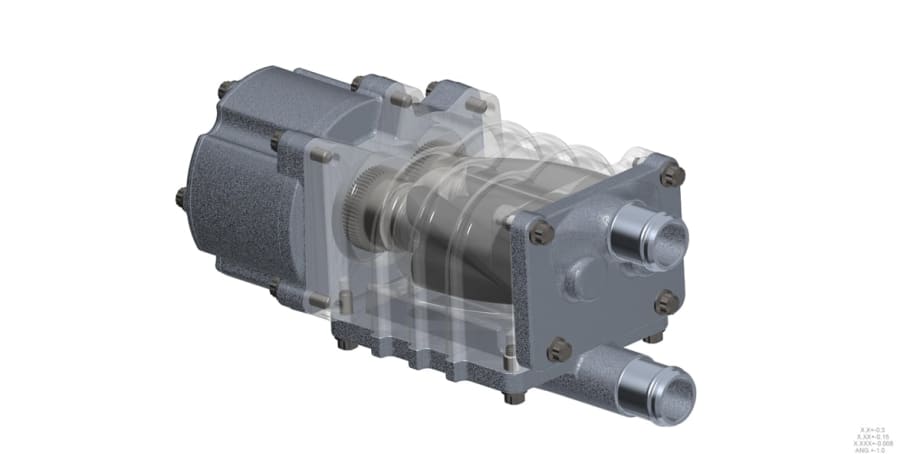
Eaton’s electrically driven TVS Roots blower allows airflow to be precisely controlled so Tenneco’s Cold Start Thermal Unit can maintain optimal aftertreatment temperatures.
Photo: Eaton
Eaton’s Vehicle Group and Tenneco’s Clean Air business group have entered an agreement to produce an integrated exhaust thermal management system that will enable commercial truck and light vehicle manufacturers to meet upcoming emissions regulations.
Under terms of the agreement, Tenneco’s Cold Start Thermal Unit (CSTU) will be combined with Eaton’s TVS blower technology. The integrated exhaust thermal management system will provide heat directly to the vehicle’s aftertreatment system, which is essential for reducing harmful exhaust emissions.
Upon heating the SCR catalyst to approximately 200–250 degrees Celsius (392–482 degrees Fahrenheit), the aftertreatment system can efficiently convert nitrogen oxide into clean emissions (e.g., nitrogen and water particles) upon exiting the SCR catalyst. Eaton’s electrically driven TVS Roots blower allows the airflow to be precisely controlled so the CSTU can maintain optimal aftertreatment temperatures.
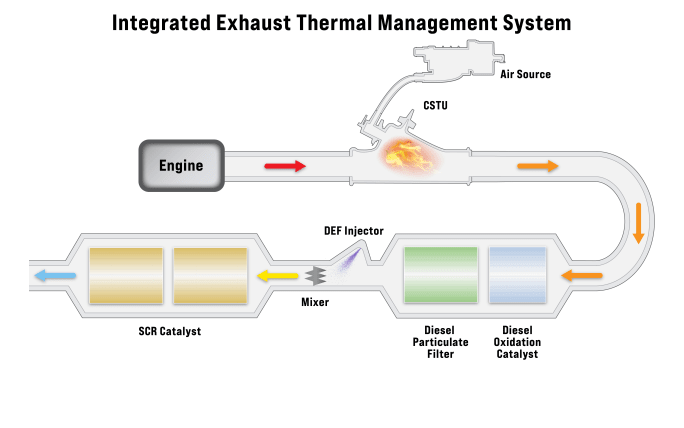
Tenneco’s Cold Start Thermal Unit will be combined with Eaton’s TVS blower technology to create an integrated exhaust thermal management system which will provide heat directly to the vehicle’s aftertreatment system.
Photo: Eaton
“CSTU is an active thermal management technology that rapidly heats and maintains the emission control system temperature,” said Nick Morley, director of global advanced engineering in Tenneco’s Clean Air business group, in a press release. “Since the majority of emissions are generated during the initial start of engine operation and during extended idle conditions, the addition of an integrated exhaust thermal management system in front of the catalyst enables rapid light-off and efficient NOx conversion through the full range of operating conditions.”
The CSTU and TVS blower will be sold individually by Tenneco and Eaton, respectively, but will be engineered as a system enabling vehicle manufacturers to seamlessly integrate the components.
Development activities will take place at Tenneco’s technical center in Edenkoben, Germany, and Eaton’s technical center in Marshall, Michigan. The integrated exhaust thermal management system is anticipated to be ready for start of production in 2025 to support regulatory timing.
Across the globe, emission standards are tightening for vehicle manufacturers. In Europe, the next stage of emissions standards, known as Euro VII (for heavy-duty vehicles) and Euro 7 (for light-duty), and are targeted for introduction in 2025. The California Air Resources Board and the U.S. Environmental Protection Agency have similar actions planned for 2027 and 2024, respectively. Collectively, these new regulations will reduce tailpipe NOx limits by 90%, thus accelerating the need for global engine manufactures to employ additional emission reduction strategies, Eaton officials said.
“It became clear about three years ago that future CARB and EPA NOx regulations would be drastically stricter than they are today, and the exhaust thermal management system is an effective technology to actively heat up an aftertreatment system for commercial vehicle diesel engines to dramatically reduce cold-start NOx emissions,” said Justin Hopkins, technology development manager of Eaton’s Vehicle Group.
More Equipment

How Volvo Updated Its D13 for EPA 2027 [Watch]
Volvo’s updated D13 promises lower emissions without sacrificing performance or fuel economy. Take a closer look at what changed inside the engine in this HDT Spotlight video.
Read More →
Michelin Tire Improves Efficiency and Durability for Regional Fleets
The Michelin X Multi Energy D2 is a regional haul drive tire engineered to help fleets improve fuel efficiency, durability and traction in demanding stop-and-go operations.
Read More →
ZF Expands Commercial Vehicle Push in North America
ZF is expanding its North American commercial-vehicle presence with new transmission applications, electrification, trailer technology and autonomous-driving systems.
Read More →
Tesla Wants a Self-Driving Semi. Are Cameras Enough?
Could Tesla’s camera-only autonomous driving technology work on an 80,000-pound Semi? In this commentary, HDT's Deborah Lockridge takes a look at Tesla, Cybercab, and how autonomous trucks see the road.
Read More →
Kodiak: Driverless Long-Haul Truck Launch on Track for 2026
Kodiak AI says its driverless long-haul safety case is 93% complete and it remains on track to begin commercial operations by year-end 2026.
Read More →
What DOT’s Automated Vehicle Strategy Means for Trucking
The U.S. Department of Transportation issued a new automated-vehicle strategy that outlines plans for driverless-truck regulations, cross-state freight corridors, and federal safety standards.
Read More →
East Coast Port Launches $45M Electric Truck Push
The Port Authority of New York and New Jersey announced millions in incentives for zero-emission drayage trucks, yard tractors, and new charging hubs near the port.
Read More →
PlusAI Going Public to Fund Autonomous Truck Launch
A SPAC deal could provide PlusAI with up to $300 million as it works toward a 2027 commercial launch of factory-built autonomous trucks.
Read More →
NHTSA Moves to Rewrite Truck Fuel-Economy Rules
The National Highway Traffic Safety Administration says it lacks authority to regulate medium- and heavy-duty truck engines separately from complete vehicles, but the existing standards have not yet been eliminated.
Read More →
Detroit Opens Orders for EPA 2027 Engines
Detroit isn’t starting from scratch to meet EPA 2027 diesel emissions standards. Its Gen 6 DD13 and DD15 engines keep much of today’s platform while updating the fuel and aftertreatment systems.
Read More →