




Driver Gets Vision Exemption After Delays, Court Battle
The Office of Motor Carrier Safety has agreed to exempt James F. Durham from federal vision requirements, ending a long court and regulatory battle for the Tennessee trucker
The Office of Motor Carrier Safety has agreed to exempt James F. Durham from federal vision requirements, ending a long court and regulatory battle for the Tennessee trucker.
Federal rules for interstate commercial truck drivers require at least 20/40 (Snellen) vision in each eye, with or without corrective lenses. Durham’s left eye easily passes the test, but a 1992 injury severely limited vision in his right eye. That happened to be the same year the Federal Highway Administration granted more than 2,000 monocular drivers vision exemptions as part of a study program. The Advocates for Highway and Auto Safety successfully sued to halt the program, but the drivers were allowed to keep their exemptions, subject to annual vision exams and the maintenance of good driving records.
Unfortunately, Durham hadn’t been part of the study group. His break -- or so he thought -- came in 1996, when the U.S. Court of Appeals for the 8th Circuit ordered FHWA to reconsider the exemption request of another excluded monocular driver, David Rauenhorst. Rauenhorst got the exemption. Like Rauenhorst, Durham had continued to drive after his injury, although he was limited to intrastate commerce. Also like Rauenhorst, Durham had an excellent safety record. He immediately applied for an exemption.
“Durham resided outside the 8th Circuit, but he concluded that as an American he had the same rights to fair treatment,” notes Gerald Von Korff , an attorney with the St. Cloud, MN, law firm Rinke-Noonan, which represented both Rauenhorst and Durham.
However, FHWA chose to apply the court ruling only to drivers from the 8th Circuit. The agency stalled making any decision on the Durham request until a lawsuit forced the issue. Meanwhile, Congress had given FHWA broader authority to grant exemptions and it has systematically been working through a pile of petitions. Durham’s was initially denied.
The vision exemption program is technically an experimental program, thus there are no official “rules.” However, FHWA and the newly formed Office of Motor Carrier Safety have consistently required applicants to have at least three years of “recent” experience driving with the vision impairment. Durham drove with the injured eye from 1992 to early 1996, when an employer disqualified him for failing the vision exam. After an 18-month break he resumed driving part time. Since 1992 he hasn’t received a traffic citation and has been involved in one minor, non-injury accident. Still, FHWA said he hadn’t satisfied the experience requirement.
“The FHWA had no direct evidence that the additional delay would make a difference,” notes Von Korff. “But it decided that it must adhere strictly to the principle that only persons who exactly met the waiver experiment’s criteria should be granted waivers.” Moreover, Durham would have satisfied the experience requirement if FHWA hadn’t delayed acting on his application. Durham once again appealed to the 6th Circuit Court of Appeals, and the government agreed not to use its own delays against him.
OMCS granted Durham’s exemption in mid-December. In the Federal Register notice it cited Durham’s safe driving record from 1992 to 1996, plus the fact that he was back on the road by late 1997. “The 18-month break . . .would have undermined the reliability of that experience as a predictor of his ability to drive safety if he had not resumed driving,” it said.
Durham has his interstate license and Von Korff is plowing new ground. His latest vision exemption case involves Ohio truck driver Jerry Parker, who has impaired vision in one eye and a single limb. Federal regulations allow limb-impaired persons to drive commercial vehicles with proper equipment. The current vision exemption program allows persons with a single eye to drive trucks. According to Von Korff, OMCS has denied Parker’s exemption request because there is no statistical data regarding the safety record of monocular, limb impaired drivers.
“We assert that Parker is entitled to a waiver under the Rehabilitation Act since he has the functional ability to see and the functional ability to manipulate controls,” says Von Korff.
The case was recently argued before the 6th Circuit Court of Appeals. It went well, says Von Korff. “We are hopeful of a good result.”
More information on the Durham and Parker cases can be found on Rinke-Noonan’s Internet site, www.rnoon.com. Click on Law for Laymen. Contact Von Korff at jvonkorff@rnoon.com. The OMCS notice to grant Durham an exemption appeared in the December 13, 1999, Federal Register at < href="http://www.nara.gov/fedreg">www.nara.gov/fedreg.
More Drivers

Competition Heating Up for Truck Drivers
New report reveals rising driver hiring costs, the return of sign-on bonuses, growing AI advantages, and the operational factors shaping driver retention.
Read More →
How Fraley & Schilling Improved Logbook Compliance by Over 50%
Fraley & Schilling needed a way to close a compliance workflow gap in its ELD system without adding more work from driver training, reminders, and back-office follow-ups. It found the answer in a custom driver app.
Read More →
Volvo Goes Gaming
Volvo has roared into American Truck Simulator with two new flagship trucks.
Read More →
What the Best Fleets to Drive For Teach About Driver Retention
Survey fatigue, AI-powered routing, owner-operator expectations, and the decline of social media all emerged as themes from this year's Best Fleets to Drive For program.
Read More →
Driver Retention Lessons From the Best Fleets to Drive For
What separates trucking's best workplaces from the rest? Jane Jazrawy shares the biggest lessons from this year's Best Fleets to Drive For program on driver retention, communication, AI, and workforce trends on the HDT Talks Trucking podcast.
Read More →
Farewell, CDL: Why I'm Giving Up My Commercial Driver's License
After more than 20 years as a CDL holder, HDT Executive Editor Jack Roberts is letting his commercial license expire. Not because he wants to — but because trucking's nuclear verdict crisis has made the risks of public-road test drives too great for editors, manufacturers, and everyone involved.
Read More →
How Top Trucking Fleets Improve Driver Retention [Video]
What do healthy snacks, optimized routing, and just picking up the phone have in common? They're all strategies the Best Fleets to Drive For are using to retain truck drivers.
Read More →
Trucker Path Adds Verisk CargoNet Theft Data to Navigation Platform
Trucker Path’s new cargo theft risk overlays give drivers and fleets visibility into high-risk areas, stolen commodity trends, and theft hotspots.
Read More →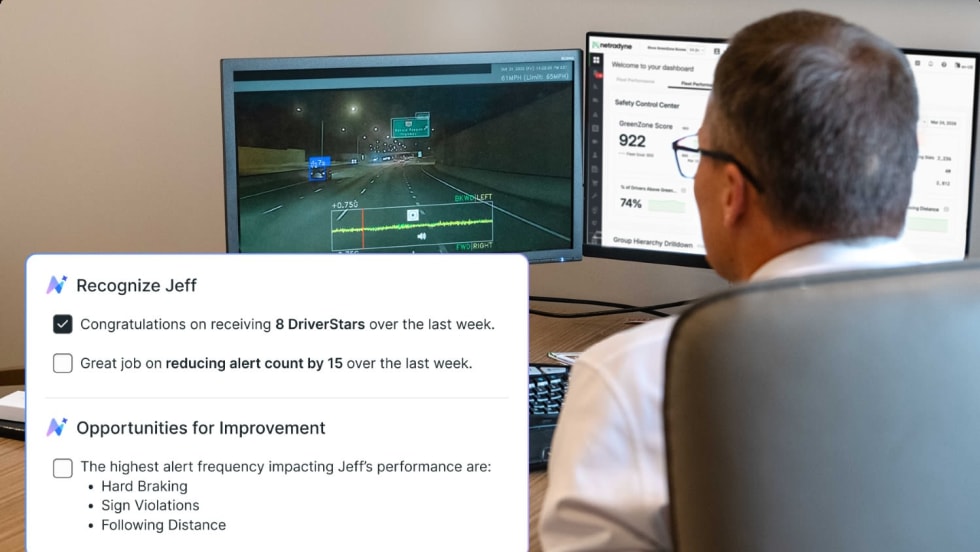
Netradyne Intelligence Uses New AI Agents to Automate Response to In-Cab Camera Data
The company called the next-generation in-cab camera safety platform "a fundamental shift from systems that report on what happened to systems that actively drive what should happen next."
Read More →
Why Truck Detention Keeps Costing Fleets Time and Money
A 2024 ATRI study found detention affects nearly 40% of truckload stops and costs the industry more than $15 billion annually. Despite the toll on drivers, fleets, and supply chains, the problem remains stubbornly persistent.
Read More →