




DOT to Revisit Hours of Service Rules
The federal government has agreed to start a new round of rulemaking on hours of service regulations. Public Citizen today announced the Department of Transportation and the Federal Motor Carrier Safety Administration agreed to revisit the rules to settle a lawsui

The federal government has agreed to start a new round of rulemaking on hours of service regulations.
Public Citizen today announced the Department of Transportation and the Federal Motor Carrier Safety Administration agreed to revisit the rules to settle a lawsuit
brought by Public Citizen, Advocates for Highway and Auto Safety, the Truck Safety Coalition and the International Brotherhood of Teamsters.
Today's settlement requires the government to draft a new proposed rule governing hours of service within nine months and to publish a final rule within 21 months.
In March 2009, the groups asked the U.S. Court of Appeals in Washington, D.C., to throw out the hours-of-service rule for the third time. The rule, which took effect in 2003, has twice before been challenged in court by safety groups. The regulations were modified somewhat following the first challenge, but the revised rule was challenged again in 2005.
In July 2007, the court remanded the hours of service rules to FMCSA, ruling that the agency must provide better explanations of its justifications for adopting the controversial 11-hour drive time and 34-hour restart provisions. Many in the trucking industry interpreted that decision as "procedural," something the agency could fix fairly easily.
In December 2007, FMCSA announced that it was keeping the 11-hour and the 34-hour provisions in an Interim Final Rule. In January 2008, a federal appeals court denied Public Citizen's request to invalidate that interim rule. The final rule was unveiled late last year and went into effect in the final days of the Bush administration.
The safety groups argue that the rule "dramatically expanded driving and working hours by allowing truck drivers to drive up to 11 consecutive hours (instead of 10) each shift and by cutting the off-duty rest and recovery time at the end of the week from a full weekend of 50 or more hours to as little as 34 hours. ... As a result, the rule allowed truckers to spend up to 17 more hours driving each week than previously allowed, a more than 25 percent increase over the prior rule, despite strong evidence that the increased hours would lead to more traffic fatalities and serious consequences for driver health."
Earlier this year, the American Trucking Associations refuted these claims. In fact, ATA noted, the new hours of service rules reduced the maximum length of the truck driver's work day by at least one hour and increased the daily required number of hours of rest by two hours. The work day was shortened from a previous maximum of 15 hours (which could be extended by breaks) to no more than 14 consecutive hours. Drivers are required to rest at least 10 hours between shifts, with at least eight of those hours in the sleeper berth if it is used while on the road. Within the shorter work day, the rules allow 11 hours of driving instead of the previous 10.
"Another myth sowed by these groups is that the 34-hour restart allows significantly longer driving and on-duty times in a week than the pre-2004 rules," ATA said. FMCSA found that "longer hypothetical hours in driving and duty schedules" envisioned by critics "requires an imaginary world with nearly perfect logistics." In the real world, drivers have found that the 34-hour restart gives them more rest and time off, not less, said the association's statement.
Previous coverage:
"Safety Groups Challenge Hours of Service in Court Again," 3/10/2009
"ATA Counters Hours of Service Myths," 3/11/2009
"FMCSA Announces Final HOS Rule," 11/19/2008
More Drivers
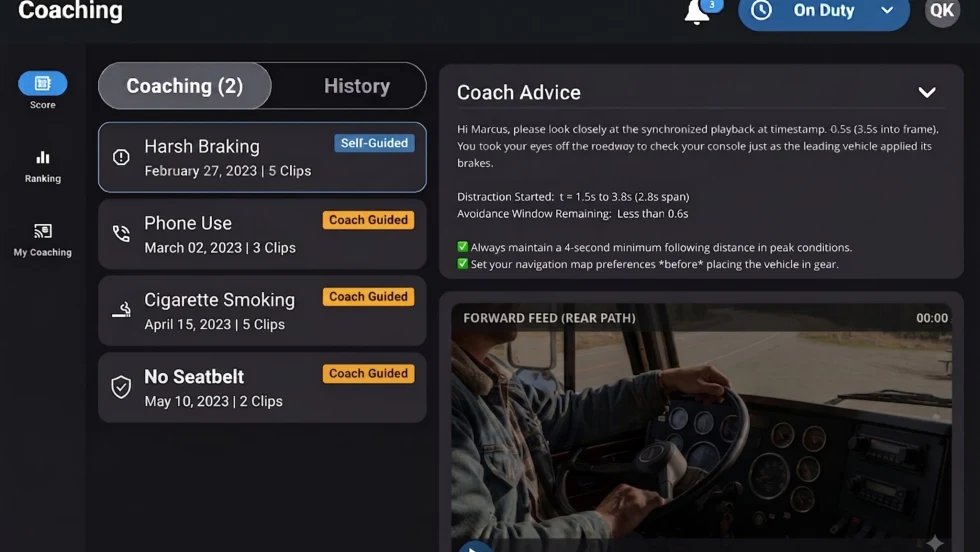
Platform Science Adds Dispatch and Safety Tools
Four additions to PS Fleet help fleets monitor loads, manage driver coaching, share truck locations and adjust video system settings.
Read More →
When Language Stops the Truck: The Return of ELP Out-of-Service Orders
English language proficiency rules for commercial drivers aren’t new, but renewed out-of-service enforcement has raised the stakes. Here’s what carriers need to know before a driver reaches a roadside inspection.
Read More →
Samsara Launches Custom AI Agent Builder
Agent Studio lets fleets create AI tools for hours-of-service monitoring, reporting and driver support, including agents that communicate by phone.
Read More →
Trucker Path Expands Reserved Parking Network
Trucker Path has added close to 6,000 more truck parking spaces to its Trucker Path Reserved Parking Network with the addition of Safe Truck Parking.
Read More →
EEOC Sues Texas Trucking Company Over Driver Age Limits
The agency says Trancasa USA rejected applicants over 65 and applied tougher driving-record standards to those over 60.
Read More →
Nussbaum, Roehl Announce Second Driver Pay Increase This Year
This year has seen a swath of major truck driver pay increases as freight capacity has tightened.
Read More →
From One Generation to the Next: How Mentorship Builds Safer Truck Drivers
After three decades in trucking, Harold Perry shares what he's learned about driver safety, mentorship, and helping the next generation build confidence behind the wheel.
Read More →
Truck Drivers Need More Than Another Alert
Fleets have more visibility into truck health, safety events, and driver activity than ever. The next challenge is turning all that information into useful guidance for the person who has to decide what to do next.
Read More →
FMCSA Removes 110 Truck Driver Training Schools from Certified ELDT List
Federal regulators also are targeting more than 160 additional training providers and launching a nationwide audit of third-party CDL skills testers as part of a broader crackdown on trucking fraud.
Read More →
Hours of Service Pilot Programs: FMCSA Readies for 2027 Rollout
Two pilot programs could eventually reshape hours-of-service rules, giving truck drivers options to pause their 14-hour clock or use longer split sleeper rest periods.
Read More →