




DOT Project to Tackle Supply Chain Visibility
A DOT-led program, Freight Logistics Optimization Works (FLOW), will pilot the exchange of key freight information among the parts of the goods movement supply chain.

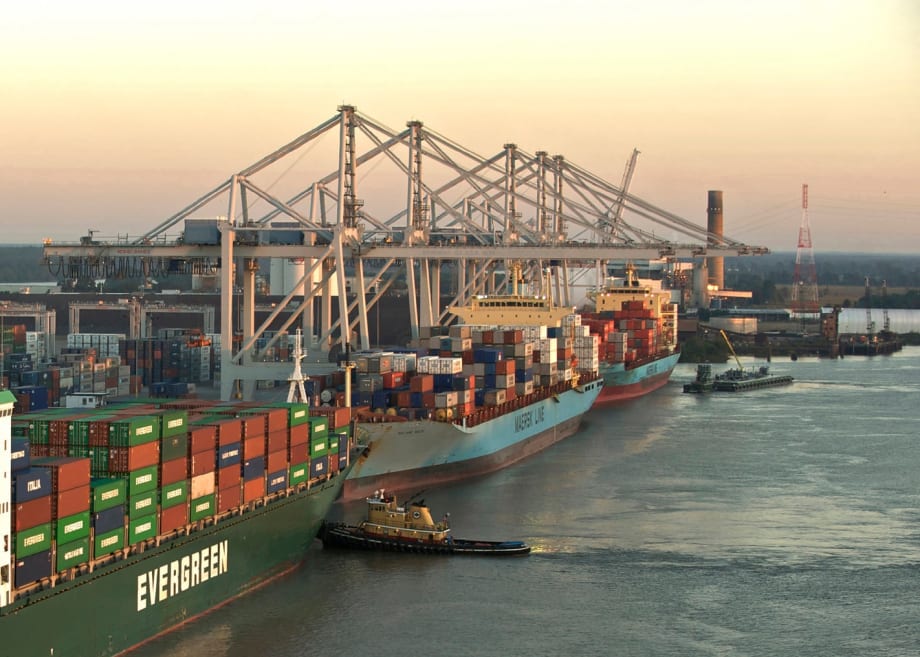
The Georgia Ports Authority is one of the initial partners in the DOT's FLOW supply-chain visibility pilot project.
Photo: Georgia Ports Authority
The transportation and logistics industry has been talking about the need for greater supply-chain visibility for most of the 21st century, although it’s really accelerated in the last few years. Now the federal government is getting into the act as it continues its effort to unsnarl supply chains.
On March 15, the Biden-Harris Administration and U.S. Department of Transportation announced a major initiative to make the supply chain more efficient by making it more transparent.
The DOT-led program, Freight Logistics Optimization Works (FLOW), aims to help speed up delivery times and reduce consumer costs. FLOW will pilot the exchange of key freight information among the parts of the goods movement supply chain.
FLOW builds on the Biden administration’s continued efforts to address supply chain challenges in both the short term and the long term.
“The lack of digital infrastructure and transparency makes our supply chains brittle and unable to adapt when faced with a shock,” explained a White House fact sheet. “The goods movement chain is almost entirely privately operated and spans shipping lines, ports, terminal operators, truckers, railroads, warehouses, and cargo owners such as retailers. These different actors have made great strides in digitizing their own internal operations, but they do not always exchange information with each other. This lack of information exchange can cause delays as cargo moves from one part of the supply chain to another, driving up costs and increasing goods movement fragility.”
In an interview with SiriusXM, Transportation Secretary Pete Buttigieg said, “one of the things we’ve learned … is that there’s a lack of data. Simple data you would assume everyone has. The ability of a company like Target to know exactly when and where its products are in containers. But because there’s so many players involved… that data is not always shared.”
FLOW includes 18 initial participants that represent diverse perspectives across the supply chain, including private businesses, trucking, warehousing, and logistics companies, ports, and more. The plan is to include more partners in the future. This initial phase aims to produce a proof-of-concept freight information exchange by the end of the summer.
Buttigieg explained to SiriusXM’s Julie Mason, “Ultimately what you’ll get is a digital tool, probably in the form of a website. But the intent is not for this to be a large, government owned and operated tool. We’re facilitating this, but it’s really going to come down to the private-sector players sharing.
"A lot of companies are used to holding tight onto their data, but this is not propriety data, trade secrets…. This is information like what’s the last day you can turn a container around and still have it on a ship if you’re exporting something. What’s the warehouse capacity so that a truck driver knows when they can arrive at a warehouse and actually be able to pick something up and drop something off. When are the containers ready at the port? We have a lot of truck drivers who get stuck waiting for hours because they’re not ready at the port to get the specific container that they’re there to pick up.”
An update from Transportation @SecretaryPete Buttigieg on a new WH initiative aimed at communication along the supply chain, and a report from his appearance at the League of Cities, where the other mayors still call him "mayor." https://t.co/Ik0lg9DxNZ via @SiriusXM
— Julie Mason (@juliemason) March 15, 2022
The initial 18 partners in the FLOW project are:
Port authorities:
Port of Long Beach
Port of Los Angeles
Georgia Ports Authority
Ocean carriers:
CMA CGM
MSC
Terminal operators:
Fenix Marine Terminal
Global Container Terminals
Business:
Albertsons
Gemini Shippers
Land O’ Lakes
Target
True Value
Trucking:
CH Robinson
Chassis:
DCLI
FlexiVan
Logistics and warehousing:
FedEx
Prologis
UPS
“Greater transparency — knowing where a vessel or a container is at every stage of transit — would provide the predictability cargo owners and logistics providers need to optimize the use of resources,” said Griff Lynch, executive director of the Georgia Ports Authority, in a statement released by DOT. “Through better communication, aspects of the supply chain such as timing on production, staffing, trucks and chassis, and warehouse space can be fine-tuned for greater efficiency and velocity.”
Within one month of the FLOW launch, DOT will launch a web page to gauge industry interest in participation and data sharing for a potential long-term FLOW effort.
On his Twitter account, Buttigieg said, “Sharing data is key to making the most of the physical infrastructure we have. Meanwhile, we’re also enhancing and adding capacity — and getting creative to help supply chains move quicker.”
More Fleet Management

Color Match Smarter: Tools That Restore & Perform
For fleet managers and collision repair professionals keeping heavy-duty trucks on the road, getting the color right the first time isn't just about appearance — it's about efficiency, turnaround time, and bottom-line results. Discover how today's digital color tools are transforming the repair process from guesswork to precision.
Read More →
FMCSA Pauses Biennial-Update Enforcement Amid Motus Transition
Carriers whose updates were due on or after June 1 have more time, while FMCSA works to stabilize its new registration system and warns of phishing sites impersonating its new carrier registration system, Motus.
Read More →
2026 Blueprint for Countering Smarter Supply Chain Theft
Cargo theft is no longer just the cost of doing business. It's a multi-billion-dollar criminal enterprise exploiting vulnerabilities across your fleet, drivers, and supply chain.
Read More →


How Telematics Improves Visibility, Control, and Performance in Refrigerated Fleets
Explore how telematics help refrigerated fleets improve visibility, uptime, efficiency, compliance, and cargo protection across connected cold chain operations.
Read More →
What the U.S.-Canada Trade War Means for Trucking
Escalating U.S.-Canada tariffs could disrupt cross-border freight, reduce truck volumes, raise costs, and create new uncertainty for carriers on both sides of the border.
Read More →
What Are Trucking’s Top Concerns for 2026?
The American Transportation Research Institute wants to know what's worrying trucking fleet managers, drivers, and other stakeholders in its annual Industry Issues survey.
Read More →
American Trucking Associations Looks for a New Leader
ATA President and CEO Chris Spear abruptly left his job at the association on August 21, at a pivotal time for the trucking industry.
Read More →
Public Wi-Fi Cybersecurity Risks: How Truck Drivers and Fleets Can Protect Their Data
Public Wi-Fi can expose truck drivers and fleets to credential theft, malware, and other cyber threats. Here’s how to reduce the risk on the road.
Read More →
For Nicky Cupp, Fleet Innovation Starts With Frustration
HDT Truck Fleet Innovator Nicky Cupp turns everyday pain points at Fraley & Schilling into opportunities for better technology and smarter processes.
Read More →
Adam Buttgenbach’s Approach to Electric Trucks: Start With Where They Fit
HDT Truck Fleet Innovator Adam Buttgenbach helped PepsiCo build one of North America’s largest EV fleets by focusing on where electric trucks make operational sense.
Read More →