





Related-- Q&A: Anthony Levandowski on the Future of Autonomous Trucks
DOT Aims to Lower Barriers to Autonomous Tech for Trucks and Cars
The National Highway Traffic Safety Administration and the Federal Motor Carrier Safety Administration are seeking public comment on matters related to rolling out autonomous-driving systems.
May 22, 2019
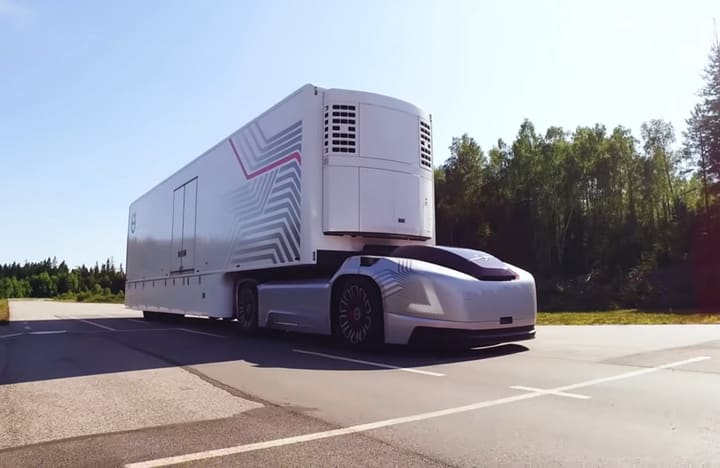
Two pre-rules issued by DOT are calls for public comment on matters related to rolling out autonomous-driving systems for trucks and cars.
Photo: AB Volvo
3 min to read
The Department of Transportation announced on May 22 that it is taking further steps toward removing “unnecessary regulatory barriers to the safe introduction of automated driving systems” on vehicles operating in the U.S.
The separate but related advance notices of proposed rulemaking (aka pre-rules) issued by the National Highway Traffic Safety Administration and the Federal Motor Carrier Safety Administration are calls for public comment on matters related to rolling out autonomous-driving systems “to ensure that all potential approaches are fully considered as the agencies move forward with these regulatory actions.”
It should be noted that descriptive terminology is not codified and eventually either makes its way into daily usage or sinks into obscurity. At this moment, DOT’s use of the term “automated driving systems” seems at least roughly equivalent to “advanced driver assistance systems,” a term widely used by car and truck makers when speaking of safety technologies that automate or partially automate specific vehicle functions to help prevent highway accidents. Both terms imply an embrace of technology that spans the various SAE levels of autonomous driving up to and including full automation (Level 5).
Also bear in mind that NHTSA is largely charged with writing and enforcing Federal Motor Vehicle Safety Standards, which address the crash avoidance, crashworthiness, and post-crash survivability capabilities of new cars and trucks. FMCSA, on the other hand, regulates motor carriers with the goal of reducing crashes, injuries, and fatalities involving large trucks and buses.
“One of the Department’s priorities is to prepare for the future by engaging with new technology while addressing legitimate public concerns about safety, security, and privacy, without hampering innovation,” stated Secretary of Transportation Elaine Chao in a news release.
NHTSA’s pre-rule seeks comment on identifying and addressing regulatory barriers to the deployment of ADS-equipped vehicles posed by certain existing FMVSS. The agency said it is is also interested in hearing from the public on various approaches that could be used to measure compliance with the FMVSS for vehicles that are not equipped with conventional controls, including steering wheels and brake pedals. “Public comments received during this stage will help inform NHTSA’s path forward,” the agency noted.
The pre-rule released by FMCSA seeks public comment on questions related to several regulatory areas to help the agency “better understand how changes to its rules can account for significant differences between human operators and ADS.”
These questions focus on such topics as:
- Requirements of human drivers
- CDL endorsements
- Hours- of -Service rules
- Medical qualifications
- Distracted driving
- Safe driving
- Inspection
- Repair
- Maintenance
- Roadside inspections
- Cybersecurity
FMCSA noted that its pre-rule is part of the process by which the agency is “considering changes to its rules to account for significant differences between human operators and [vehicles with] ADS.”
“FMCSA is hoping to receive feedback from commercial motor vehicle stakeholders and the motoring public on how the agency should adapt its regulations for the development of increased automated driving systems in large trucks and buses,” said FMCSA Administrator Ray Martinez.
“We know that while many of these technologies are still in development, it is critical that we carefully examine how to make federal rules keep up with this advancing technology,” he added.
Both notices list a 60-day comment period, which will commence with publication of the ANPRMs in the Federal Register. The public is strongly encouraged to submit their comments to the Federal Register dockets.
An advance copy of the FMCSA document is available here.
More Safety & Compliance

FMCSA Pauses Biennial-Update Enforcement Amid Motus Transition
Carriers whose updates were due on or after June 1 have more time, while FMCSA works to stabilize its new registration system and warns of phishing sites impersonating its new carrier registration system, Motus.
Read More →
ZF Expands Commercial Vehicle Push in North America
ZF is expanding its North American commercial-vehicle presence with new transmission applications, electrification, trailer technology and autonomous-driving systems.
Read More →
Truck Drivers Need More Than Another Alert
Fleets have more visibility into truck health, safety events, and driver activity than ever. The next challenge is turning all that information into useful guidance for the person who has to decide what to do next.
Read More →
Tesla Wants a Self-Driving Semi. Are Cameras Enough?
Could Tesla’s camera-only autonomous driving technology work on an 80,000-pound Semi? In this commentary, HDT's Deborah Lockridge takes a look at Tesla, Cybercab, and how autonomous trucks see the road.
Read More →
What DOT’s Automated Vehicle Strategy Means for Trucking
The U.S. Department of Transportation issued a new automated-vehicle strategy that outlines plans for driverless-truck regulations, cross-state freight corridors, and federal safety standards.
Read More →
NYC Expands Speed, Pedestrian Safety Tech Across Fleet
New York City is expanding intelligent speed assistance and pedestrian-alert systems across its municipal fleet, moving the technologies from pilot programs into vehicle procurement and retrofit requirements.
Read More →
FMCSA Removes 110 Truck Driver Training Schools from Certified ELDT List
Federal regulators also are targeting more than 160 additional training providers and launching a nationwide audit of third-party CDL skills testers as part of a broader crackdown on trucking fraud.
Read More →
Beyond DOT Compliance: What Makes a Trucking Fleet Truly Safe?
A trucking fleet can follow every rule and still make unsafe decisions. The real test comes when safety conflicts with freight, productivity, or cost.
Read More →
Hours of Service Pilot Programs: FMCSA Readies for 2027 Rollout
Two pilot programs could eventually reshape hours-of-service rules, giving truck drivers options to pause their 14-hour clock or use longer split sleeper rest periods.
Read More →
New Guide Offers Pet Safety Tips for Truck Drivers
Hundreds of thousands of pets travel in truck cabs. A new safety guide from Volvo Trucks and the Center for Pet Safety offers practical advice for truck drivers who bring dogs and cats along for the ride.
Read More →