




Don't Worry About the Economy, Says ATA's Chief Economist
Don’t worry about some signs of the economy softening in recent months, Bob Costello, chief economist for the American Trucking Associations, told trucking executives during the American Trucking Associations’ annual Management Conference and Exhibition.
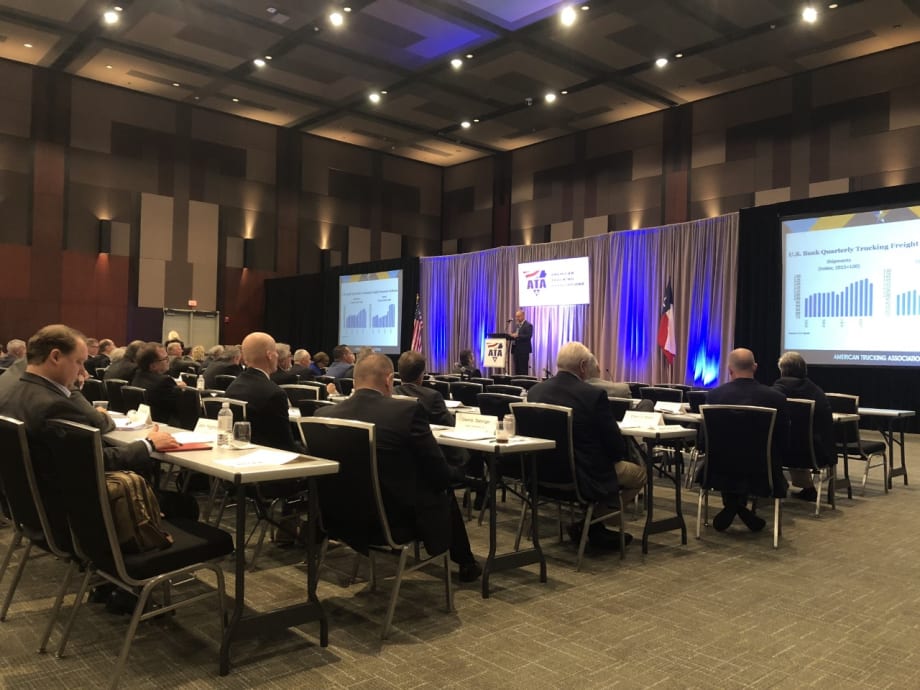
American Trucking Associations Chief Economist Bob Costello offered an economic update as part of the board of directors meeting at the Management Conference and Exhibition.
Photo by John G. Smith (courtesy Today's Trucking)
Don’t worry about some signs of the economy softening in recent months, Bob Costello, chief economist for the American Trucking Associations, told trucking executives during the American Trucking Associations’ annual Management Conference and Exhibition. He’s confident that the second-longest economic expansion in U.S. history will continue.
“There’s no reason to worry,” he said. “We are going to see a deceleration both in our industry and the economy, but deceleration doesn’t mean decrease.”
Several trends support his optimism.
“The labor market is strong,” he said as an example. There were 200,000 jobs created every month over the last 12 months, and September’s unemployment rate dropped to levels not seen since 1969. “There are more job openings today in the economy than there are unemployed people,” he said. “We have never seen this.”
That doesn’t mean everyone is ready to work. Available skills don’t always match up with the openings.
This year, salaries and wages are also expected to grow 3.1%, marking the first such boost in this economic cycle. “That translates into more spending,” he said. Spending on goods is expected to grow 3.5% next year, with holiday sales for this year expected to increase 4.1%
Construction activity is strong, too. This year, 1.3 million new homes were built in the U.S. – the most since 2007. “Of course, when I say that everyone panics,” Costello said. But he reminded the crowd that the country was building 2 million new homes a year before the great recession, when a housing bubble came to the fore.
Factory-related spending is increasing as well. Costello sees the new U.S.-Mexico-Canada Agreement (USMCA) that is intended to replace the North American Free Trade Agreement as a positive, and he hopes the trade deal will be passed.
“Inventory levels throughout the supply chain are no longer a drag on freight volumes,” Costello added. Online purchases continue to demand more products to be stored near consumers. “We’ve seen an explosion of warehouses across the country,” he said.
Retail diesel prices are expected to remain flat this year, but Costello warned about a January 2020 change, when the international maritime organization will cap sulfur levels for oil-carrying ships. “That is likely to put upward pressure on the prices of our diesel,” he said.
While truck sales are hot, they don’t seem to have added to capacity. “This is a replacement cycle, for a large part because you can’t find enough drivers,” Costello said. “Employment numbers are rising, but it doesn’t mean capacity is rising.”
John G. Smith is the editor of the award-winning Canadian publication Today's Trucking. This article was adapted under a cooperative editorial sharing agreement between HDT and its Canadian counterpart.
More Fleet Management

Why Private Fleets Are Taking More Freight
Private fleets are putting their own trucks on demanding customers and high-cost lanes as companies seek greater control over service, costs, and capacity.
Read More →
Color Match Smarter: Tools That Restore & Perform
For fleet managers and collision repair professionals keeping heavy-duty trucks on the road, getting the color right the first time isn't just about appearance — it's about efficiency, turnaround time, and bottom-line results. Discover how today's digital color tools are transforming the repair process from guesswork to precision.
Read More →
FMCSA Pauses Biennial-Update Enforcement Amid Motus Transition
Carriers whose updates were due on or after June 1 have more time, while FMCSA works to stabilize its new registration system and warns of phishing sites impersonating its new carrier registration system, Motus.
Read More →


2026 Blueprint for Countering Smarter Supply Chain Theft
Cargo theft is no longer just the cost of doing business. It's a multi-billion-dollar criminal enterprise exploiting vulnerabilities across your fleet, drivers, and supply chain.
Read More →
How Telematics Improves Visibility, Control, and Performance in Refrigerated Fleets
Explore how telematics help refrigerated fleets improve visibility, uptime, efficiency, compliance, and cargo protection across connected cold chain operations.
Read More →
What the U.S.-Canada Trade War Means for Trucking
Escalating U.S.-Canada tariffs could disrupt cross-border freight, reduce truck volumes, raise costs, and create new uncertainty for carriers on both sides of the border.
Read More →
What Are Trucking’s Top Concerns for 2026?
The American Transportation Research Institute wants to know what's worrying trucking fleet managers, drivers, and other stakeholders in its annual Industry Issues survey.
Read More →
American Trucking Associations Looks for a New Leader
ATA President and CEO Chris Spear abruptly left his job at the association on August 21, at a pivotal time for the trucking industry.
Read More →
Public Wi-Fi Cybersecurity Risks: How Truck Drivers and Fleets Can Protect Their Data
Public Wi-Fi can expose truck drivers and fleets to credential theft, malware, and other cyber threats. Here’s how to reduce the risk on the road.
Read More →
For Nicky Cupp, Fleet Innovation Starts With Frustration
HDT Truck Fleet Innovator Nicky Cupp turns everyday pain points at Fraley & Schilling into opportunities for better technology and smarter processes.
Read More →