




Doleco Brings New Double-Decking Option to Market
Doleco USA introduced a double-decking systems for trailers and containers that can allow fleets to double payload capacity, and which Doleco said has advantages over existing systems in the market.

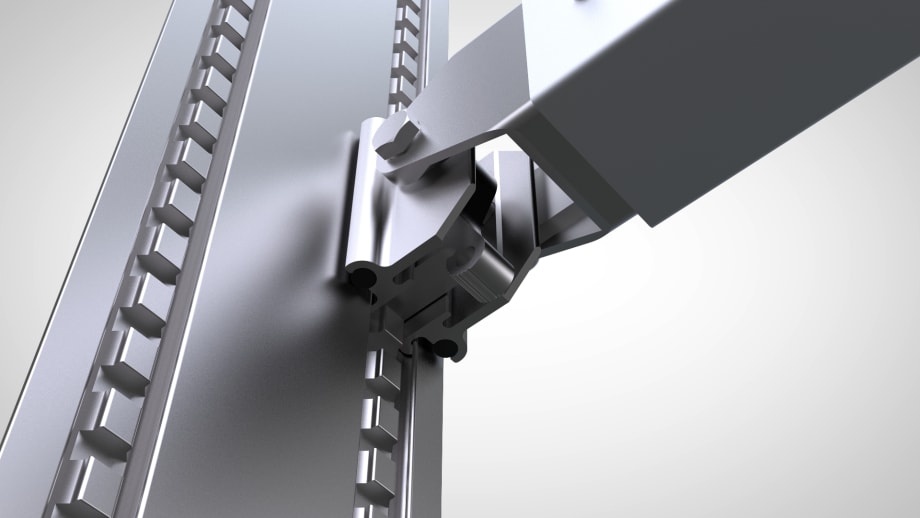
The LayerLok XP features a “radically different” machined aluminum track design, according to Doleco.
Photo: Doleco USA
Doleco USA introduced a double-decking systems for trailers and containers that can allow fleets to double payload capacity, and which the company said has advantages over existing systems in the market.
During the ATA's Technology & Maintenance Council’s annual meeting in Cleveland, Ohio, Doleco officials announced the new LayerLok XP, AF and SC decking systems. The LayerLok XP and AF are engineered for use in dry van and reefer applications. The LayerLok SC is specifically designed for installation in shipping containers.
With new-trailer orders heavily backlogged, fleets are looking for ways to improve efficiency. Double-decking systems have been around for almost three decades, but Doleco officials contend that popular systems are based on aircraft seating track, which they say was never designed for repetitive sliding or to carry vertical loads.
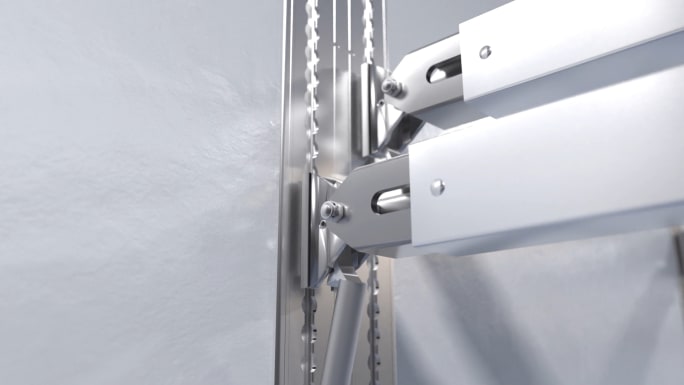
LayerLok AF tracks and decking beams are interchangeable with competing systems.
Photo: Doleco USA
“The LayerLok XP, AF and SC double-decking systems are each purpose-designed and precision-engineered to meet the harsh demands of the shipping environment,” said Ralph Abato, president and managing director of Doleco USA. “The entry of a new major competitor, like Doleco, into the North America marketplace, will expand customer options and renew competitive vigor within the load securement industry generally, and within the double-decking segment specifically.”
All “captive” LayerLok systems never leave the trailer and can be stowed at ceiling height when not in use. While different in design, each of the three systems has been optimized to minimize material use and weight, while maximizing strength and durability.
The LayerLok XP system is made of proprietary materials that have a higher strength-to-weight ratio than competing products, allowing it to be designed with the thinnest track profiles in the world, according to the company.
LayerLok XP
The LayerLok XP features a “radically different” machined aluminum track design, with beveled teeth instead of holes or slots, said Doleco officials. The system’s steel head assembly and beam adjustment tool both glide seamlessly within recessed slots on either side of the teeth, virtually eliminating the snag points common to other systems, according to the company.
Optional, cushioned head assemblies enable the system to operate at just 60 decibels.
The LayerLok XP can also be configured with interconnecting horizontal tracks that use turntable intersections, enabling decking beams to seamlessly switch from vertical to horizontal travel. The unique feature allows users to accommodate a wider array of cargo capacity and securement needs, by letting decking beams serve double duty as shoring beams when needed.
LayerLok AF
The LayerLok AF is designed as an "intelligent alternative" to the most common aircraft-track-based systems and is modeled on a complementary design. Its tracks and decking beams are interchangeable with competing systems. Single-and double-track styles with surface-mount and semi-recessed versions are also available.
“LayerLok AF is designed as a universal solution for trailer OEMs and fleets that are comfortable with the status quo, but less comfortable with the lack of competitive sourcing and pricing for aircraft-track systems,” said Abato.
LayerLok SC
The LayerLok SC is designed for use in 20- and 40-foot shipping container applications. The steel tracks are engineered to be welded into position within the container body. In addition to optimizing container capacity, the LayerLok SC helps protect cargo and maintain its stability during intermodal transfers.
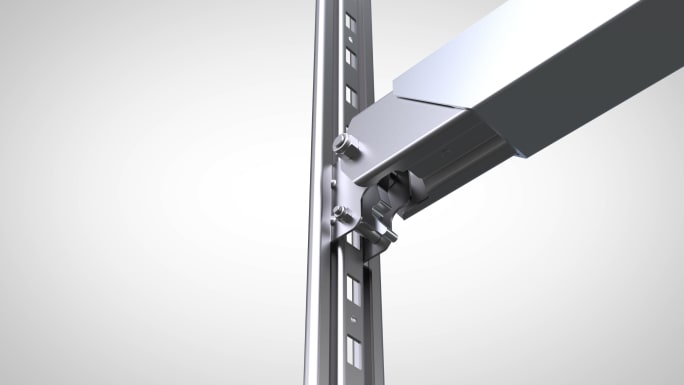
The LayerLok SC is designed for use in 20- and 40-foot shipping container applications.
Photo: Doleco USA
LayerLok XP, AF and SC were developed by The Netherlands-based LoadLok. LayerLok has been in use throughout Europe for more than 15 years and is already available in 42 countries worldwide. Through an agreement with LoadLok, Doleco is now the exclusive North American distributer and co-manufacturer of the LayerLok XP, AF and SC.
At TMC, Doleco announced it will give a "free" system to any qualifying fleet.
Textile chains
Doleco officials also showed off the DoNova PowerLash Textile Lashing Chain and PowerLift textile Chain Sling. These textile chains, introduced to the U.S. in 2018, consist of high-performance webbing made with Dyneema to create a chain that is as strong as steel and 85% lighter, according to the company.
The DoNova textile chain, which can be used as a traditional lashing or lifting chain, is a multilayered redundant system which is abrasion and cut-resistant. When used as a lashing chain, the DoNova PowerLash is as powerful as a 13mm grade 80 steel chain, with a lashing working load limit of 22,000 pounds.
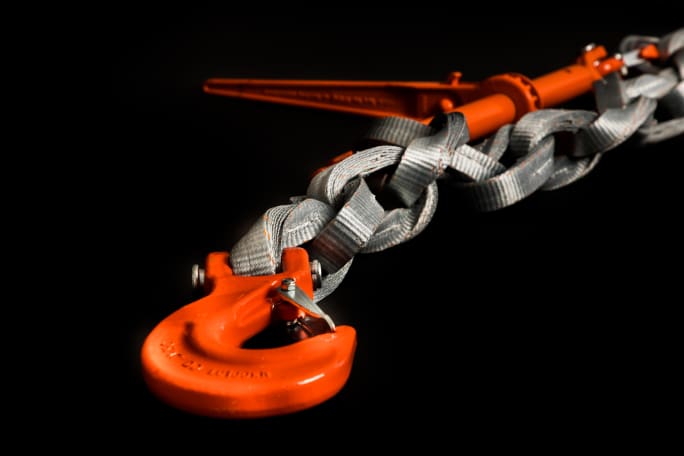
DoNova PowerLash Textile Lashing Chain
Photo: Doleco USA
Because they are so much lighter than traditional chains, they help with fuel savings, and the light weight and flexibility are easier and safer for operators to handle.
Incorporated in 2013, Doleco USA is a cargo securement, optimization and protection supplier in the United States. Doleco is a subsidiary of Dolezych GMBH, a German manufacturer and supplier of lifting equipment, slings, ropes and load-securing technologies, including the DoNova PowerLash Textile Lashing Chain and PowerLift textile Chain Slings.
More Equipment

How Volvo Updated Its D13 for EPA 2027 [Watch]
Volvo’s updated D13 promises lower emissions without sacrificing performance or fuel economy. Take a closer look at what changed inside the engine in this HDT Spotlight video.
Read More →
Michelin Tire Improves Efficiency and Durability for Regional Fleets
The Michelin X Multi Energy D2 is a regional haul drive tire engineered to help fleets improve fuel efficiency, durability and traction in demanding stop-and-go operations.
Read More →
ZF Expands Commercial Vehicle Push in North America
ZF is expanding its North American commercial-vehicle presence with new transmission applications, electrification, trailer technology and autonomous-driving systems.
Read More →
Tesla Wants a Self-Driving Semi. Are Cameras Enough?
Could Tesla’s camera-only autonomous driving technology work on an 80,000-pound Semi? In this commentary, HDT's Deborah Lockridge takes a look at Tesla, Cybercab, and how autonomous trucks see the road.
Read More →
Kodiak: Driverless Long-Haul Truck Launch on Track for 2026
Kodiak AI says its driverless long-haul safety case is 93% complete and it remains on track to begin commercial operations by year-end 2026.
Read More →
What DOT’s Automated Vehicle Strategy Means for Trucking
The U.S. Department of Transportation issued a new automated-vehicle strategy that outlines plans for driverless-truck regulations, cross-state freight corridors, and federal safety standards.
Read More →
East Coast Port Launches $45M Electric Truck Push
The Port Authority of New York and New Jersey announced millions in incentives for zero-emission drayage trucks, yard tractors, and new charging hubs near the port.
Read More →
PlusAI Going Public to Fund Autonomous Truck Launch
A SPAC deal could provide PlusAI with up to $300 million as it works toward a 2027 commercial launch of factory-built autonomous trucks.
Read More →
NHTSA Moves to Rewrite Truck Fuel-Economy Rules
The National Highway Traffic Safety Administration says it lacks authority to regulate medium- and heavy-duty truck engines separately from complete vehicles, but the existing standards have not yet been eliminated.
Read More →
Detroit Opens Orders for EPA 2027 Engines
Detroit isn’t starting from scratch to meet EPA 2027 diesel emissions standards. Its Gen 6 DD13 and DD15 engines keep much of today’s platform while updating the fuel and aftertreatment systems.
Read More →