




DOE: Diesel to Average $2.85 in 2015
In the wake of diesel prices falling from an average of more than $4 per gallon nearly a year ago the U.S. Energy Department's Energy Information Administration has lowered its price forecast from last month’s prediction.

In the wake of diesel prices falling from an average of more than $4 per gallon nearly a year ago the U.S. Energy Department's Energy Information Administration has lowered its price forecast from last month’s prediction.
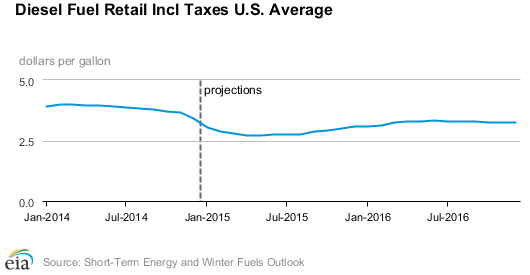
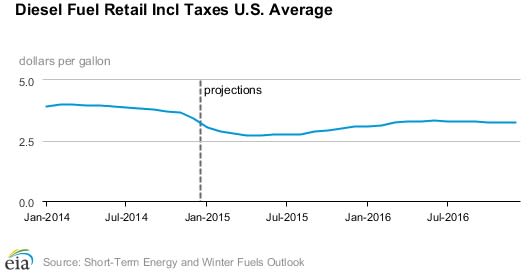
The new Short Term Energy Outlook calls for trucking’s main fuel to average $2.85 per gallon in 2015, 22 cents less that what it said it was expecting a month ago. This compares to an average diesel price of $3.83 last year. However, its first look into 2016 forecasts diesel to rebound at $3.25 per gallon.
The current weekly average for diesel is just over $3.05 per gallon per gallon, its lowest price since October 2010.
In the first quarter of 2015, diesel is expected to average $2.90, falling even more into the second quarter, averaging $2.71, before turning around in the third quarter with an average of $2.79. It should head even higher into the final quarter with an average of $2.99.
DOE projects 2016 prices to average $3.15 in the first quarter, peaking in the second or third quarter at around $3.30, before declining slightly in the final quarter at an average of $3.25.
Regular grade gasoline, which averaged $3.36 in 2014, is forecast to average $2.33 this year, 27 cents less than the outlook a month earlier, and $2.72 in 2016. The currently weekly average is nearly $2.14, its lowest price since May 2009.
Not surprisingly, the expectations are due to the price of oil, which is down from just over $107 in June to less than $50 per barrel this week.
EIA forecasts that Brent crude oil prices will average $58 per barrel in 2015 and $75 per barrel in 2016, with annual West Texas Intermediate prices expected to average $55 per barrel this year, $8 less than last month’s outlook, and $71 in 2016.
It warns because of the current values of futures and options contracts there is very high uncertainty in the price outlook.
Part of the reason for expected lower crude prices is that U.S. oil production is projected to increase. Total U.S. crude oil production averaged an estimated 9.2 million barrels per day in December, according to EIA. Forecast total crude oil production should 9.3 million barrel per day in 2015, followed by 9.5 million barrels per day in 2016, which would be the second-highest annual average level of production in U.S. history. The highest was 9.6 million barrels per day in 1970. This is expected to be offset by cuts in crude oil production overseas.
The forecast for oil is above a new report from the investment firm Goldman Sachs, predicting crude could go as low as $40 per barrel in the first half of this year, with Brent and WTI crude averaging around $50 and $47, respectively in 2015. That’s way down from an earlier forecast of nearly $84 for Brent and almost $74 for WTI. For 2016, it sees Brent at $70 and WTI at $65, down from earlier projections of $90 and $80, respectively.
It's also worth noting oil investor and Saudi Prince Alwaleed bin Tala this week told USA Today he believes the days of $100 a barrel oil are gone forever, due to less demand and an oversupply of crude. His remarks are similar to those last month by Ali al-Naimi, the Saudi oil minister, who said $100 plus crude may also be a thing of the past.
More Fuel Smarts

How Volvo Updated Its D13 for EPA 2027 [Watch]
Volvo’s updated D13 promises lower emissions without sacrificing performance or fuel economy. Take a closer look at what changed inside the engine in this HDT Spotlight video.
Read More →
Diesel Price Spike Shortens Payback for Natural Gas Trucks, Report Says
Energy Vision estimates fleets could recover the higher purchase price of an RNG-fueled Class 8 tractor in 1.3 to 2.8 years under current fuel-price scenarios.
Read More →
Calstart Becomes Catalyst Mobility, Reflecting Broader Focus
Calstart is now Catalyst Mobility, reflecting the nonprofit’s growing national role in clean transportation, including zero-emission trucks, infrastructure and incentive programs.
Read More →

Record Diesel Prices Squeeze Trucking Fleets
Average U.S. diesel prices have climbed to nearly $6 a gallon, surpassing the 2022 record as tight refinery capacity and Middle East disruptions keep fuel costs elevated.
Read More →
How Fuel Delivery Shapes Engine Performance
Fuel delivery depends on more than what happens at the injector. For fleet, maintenance and technical professionals, looking at the full path from pump to injector can provide useful context for understanding engine performance.
Read More →
East Coast Port Launches $45M Electric Truck Push
The Port Authority of New York and New Jersey announced millions in incentives for zero-emission drayage trucks, yard tractors, and new charging hubs near the port.
Read More →
California Bill Could Shed Light on Electric Truck Prices
Why do battery-electric Class 8 trucks remain so expensive? A California bill headed to Gov. Gavin Newsom would give fleets and state agencies more visibility into what manufacturers charge.
Read More →
Detroit Opens Orders for EPA 2027 Engines
Detroit isn’t starting from scratch to meet EPA 2027 diesel emissions standards. Its Gen 6 DD13 and DD15 engines keep much of today’s platform while updating the fuel and aftertreatment systems.
Read More →
Zero-Emission Truck Corridor Planned for West Coast
California, Oregon, Washington, British Columbia and Baja California are coordinating plans for truck charging and hydrogen fueling from Canada to Mexico.
Read More →
A Closer Look at Kenworth’s Electric T880E Vocational Truck [Video]
Learn more about Kenworth's T880E battery-electric vocational truck at the Paccar Technical Center, including its range, applications, upfitting considerations, and PTO options, in this HDT Spotlight video.
Read More →