




Related: Business Investment Sinks as Durable Orders Decline
Diesel Prices Plateau While Oil Markets Evaluate Brexit
The price of diesel fuel remained relatively unchanged for the third straight week and the energy markets are still feeling the effects from the United Kingdom’s vote to leave the European Union.
by Staff
July 5, 2016
2 min to read
Source: EIA
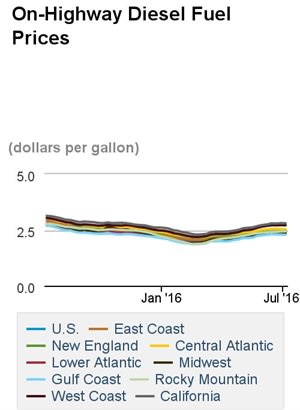
The price of diesel fuel remained relatively unchanged for the third straight week and the energy markets are still feeling the effects from the United Kingdom’s vote to leave the European Union, according to the latest numbers from the Energy Department.
The average price of on-highway diesel fuel dropped by 0.3 cents last week, settling at $2.423 per gallon. The price is 40.9 cents than it was in the same week a year ago.
There are usually significant differences in fuel price fluctuations region to region but prices were slightly down in nearly all areas. The largest decrease in prices was in the New England region at 0.9 cents per gallon while the largest increase in prices was 0.7 cents in the Rocky Mountain region.
The average national price of regular gasoline was down last week by 3.8 cents, hitting $2.291 per gallon. The current average price is 50.2 cents cheaper than it was in the same a week in 2015.
When separated by region, the largest decrease in prices was in the Midwest with an 8.3-cent drop for the week. The smallest change in prices were on the West Coast where prices fell 0.5 cents.
The price of crude oil was down on July 5 as energy prices have felt the effects of the UK’s vote to leave the EU, according to a CNBC report. The worry is that the, economic downturn in the UK would slow the global economy, reducing demand for oil.
While oil prices had been steadily rising for the past few months on news that oil producers would be reducing the supply of oil, a slower economy could prevent the prices from continuing to increase.
More Fleet Management

Why Private Fleets Are Taking More Freight
Private fleets are putting their own trucks on demanding customers and high-cost lanes as companies seek greater control over service, costs, and capacity.
Read More →
Sponsored•September 16, 2026
Color Match Smarter: Tools That Restore & Perform
For fleet managers and collision repair professionals keeping heavy-duty trucks on the road, getting the color right the first time isn't just about appearance — it's about efficiency, turnaround time, and bottom-line results. Discover how today's digital color tools are transforming the repair process from guesswork to precision.
Read More →
FMCSA Pauses Biennial-Update Enforcement Amid Motus Transition
Carriers whose updates were due on or after June 1 have more time, while FMCSA works to stabilize its new registration system and warns of phishing sites impersonating its new carrier registration system, Motus.
Read More →


Sponsored•September 14, 2026
2026 Blueprint for Countering Smarter Supply Chain Theft
Cargo theft is no longer just the cost of doing business. It's a multi-billion-dollar criminal enterprise exploiting vulnerabilities across your fleet, drivers, and supply chain.
Read More →
Sponsored•September 1, 2026
How Telematics Improves Visibility, Control, and Performance in Refrigerated Fleets
Explore how telematics help refrigerated fleets improve visibility, uptime, efficiency, compliance, and cargo protection across connected cold chain operations.
Read More →
What the U.S.-Canada Trade War Means for Trucking
Escalating U.S.-Canada tariffs could disrupt cross-border freight, reduce truck volumes, raise costs, and create new uncertainty for carriers on both sides of the border.
Read More →
What Are Trucking’s Top Concerns for 2026?
The American Transportation Research Institute wants to know what's worrying trucking fleet managers, drivers, and other stakeholders in its annual Industry Issues survey.
Read More →
American Trucking Associations Looks for a New Leader
ATA President and CEO Chris Spear abruptly left his job at the association on August 21, at a pivotal time for the trucking industry.
Read More →
Public Wi-Fi Cybersecurity Risks: How Truck Drivers and Fleets Can Protect Their Data
Public Wi-Fi can expose truck drivers and fleets to credential theft, malware, and other cyber threats. Here’s how to reduce the risk on the road.
Read More →
For Nicky Cupp, Fleet Innovation Starts With Frustration
HDT Truck Fleet Innovator Nicky Cupp turns everyday pain points at Fraley & Schilling into opportunities for better technology and smarter processes.
Read More →