




Diesel Price Falls to Lowest Level in 5+ Years
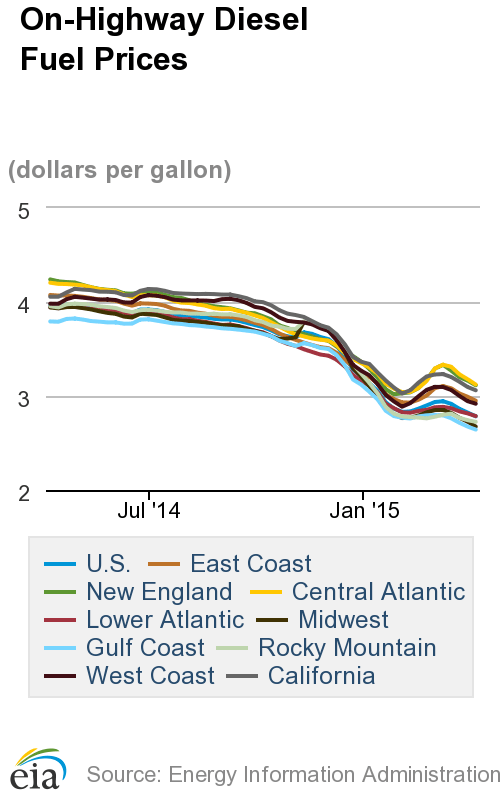
On-highway diesel prices are continuing with their recent round of declines with the national average falling again over the past week and hitting its lowest level since February 2010.

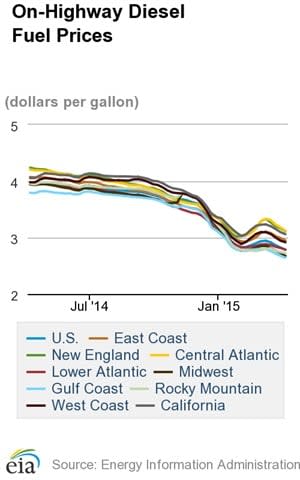
On-highway diesel prices are continuing with their recent round of declines with the national average falling again over the past week and hitting its lowest level since February 2010.
According to the U.S. Energy Department it has fallen for the fourth straight week, hitting $2.784 per gallon this week, 4 cents less than it was a week ago. Compared to the same week last year the price is $1.175 less.
Prices fell in all the different sections of the country, ranging from 1.8 cent in Rocky Mountain region for an average of $2.725, to as much as 5.7 cents in the Central Atlantic states for an average of $3.122 per gallon, also the highest priced part of the country.
The least expensive average diesel price is in the Gulf Coast region at $2.643, down 3.2 cents from last week.
Compared to the same time a year ago prices in the different sections of the country are at least $1.064 less.
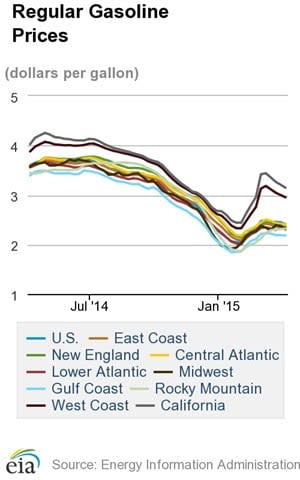
The average cost of regular grade gasoline also fell over the past week, shedding 3.5 cents, for $2.413. Compared to this time in 2014, the average cost is $1.183 less.
Regionally, the only price increase was in the Rocky Mountains, where it added 0.6 cent from last week for an average of $2.319.
Gasoline ranges from a low of $2.183 in the Gulf Coast region to a high of $2.954 in the West Coast region.
This happened as the price of crude oil on Monday increased $3 by the close of trading in New York, settling at $52.14 per barrel, amid recent signs demand for the black gold in increasing in the U.S. and Asia while stockpiles in the U.S. are falling from historic highs. Compared to last Tuesday’s opening price it is up by $3.68 per barrel.
More Fuel Smarts

California Bill Could Shed Light on Electric Truck Prices
Why do battery-electric Class 8 trucks remain so expensive? A California bill headed to Gov. Gavin Newsom would give fleets and state agencies more visibility into what manufacturers charge.
Read More →
Detroit Opens Orders for EPA 2027 Engines
Detroit isn’t starting from scratch to meet EPA 2027 diesel emissions standards. Its Gen 6 DD13 and DD15 engines keep much of today’s platform while updating the fuel and aftertreatment systems.
Read More →
Zero-Emission Truck Corridor Planned for West Coast
California, Oregon, Washington, British Columbia and Baja California are coordinating plans for truck charging and hydrogen fueling from Canada to Mexico.
Read More →
A Closer Look at Kenworth’s Electric T880E Vocational Truck [Video]
Learn more about Kenworth's T880E battery-electric vocational truck at the Paccar Technical Center, including its range, applications, upfitting considerations, and PTO options, in this HDT Spotlight video.
Read More →
Kenworth T880E Brings EV Power to Vocational Trucks
A closer look at the Kenworth T880E’s range, charging, powertrain and upfit options — and where fleets are showing the most interest.
Read More →
Jennie Abarca Is Proving Electric Trucks Can Do the Job
HDT Truck Fleet Innovator Jennie Abarca is building confidence in fleet electrification one load at a time while openly sharing the challenges she encounters along the way as a small-fleet owner.
Read More →
Cummins Adjusts 2027 Engine Rollout After EPA Proposal
The engine maker will gradually introduce its new Model Year 2027 diesel engines while continuing to offer current models during the transition, citing the EPA's proposed emissions rule changes.
Read More →
EPA Proposal Could Ease 2027 Truck Costs and Buying Uncertainty
The proposal doesn't change the tougher NOx standard, but it would revise key implementation requirements that manufacturers say have driven up costs and complicated fleet purchasing decisions.
Read More →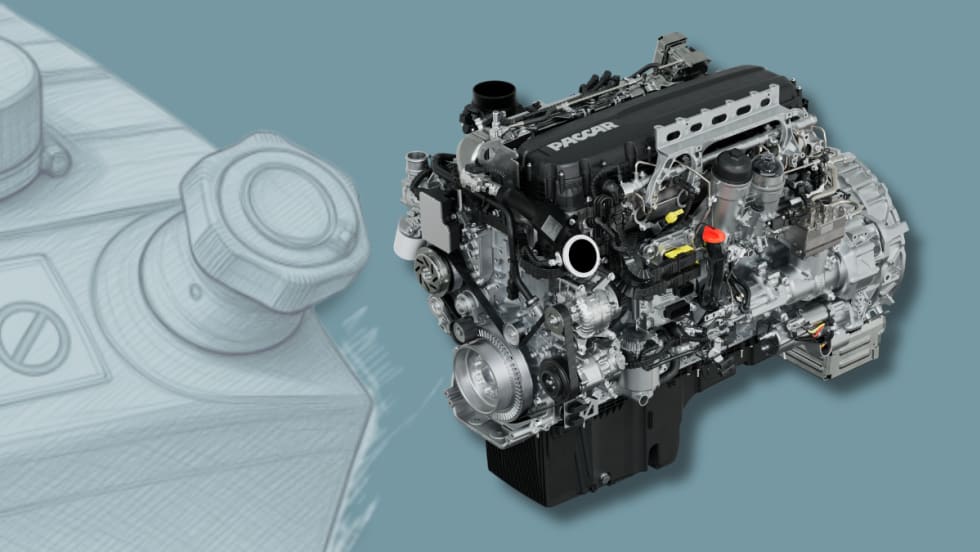
Cummins, Paccar Ease DEF Derates After EPA Guidance
Updated diesel engine software gives truck operators more time to address emissions-system issues while staying compliant with EPA emissions standards.
Read More →
Maintenance in the Messy Middle Part 3: Biodiesel
Biodiesel can reduce emissions, improve fuel-system lubricity and use existing diesel infrastructure. But NACFE’s Messy Middle maintenance report says fleets must actively manage storage, cold-weather operation, filters and oil drain intervals to avoid problems.
Read More →