




Diesel, Gasoline and Oil Prices Expected to Move Lower
Diesel prices this year are expected to average slightly less than they were last year and continue moving lower next year, according to a new forecast.

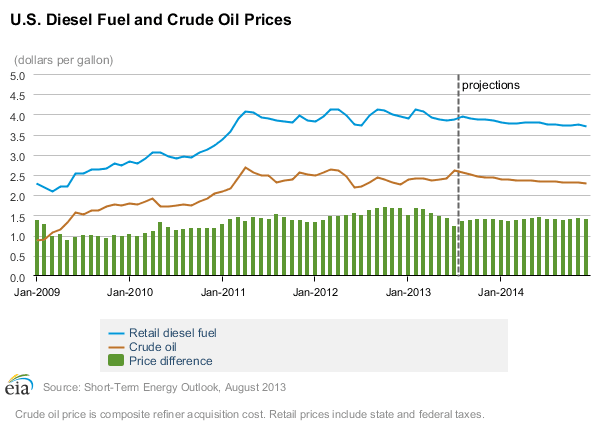
Credit: DOE/EIA.
Diesel prices this year are expected to average slightly less than they were last year and continue moving lower next year, according to a new forecast.
The U.S. Energy Department and its Energy Information Administration’s new Short-Term Energy Outlook says the fuel, which was $3.97 per gallon in 2012, is projected to average $3.92 per gallon in 2013 and $3.76 per gallon in 2014. The expectation for this year is 4 cents higher than last month’s forecast but remains the same for 2014.

At the retail level, EIA expects diesel fuel prices to be most affected by higher biodiesel blending yields. On Tuesday the U.S. Environmental Protection Agency finalized an earlier proposal requiring that 2.75 billion gallons of advanced biofuel, such a biodiesel, be blended into the U.S. fuel supply this year.
Gasoline Prices
EIA expects the regular gasoline retail price to average $3.59 per gallon in the third quarter of 2013, and the annual average price to decline from an average of $3.63 per gallon in 2012 to $3.52 per gallon in 2013 and to $3.37 per gallon in 2014.
It notes U.S. regular gasoline retail prices increased from an average of $3.50 per gallon to $3.68 per gallon over the first three weeks of July. Prices have declined over the past two weeks, reaching $3.63 per gallon on August 5. Isolated refinery outages and regional disruptions have contributed to greater volatility in regional gasoline prices across the United States this year. Some of the greatest volatility was again seen across the Midwest. EIA expects gasoline prices to slowly fall from their mid-July levels as crude oil prices begin to fall and the summer driving season comes to a close.
Oil Prices
EIA expects that the Brent crude oil spot price, which averaged $108 per barrel over the first half of 2013, will average $104 per barrel over the second half of 2013, and $100 per barrel in 2014.
After averaging $94 per barrel in 2012 and increasing to $105 per barrel in July 2013, the forecast West Texas Intermediate crude oil spot price averages $97 per barrel in 2013 and $93 per barrel in 2014. By 2014, several pipeline projects from the midcontinent to the Gulf Coast refining centers are expected to come on line, reducing the cost of transporting crude oil to refiners, which is reflected in a narrowing in the WTI price discount to Brent next year.
The full report is available from the DOE/EIA webiste.
More Drivers

Truck Drivers Need More Than Another Alert
Fleets have more visibility into truck health, safety events, and driver activity than ever. The next challenge is turning all that information into useful guidance for the person who has to decide what to do next.
Read More →
FMCSA Removes 110 Truck Driver Training Schools from Certified ELDT List
Federal regulators also are targeting more than 160 additional training providers and launching a nationwide audit of third-party CDL skills testers as part of a broader crackdown on trucking fraud.
Read More →
Hours of Service Pilot Programs: FMCSA Readies for 2027 Rollout
Two pilot programs could eventually reshape hours-of-service rules, giving truck drivers options to pause their 14-hour clock or use longer split sleeper rest periods.
Read More →
Medical Cards, English Proficiency Reshape Roadcheck Violations
Medical-card violations jumped to the top of the driver out-of-service list during CVSA’s 2026 International Roadcheck, while English-language proficiency violations appeared among the leading violations for the first time.
Read More →
Driver Trust Can Make or Break the Success of Fleet Safety Technology
New Teletrac Navman research suggests that onboarding, transparency about driver data, and positive feedback can play a significant role in how commercial drivers respond to safety and coaching technology.
Read More →
EEOC Sues KLLM Over Alleged Sex Discrimination in Driver Training
KLLM is facing a federal sex-discrimination lawsuit over policies the EEOC alleges put female truck driver trainees at a disadvantage.
Read More →
FMCSA Moves to Codify English Language Requirements for Commercial Drivers
By changing regulations on English-language proficiency requirements for commercial drivers, rather than relying on a guidance memo, the FMCSA said future administrations won't be able to walk back the Trump administration's stricter enforcement with just a memo.
Read More →
Drivers Put Western Star Trucks to the Test at Star Nation Experience
Watch to get an inside look at the Western Star trucks, technology, and community behind the Star Nation Experience 2026!
Read More →
Trump Administration Looks to Put More Veterans Behind the Wheel
The Freedom Haulers program pulls together existing and expanded programs at several federal agencies to recruit veterans to drive commercial heavy-duty trucks and cut the red tape for them to get a CDL, training, and employment.
Read More →
Putting Mack’s Command Steer to the Test
A test drive of Mack’s Command Steer active steering system evaluates how it can make truck driving easier and less tiring.
Read More →