





Related: Daimler Sees Truck Sales Leveling Out After Record 2018
Daimler Trucks North America Sold Out for 2019
In a seeming repeat of last year's performance, Daimler Trucks North America said it is effectively sold out for the remainder of the 2019 model year. The company sold a record 175,950 units in 2018. It was the largest year ever for retail sales in the history of the company, said Richard Howard, DTNA’s senior vice president – sales and marketing.
February 19, 2019
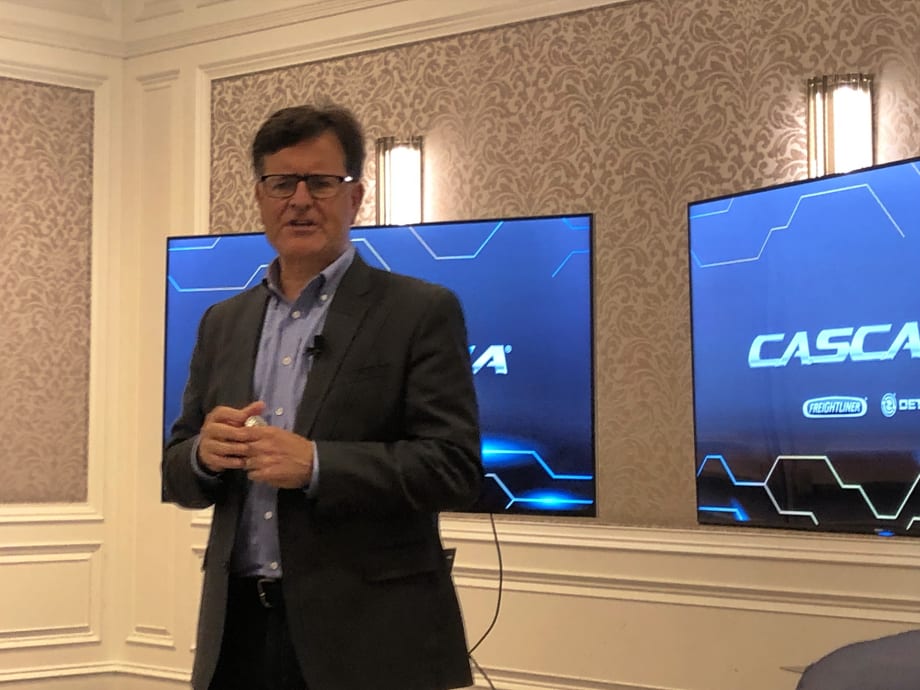
Daimler Trucks North America has already filled up its production capacity for the rest of 2019 with truck orders, said Richard Howard, senior VP, sales and marketing.
Photo by Jim Park
2 min to read
In a seeming repeat of last year's performance, Daimler Trucks North America said it is effectively sold out for the remainder of the 2019 model year. The company sold a record 175,950 units in 2018. It was the largest year ever for retail sales in the history of the company, said Richard Howard, DTNA’s senior vice-president – sales and marketing.
"By March of last year, we were technically sold out for the whole of 2018," Howard told a press gathering in Palm Beach, Florida. "And in terms of business performance, today, we are effectively sold out for 2019. It's a great position to be in."
In terms of New Cascadia registrations and sales, DTNA was sitting at just under 90,000 units as of last month. Howard predicted DTNA would "punch through the 100,000 mark" during the first three months of 2019. "That is quite an amazing number for a truck that has been on the road for such a short period of time," he said.
The New Cascadia was first unveiled in 2016. Production ramped up to full capacity during the second quarter of last year and has been going full-bore ever since.
Daimler has taken steps to ensure that all those spots on the assembly line turn into actual sales.
"Back in July of last year, we conducted a deep review of dealer orders and purged 45,000 orders to ensure those we had were based on actual customer demand not just speculative orders from the dealer network," Howard said.
As well, Daimler moved to a dealer allocation system in 2018 to ensure a fairer approach. The company reviewed order intake again in the fall and concluded it had lower than normal cancellation rates, which historically run at about 3%. "Today, we are at about half that cancellation rate on our backlog, and we still have more order intake than we can handle in 2019," noted Howard.
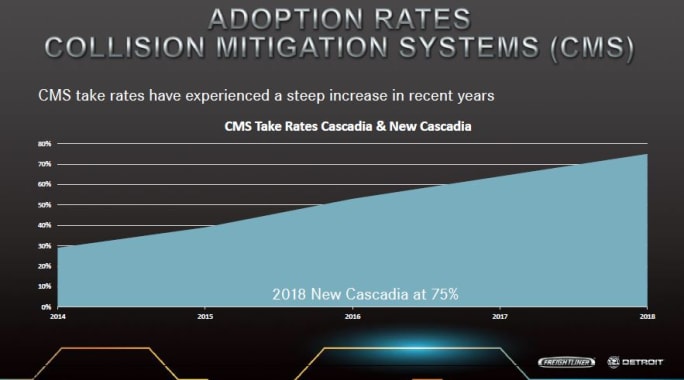
Collision mitigation systems have increased in popularity in recent years.
Howard attributed the high market acceptance of the New Cascadia to the integrated Detroit powertrain and the advanced safety systems. He said 95% of all DTNA customers choose Detroit power and the DT12 automated transmission, while 75% of the customer base choose Detroit Assurance as their safety system of choice.
"Customers have told us that prior to the introduction of Detroit Assurance, their incident rate was as high as 1 in 5 in any given year. They now claim it has dropped to 1 in 20," said Howard.
The New Cascadia will launch later this year in Australia, while the classic Cascadia will see the end of its run by the end of 2019.
More Equipment

How Volvo Updated Its D13 for EPA 2027 [Watch]
Volvo’s updated D13 promises lower emissions without sacrificing performance or fuel economy. Take a closer look at what changed inside the engine in this HDT Spotlight video.
Read More →
Michelin Tire Improves Efficiency and Durability for Regional Fleets
The Michelin X Multi Energy D2 is a regional haul drive tire engineered to help fleets improve fuel efficiency, durability and traction in demanding stop-and-go operations.
Read More →
ZF Expands Commercial Vehicle Push in North America
ZF is expanding its North American commercial-vehicle presence with new transmission applications, electrification, trailer technology and autonomous-driving systems.
Read More →
Tesla Wants a Self-Driving Semi. Are Cameras Enough?
Could Tesla’s camera-only autonomous driving technology work on an 80,000-pound Semi? In this commentary, HDT's Deborah Lockridge takes a look at Tesla, Cybercab, and how autonomous trucks see the road.
Read More →
Kodiak: Driverless Long-Haul Truck Launch on Track for 2026
Kodiak AI says its driverless long-haul safety case is 93% complete and it remains on track to begin commercial operations by year-end 2026.
Read More →
What DOT’s Automated Vehicle Strategy Means for Trucking
The U.S. Department of Transportation issued a new automated-vehicle strategy that outlines plans for driverless-truck regulations, cross-state freight corridors, and federal safety standards.
Read More →
East Coast Port Launches $45M Electric Truck Push
The Port Authority of New York and New Jersey announced millions in incentives for zero-emission drayage trucks, yard tractors, and new charging hubs near the port.
Read More →
PlusAI Going Public to Fund Autonomous Truck Launch
A SPAC deal could provide PlusAI with up to $300 million as it works toward a 2027 commercial launch of factory-built autonomous trucks.
Read More →
NHTSA Moves to Rewrite Truck Fuel-Economy Rules
The National Highway Traffic Safety Administration says it lacks authority to regulate medium- and heavy-duty truck engines separately from complete vehicles, but the existing standards have not yet been eliminated.
Read More →
Detroit Opens Orders for EPA 2027 Engines
Detroit isn’t starting from scratch to meet EPA 2027 diesel emissions standards. Its Gen 6 DD13 and DD15 engines keep much of today’s platform while updating the fuel and aftertreatment systems.
Read More →