




Daimler Trucks Launches Global Electric-Truck Charging Initiative
A global initiative to set up charging infrastructure for battery-electric commercial trucks launched by Daimler will initially push to establish in the U.S. and Europe charging stations at truck terminals and shops; what Daimler refers to as “depot charging.”

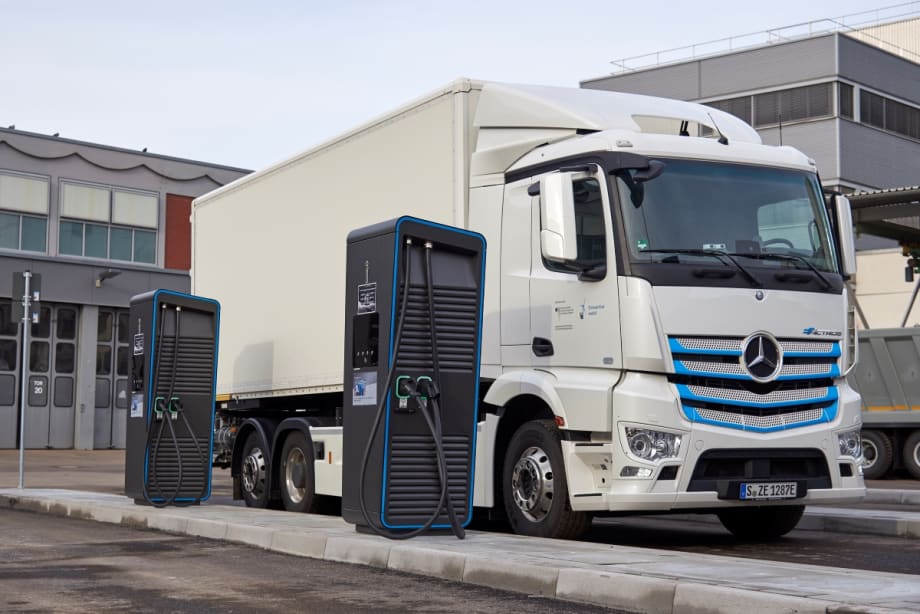
New “charging park” for electric trucks at Daimler Trucks’ headquarters in Stuttgart, Germany.
Photo: Daimler Trucks
The E-Mobility Group of Germany-based Daimler Trucks has launched a global initiative to set up charging infrastructure for battery-electric commercial trucks. The initial push will be to establish charging stations at truck terminals and shops; what Daimler refers to as “depot charging.”
The truck maker said the idea is to build “a network for shared infrastructure solutions.” Other players that will take part in the “eTruck Charging Initiative” will include electric-truck fleets, power grid operators, energy suppliers, charging hardware manufacturers, and charging software providers. The focus is currently on infrastructure for the United States and Europe with Japan to be the next market to follow.
The initiative is meant to foster “close dialogue” between the main participants to help “speed up previously lengthy and complex planning and application processes for network connections.” In addition, the players are concerned with such aspects as optimized load management of the electricity grid and ensuring a sustainable electricity supply.
Gesa Reimelt, head of Daimler Trucks’ E-Mobility Group, said the effort’s goals include “supporting truck customers in the selection of the energy supplier and of the charging-station provider, as well as providing the appropriate charging software.”
According to Daimler Trucks, “the earlier and more exactly the energy suppliers and power grid operators know what customers’ infrastructure requirements are, the faster and more efficiently they can build them up.” Therefore, the initiative’s measures include the development of standard concepts that cover common charging profiles. Different energy suppliers can use these concepts, significantly reducing their planning time.
In addition, per the OEM, “standardized and optimized forms” accelerate the approval process for network operators—“fast processes mean reduced costs for all involved.” Other approaches, including the best possible design of the interfaces between charging infrastructure, vehicle and grid, as well as the possibilities of controlling the grid load and thus ensuring the sustainable supply of electricity, will also be addressed within the initiative.
As for depot charging itself, Daimler Trucks said that its necessary infrastructure is individually tailored to the needs and processes of the respective truck operator. He company said there are several benefits:
The use of one’s own charging infrastructure usually offers advantages in terms of total cost of ownership, as there’s no additional operator involved
There is no need for time-consuming billing and authentication of authorized vehicles, and the ability to charge can always be guaranteed
Charging procedures are subject to the company’s specifications and the energy costs can be calculated in advance
Daimler Trucks sees depot charging as especially suitable for electric trucks running in urban areas. Since they cover routes that can be planned, such trucks can be charged overnight or during regular downtime. In most cases, therefore, little or no change needed to fleet operating procedures. The OEM noted that battery-electric drive has the highest efficiency among alternative drive systems.
The truck maker added that the “development of further charging possibilities through opportunity charging [“topping off” battery capacity and public charging will successively open up further applications with a larger radius of action” for truck fleet operations.
“Through our intensive dialogue with customers, we are building up comprehensive expertise in all aspects of the power requirements and infrastructure needs of fleets,” said Reimelt. “In the first step, we find out which power supply is available at a customer’s depot and which operating processes have an influence on power charging.
“With our newly launched eTruck Charging Initiative, we are now translating these findings into suitable offers together,” she continued. “This includes, for example, supporting truck customers in the selection of the energy supplier and of the charging-station provider, as well as providing the appropriate charging software.”
More Fuel Smarts

How Volvo Updated Its D13 for EPA 2027 [Watch]
Volvo’s updated D13 promises lower emissions without sacrificing performance or fuel economy. Take a closer look at what changed inside the engine in this HDT Spotlight video.
Read More →
Diesel Price Spike Shortens Payback for Natural Gas Trucks, Report Says
Energy Vision estimates fleets could recover the higher purchase price of an RNG-fueled Class 8 tractor in 1.3 to 2.8 years under current fuel-price scenarios.
Read More →
Calstart Becomes Catalyst Mobility, Reflecting Broader Focus
Calstart is now Catalyst Mobility, reflecting the nonprofit’s growing national role in clean transportation, including zero-emission trucks, infrastructure and incentive programs.
Read More →

Record Diesel Prices Squeeze Trucking Fleets
Average U.S. diesel prices have climbed to nearly $6 a gallon, surpassing the 2022 record as tight refinery capacity and Middle East disruptions keep fuel costs elevated.
Read More →
How Fuel Delivery Shapes Engine Performance
Fuel delivery depends on more than what happens at the injector. For fleet, maintenance and technical professionals, looking at the full path from pump to injector can provide useful context for understanding engine performance.
Read More →
East Coast Port Launches $45M Electric Truck Push
The Port Authority of New York and New Jersey announced millions in incentives for zero-emission drayage trucks, yard tractors, and new charging hubs near the port.
Read More →
California Bill Could Shed Light on Electric Truck Prices
Why do battery-electric Class 8 trucks remain so expensive? A California bill headed to Gov. Gavin Newsom would give fleets and state agencies more visibility into what manufacturers charge.
Read More →
Detroit Opens Orders for EPA 2027 Engines
Detroit isn’t starting from scratch to meet EPA 2027 diesel emissions standards. Its Gen 6 DD13 and DD15 engines keep much of today’s platform while updating the fuel and aftertreatment systems.
Read More →
Zero-Emission Truck Corridor Planned for West Coast
California, Oregon, Washington, British Columbia and Baja California are coordinating plans for truck charging and hydrogen fueling from Canada to Mexico.
Read More →
A Closer Look at Kenworth’s Electric T880E Vocational Truck [Video]
Learn more about Kenworth's T880E battery-electric vocational truck at the Paccar Technical Center, including its range, applications, upfitting considerations, and PTO options, in this HDT Spotlight video.
Read More →