





Dig Deeper: Is Collaboration the Answer to Trucking's Advancement?
Daimler Truck, Toyota Strike Deal to Advance Zero-Emissions Truck Tech
Mitsubishi Fuso and Hino will merge under a new deal struck by the two companies and their parent corporations, Daimler Truck and Toyota Motor Corp., respectively. The goal? Accelerate the development of advanced technologies such as zero-emissions and connected vehicles.
May 30, 2023
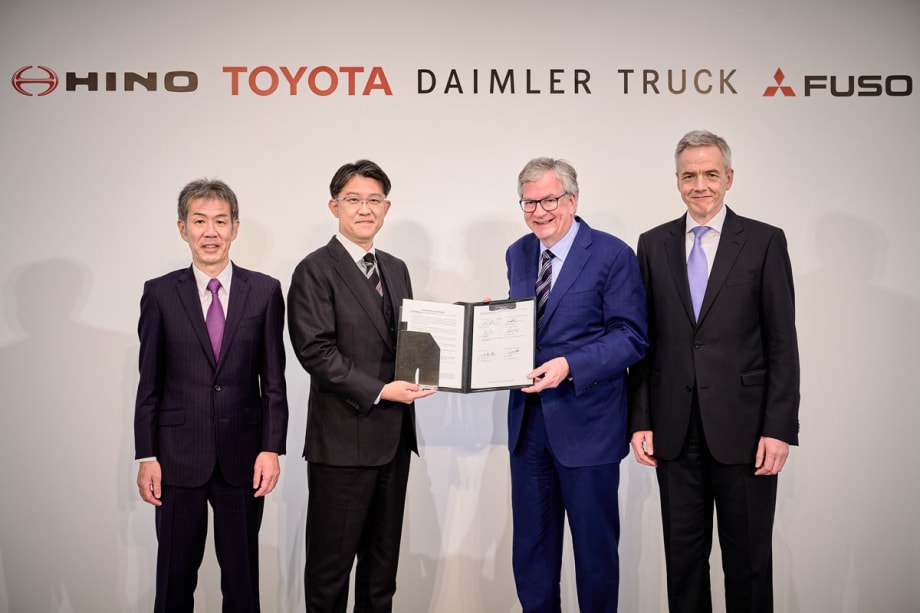
Daimler Truck, Mitsubishi Fuso, Hino, and Toyota signed a memorandum of understanding to merge Mitsubishi Fuso and Hino. Left to right, Satoshi Ogiso, president and CEO of Hino Motors; Koji Sato, president and CEO of Toyota Motor Corp.; Martin Daum, CEO of Daimler Truck AG; and Karl Deppen, CEO of Daimler Truck Asia.
Photo: Daimler Truck
2 min to read
Mitsubishi Fuso and Hino will merge under a new deal struck by the two companies and their parent corporations, Daimler Truck and Toyota Motor Corp., respectively. The goal? Accelerate the development of advanced technologies such as zero-emissions and connected vehicles.
MFTBC and Hino will merge on an equal footing and collaborate on commercial vehicle development, procurement and production, with the goal of building a globally competitive Japanese commercial vehicle manufacturer.
Daimler Truck and Toyota will equally invest in the holding company of the merged MFTBC and Hino. They will collaborate on the development of hydrogen and other CASE technologies (Connected/Autonomous & Automated/Shared/Electric), to support the competitiveness of the new company.
The deal is the latest in a trend of competitive truck makers teaming up in certain areas to advance zero-emissions technology. For instance, in 2021, Daimler Truck AG and Volvo Group formed a fuel-cell joint venture called Cellcentric.
More Details on Fuso-Hino Merger
By joining forces, MFTBC and Hino can enhance the competitiveness of Japanese truck manufacturers, according to the May 30 announcement. Both Daimler Truck and Toyota offer global lineups with diverse options based on local conditions and how their customers use vehicles.
Details on the scope and nature of the collaboration, including the name, location, shareholding ratio and corporate structure of the new holding company, will be decided over the course of the next 18 months.
The companies look to sign definitive agreements in the first quarter of 2024 and aim to close the transaction by the end of 2024.
What About North America?
The announcement did not mention how or if this announcement might affect the companies’ offerings in North America; HDT's editors are working to get more insight on that.
Comments provided in a news release focused on Japan and Southeast Asia. For instance, Martin Daum, CEO of Daimler Truck, said, "The planned new company will be a major force in Southeast Asia and an important associate of the Daimler Truck family."
Koji Sato, CEO of Toyota, called the collaboration between the four companies “a partnership for creating the future of commercial vehicles in Japan and the future of mobility society.”
Hino, which debuted heavy-duty trucks for North America a few years ago, recently announced it’s working with Hexagon Purus to offer a battery-electric version.
Daimler Truck North America dropped the Fuso brand in North America in 2020, but Daimler Truck recently introduced a new all-electric medium-duty Class 4-5 truck brand for North America, Rizon, which appears to be based on Fuso’s eCanter.
More Equipment

How Volvo Updated Its D13 for EPA 2027 [Watch]
Volvo’s updated D13 promises lower emissions without sacrificing performance or fuel economy. Take a closer look at what changed inside the engine in this HDT Spotlight video.
Read More →
Michelin Tire Improves Efficiency and Durability for Regional Fleets
The Michelin X Multi Energy D2 is a regional haul drive tire engineered to help fleets improve fuel efficiency, durability and traction in demanding stop-and-go operations.
Read More →
ZF Expands Commercial Vehicle Push in North America
ZF is expanding its North American commercial-vehicle presence with new transmission applications, electrification, trailer technology and autonomous-driving systems.
Read More →
Tesla Wants a Self-Driving Semi. Are Cameras Enough?
Could Tesla’s camera-only autonomous driving technology work on an 80,000-pound Semi? In this commentary, HDT's Deborah Lockridge takes a look at Tesla, Cybercab, and how autonomous trucks see the road.
Read More →
Kodiak: Driverless Long-Haul Truck Launch on Track for 2026
Kodiak AI says its driverless long-haul safety case is 93% complete and it remains on track to begin commercial operations by year-end 2026.
Read More →
What DOT’s Automated Vehicle Strategy Means for Trucking
The U.S. Department of Transportation issued a new automated-vehicle strategy that outlines plans for driverless-truck regulations, cross-state freight corridors, and federal safety standards.
Read More →
East Coast Port Launches $45M Electric Truck Push
The Port Authority of New York and New Jersey announced millions in incentives for zero-emission drayage trucks, yard tractors, and new charging hubs near the port.
Read More →
PlusAI Going Public to Fund Autonomous Truck Launch
A SPAC deal could provide PlusAI with up to $300 million as it works toward a 2027 commercial launch of factory-built autonomous trucks.
Read More →
NHTSA Moves to Rewrite Truck Fuel-Economy Rules
The National Highway Traffic Safety Administration says it lacks authority to regulate medium- and heavy-duty truck engines separately from complete vehicles, but the existing standards have not yet been eliminated.
Read More →
Detroit Opens Orders for EPA 2027 Engines
Detroit isn’t starting from scratch to meet EPA 2027 diesel emissions standards. Its Gen 6 DD13 and DD15 engines keep much of today’s platform while updating the fuel and aftertreatment systems.
Read More →