




Daimler Tests Fuel Cell Trucks in Swiss Alps
Daimler Truck is testing its next generation of fuel cell trucks in the Swiss Alps.

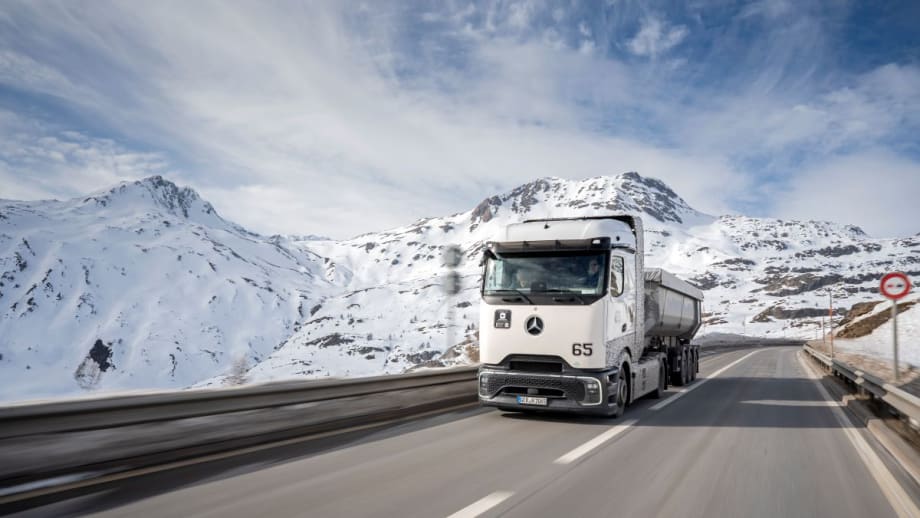
Daimler is testing its next generation of hydrogen fuel cell trucks in the Swiss Alps.
Photo: Daimler Truck
Daimler Truck’s development team has built up first prototypes of Mercedes-Benz's next generation fuel cell trucks, the OEM announced.
Currently, Daimler engineers are putting the new trucks through their paces in a first series of demanding tests.
Harsh Winter Testing
Two vehicles of the next development stage of the Mercedes-Benz GenH2 Truck underwent intensive winter testing at the Simplon Pass in the Swiss Canton of Valais.
The tough conditions in the cold and snow, as well as challenging gradient profiles in the region provided excellent conditions for testing the innovative technology under the hood of the liquid hydrogen-powered vehicles and allowed the team to gain valuable insights under realistic extreme conditions.
“For the further development of our Mercedes-Benz GenH2 Truck, we are seamlessly building on the experiences of the first prototype generation and are therefore able to test the improved technology under extreme conditions right from the outset,” said Rainer Müller-Finkeldei, head of Mercedes-Benz Trucks Product Engineering. “With a maximum elevation of more than 2,000 meters above sea level and a climb from 600 meters, the route over the Simplon Pass provided good conditions for testing the interplay of the fuel cell system with other enhanced components. The successful tests have underlined the potential and reliability of the GenH2 Trucks, even under demanding conditions.”
Daimler said the interaction of all essential components was tested intensively. This included the fuel cell, the high-voltage battery, the e-axle, the tank system, and thermal management.
A particular focus was on the use of the Predictive Powertrain Controls system, the topography-dependent cruise control. The objective was to use the battery in combination with the fuel cell efficiently, both with regard to propulsion as well as for recuperation when driving downhill.
Two hydrogen trucks that are CO2-emission-free in driving operation were deployed and underwent an extensive and demanding test program with a gross vehicle weight of up to 40 tons during a period of 14 days.
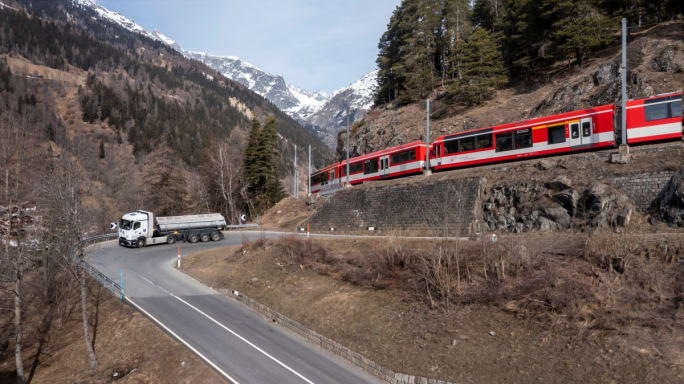
During Alpine evaluation tests, Daimler hydrogen fuel cell trucks covered a total of 6,500 kilometers and crossed mountain roads with an accumulated climb of 83,000 meters.
Photo: Daimler Truck
They covered a total of 6,500 kilometers and crossed mountain roads with an accumulated climb of 83,000 meters.
Particularly challenging were the approximate 20-km-long up- and downhill stretches with gradients of 10 to 12 percent, with a total distance covering 1,600 kilometers.
The fuel cell trucks were refueled via a mobile hydrogen refueling station from Air Products, which was set up at the test base in Valais.
EU Funding
Last autumn, the German Federal Ministry for Digital Affairs and Transport (BMDV) and the federal states of Baden-Württemberg and Rhineland-Palatinate approved funding totaling € 226 million for Daimler Truck.
The funding is intended for the development, small-scale production and customer deployment (operation and maintenance) of 100 fuel cell trucks.
The funding project, created within the framework of the European Union’s IPCEI (Important Project of Common European Interest) Hydrogen program, covers both vehicle and production-related activities. In addition to the development and build-up of the vehicles, the funding will also be used for feasibility studies with regard to the hydrogen value chain as well as investments in required production facilities and processes in preparation for planned series production.
Final assembly of the next generation fuel cell trucks is set to take place at the Mercedes-Benz plant in Wörth and the trucks are expected to go into operation at various customers from the end of 2026 onwards.
More Fuel Smarts

How Volvo Updated Its D13 for EPA 2027 [Watch]
Volvo’s updated D13 promises lower emissions without sacrificing performance or fuel economy. Take a closer look at what changed inside the engine in this HDT Spotlight video.
Read More →
Diesel Price Spike Shortens Payback for Natural Gas Trucks, Report Says
Energy Vision estimates fleets could recover the higher purchase price of an RNG-fueled Class 8 tractor in 1.3 to 2.8 years under current fuel-price scenarios.
Read More →
Calstart Becomes Catalyst Mobility, Reflecting Broader Focus
Calstart is now Catalyst Mobility, reflecting the nonprofit’s growing national role in clean transportation, including zero-emission trucks, infrastructure and incentive programs.
Read More →

Record Diesel Prices Squeeze Trucking Fleets
Average U.S. diesel prices have climbed to nearly $6 a gallon, surpassing the 2022 record as tight refinery capacity and Middle East disruptions keep fuel costs elevated.
Read More →
How Fuel Delivery Shapes Engine Performance
Fuel delivery depends on more than what happens at the injector. For fleet, maintenance and technical professionals, looking at the full path from pump to injector can provide useful context for understanding engine performance.
Read More →
East Coast Port Launches $45M Electric Truck Push
The Port Authority of New York and New Jersey announced millions in incentives for zero-emission drayage trucks, yard tractors, and new charging hubs near the port.
Read More →
California Bill Could Shed Light on Electric Truck Prices
Why do battery-electric Class 8 trucks remain so expensive? A California bill headed to Gov. Gavin Newsom would give fleets and state agencies more visibility into what manufacturers charge.
Read More →
Detroit Opens Orders for EPA 2027 Engines
Detroit isn’t starting from scratch to meet EPA 2027 diesel emissions standards. Its Gen 6 DD13 and DD15 engines keep much of today’s platform while updating the fuel and aftertreatment systems.
Read More →
Zero-Emission Truck Corridor Planned for West Coast
California, Oregon, Washington, British Columbia and Baja California are coordinating plans for truck charging and hydrogen fueling from Canada to Mexico.
Read More →
A Closer Look at Kenworth’s Electric T880E Vocational Truck [Video]
Learn more about Kenworth's T880E battery-electric vocational truck at the Paccar Technical Center, including its range, applications, upfitting considerations, and PTO options, in this HDT Spotlight video.
Read More →