




Daimler Eyes 40% Vocational Market Share by 2015
Daimler Trucks North America mapped out its goals in the Class 6,7, and 8 markets, as well as its goal to increase the company's market share in the vocational market at its annual press event in Northern California.

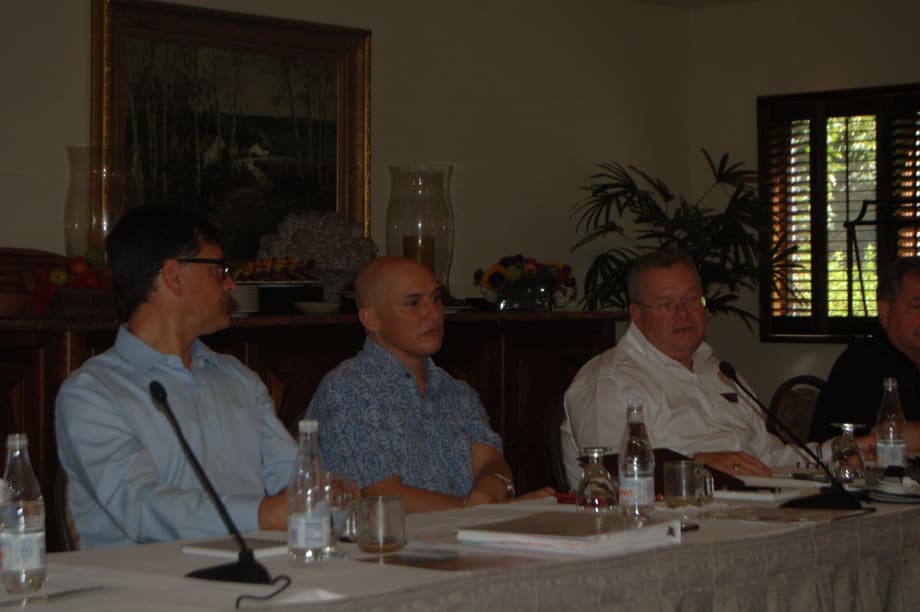
Richard Howard, Daimler Trucks North America’s senior vice president of sales and marketing, left, and David Hames, DTNA general manager, marketing and strategy, gave attendees a look into the company's plans for 2014 and beyond. Photo: Stephane Babcock
Richard Howard, Daimler Trucks North America’s senior vice president of sales and marketing, left, and David Hames, DTNA general manager, marketing and strategy, gave attendees a look into the company's plans for 2014 and beyond.Photo: Stephane Babcock
NAPA, Calif. -- Building on the steady growth seen in vocational sales during the first half of 2014, Richard Howard, Daimler Trucks North America’s senior vice president of sales and marketing, expects to see the company's Class 6-7 market share on the "north side of 40% by the end of the year."
Howard's remarks came at during a DTNA press event in Napa Tuesday.
DTNA saw vocational orders rise by 24% during the first quarter of the year, he said, and by 9% in the second quarter. Since initiating a growth vocational strategy in 2010, the OEM has increased its Class 6-8 market share from 30.1% to close to 36%.
On the Class 8 side, Freightliner has seen a 36% increase in orders in the first quarter of 2014 compared to 2013. Overall, Howard is calling 2014 a very good year for truck manufacturing, with total Class 6-8 NAFTA region sales (U.S., Canada and Mexico) expected to top 372,000 units.
"There were some hesitation on the first quarter's performance, but so far this year we've seen what I would call cautious optimism," Howard said. "Certainly, an expansion of the market is expected."
The biggest leap in market share gains for DTNA this year will come from the vocational sector. While the sector is relatively small (about 41,000 units overall in 2014, up from 28,000 in 2009) compared to the Class 8 on-highway market, DTNA is expecting to end the year with 32% of the NAFTA market for Class 6-8 vocational business.
"We're at 30.8% at the end of the second quarter," said David Hames, DTNA general manager, marketing and strategy. "Our goal in 2009 was to achieve a number one position in that market by 2015, and we're gaining share completely at the expense of other manufacturers."
"Keeping the customer central to what we’re doing is key,” Howard noted during his remarks. “We make sure we stay very close to our customers.”
Gaining market share at the expense of a competitor is one thing, Howard said, but DTNA recognizes that there will be a lot of effort required to maintain that position with the customer.
“There are three non-negotiables: We have to be number one in customer satisfaction. We have to be number one with our dealers. We have to focus on being a great place to work,” Howard added.
Another key, he explained, is making sure the company offers the right product for the right application, which, in some instances, includes integrating telematics with its vehicles. This technological support would be helpful when it comes to meeting another of the company’s goals – reducing the maximum time a truck should sit in a shop. DTNA is pushing to keep that time to a maximum of three days, which includes a diagnostic appraisal of the repair within two hours of the vehicles pulling into a shop.
The vocational segment of Freightliner’s business is going to get a bigger push in 2014 and beyond. Hames said the company must “speak the dialect of vocational.”
“We can’t look at medium-duty or vocational as a second, side business,” explained Hames. “You have to look at the end customer needs.”
DTNA now has a full line of vocational chassis, including the M2, 114 SD and the 122 SD, which are configurable for practically any application imaginable, and there's now a solid cross-section of natural gas-powered vocation equipment in the DTNA data book.
DTNA plans a full-on push into the market this year and beyond, offering the chassis options that end-user and upfitters are asking for.
"There are no cookie-cutter chassis in the vocational market," said Richard Saward, general manager of vocational sales, Freightliner Trucks. "Every truck we build is engineered exactly to the customer specifications and then run through our test engineering department to ensure it's the right product for the application."
Freightliner's new approach to the vocational market speaks to the start of the Freightliner brand, which began when Leland James founded the company because he could not find the vehicle he needed from the market.
“We were customer-driven from the outset,” Hames concluded.
Related Story:
Freightliner Adds 12-Liter Natural Gas Power to 114SD Severe-Duty Model
CORRECTION, 7/30/2014, 2:20 EDT: The initial version of this story misspelled Richard Saward's name. We apologize for the error.
More Equipment

How Volvo Updated Its D13 for EPA 2027 [Watch]
Volvo’s updated D13 promises lower emissions without sacrificing performance or fuel economy. Take a closer look at what changed inside the engine in this HDT Spotlight video.
Read More →
Michelin Tire Improves Efficiency and Durability for Regional Fleets
The Michelin X Multi Energy D2 is a regional haul drive tire engineered to help fleets improve fuel efficiency, durability and traction in demanding stop-and-go operations.
Read More →
ZF Expands Commercial Vehicle Push in North America
ZF is expanding its North American commercial-vehicle presence with new transmission applications, electrification, trailer technology and autonomous-driving systems.
Read More →
Tesla Wants a Self-Driving Semi. Are Cameras Enough?
Could Tesla’s camera-only autonomous driving technology work on an 80,000-pound Semi? In this commentary, HDT's Deborah Lockridge takes a look at Tesla, Cybercab, and how autonomous trucks see the road.
Read More →
Kodiak: Driverless Long-Haul Truck Launch on Track for 2026
Kodiak AI says its driverless long-haul safety case is 93% complete and it remains on track to begin commercial operations by year-end 2026.
Read More →
What DOT’s Automated Vehicle Strategy Means for Trucking
The U.S. Department of Transportation issued a new automated-vehicle strategy that outlines plans for driverless-truck regulations, cross-state freight corridors, and federal safety standards.
Read More →
East Coast Port Launches $45M Electric Truck Push
The Port Authority of New York and New Jersey announced millions in incentives for zero-emission drayage trucks, yard tractors, and new charging hubs near the port.
Read More →
PlusAI Going Public to Fund Autonomous Truck Launch
A SPAC deal could provide PlusAI with up to $300 million as it works toward a 2027 commercial launch of factory-built autonomous trucks.
Read More →
NHTSA Moves to Rewrite Truck Fuel-Economy Rules
The National Highway Traffic Safety Administration says it lacks authority to regulate medium- and heavy-duty truck engines separately from complete vehicles, but the existing standards have not yet been eliminated.
Read More →
Detroit Opens Orders for EPA 2027 Engines
Detroit isn’t starting from scratch to meet EPA 2027 diesel emissions standards. Its Gen 6 DD13 and DD15 engines keep much of today’s platform while updating the fuel and aftertreatment systems.
Read More →