





Dig Deeper — EPA 2027 and Beyond: How Will New Low-NOx Rules Affect Fleets?
Cummins Preps for Fuel-Agnostic Engine Production at Jamestown Plant
While celebrating the production of 2.5 million engines at its heavy-duty engine plant in Jamestown, New York, Cummins announced it will invest $452 million in the facility to produce its new fuel-agnostic engine line.
May 23, 2023
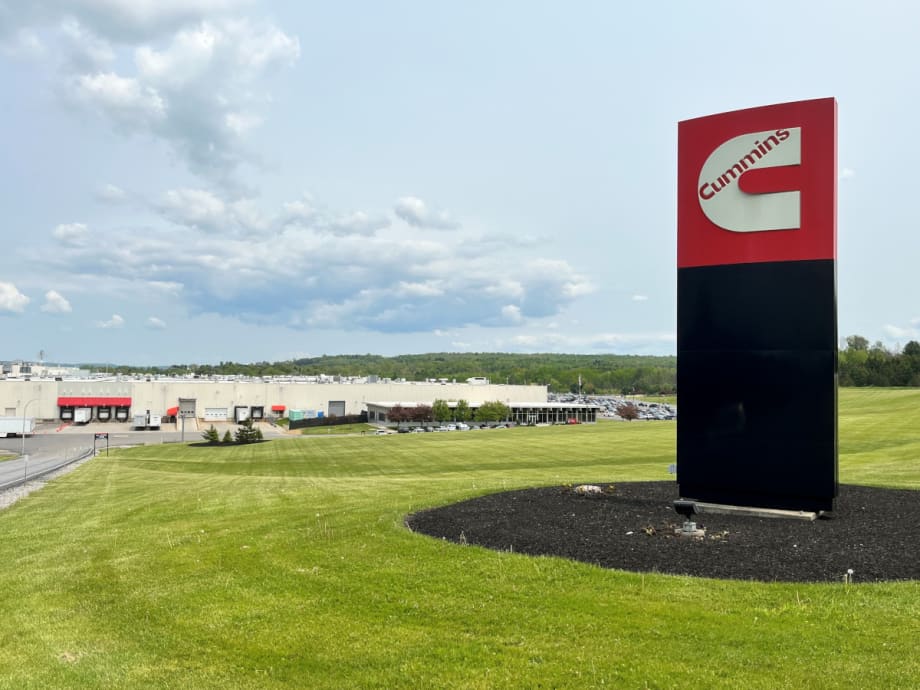
Cummins’ Jamestown, New York engine plant is a critical piece of the company’s long-term Destination Zero strategy. The facility has been operating for 49 years and annually contributes $1 million to the community through charitable donations and employee volunteer hours.
Photo: Jim Park
3 min to read
While celebrating the production of 2.5 million engines at its heavy-duty engine plant in Jamestown, New York, Cummins announced it will invest $452 million in the 998,000-square-foot facility to produce the industry’s first fuel-agnostic internal combustion engine platform.
The new Cummins engine platform leverages a range of lower-carbon fuel types, including natural gas and hydrogen. The investment is aligned with the company’s Destination Zero strategy.
“The world is changing in front of us, and we want to be part of that change," said Srikanth Padmanabhan, vice president and president of Cummins Engine Business, at the event. “Climate change is the existential crisis of our time. Decarbonization is our method of helping with that crisis.”

Srikanth Padmanabhan, vice president and president, Cummins Engine Business, said no facility other than Jamestown was ever even considered to produce the next generation of fuel-agnostic engines.
Photo: Jim Park
Engine Platforms
The Jamestown Engine Plant (JEP) has produced a number of engine platforms over the past 47 years, beginning with the L10. Other engines built there have included the M11, X12 ISX12, ISX12G ISX15, and the X15.
The first X15N natural gas engines will be built in the same part of the plant where the M11 was once produced. No firm dates were announced for the start of the X15N production, but the installation of the production lines will be underway soon, according to Anna Dibble, JEP plant manager.
“Those planning to attend the 50th anniversary of JEP next summer will see this space filled with new manufacturing equipment,” she said.
Cummins has already committed to, and in some cases started, field-testing programs for the X15N with fleets such as Knight-Swift Transportation, Ryder, and United Parcel Service.
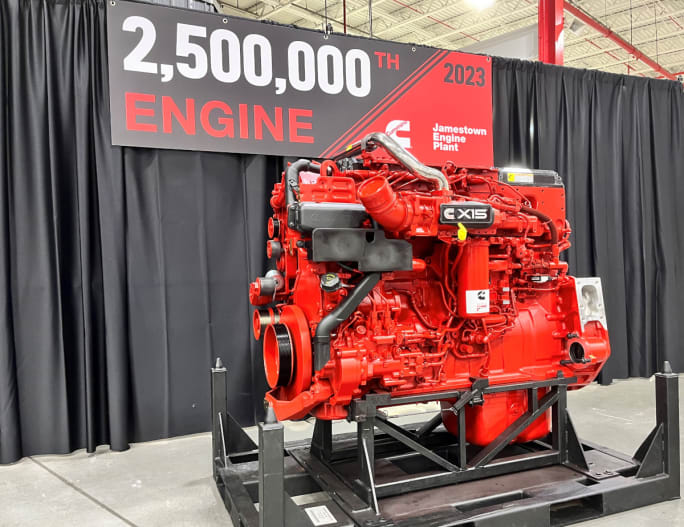
The Cummins plant in Jamestown, New York, will produce the X15N natural gas engines.
Photo: Jim Park
This next-generation engine is the first natural gas engine to be specifically designed for heavy-duty truck applications with up to 500-hp output. Cummins said it’s a key step for the future of heavy-duty transportation fleets and a road to zero emissions.
Cummins claims over half of all medium- and heavy-duty trucks on the road in the U.S. today use Cummins engines. Padmanabhan said he hopes the 3 millionth engine to come from this plant will be a hydrogen engine, which is a zero-carbon fuel engine.
“The reason I think this is important is that battery-electric and fuel-cell-electric solutions are not ready,” he said. “The transition is what we are calling the messy middle, and that’s where we are today. To get to that net zero position is going to take more low-carbon solutions, like natural gas, biodiesel, and hydrogen. And this plant will make those engines.”
The Jamestown Legacy
JEP is a critical piece of Cummins’ long-term Destination Zero strategy and next-generation engine portfolio and remains one of the company’s largest manufacturing facilities. The facility has been operating for 49 years and has more than 1,500 employees serving 1,949 active customers.
Cummins also pointed out that this investment is intended to retain the current engineering and manufacturing jobs and support the creation of hundreds of new jobs.
“Our plant wouldn’t be successful without the dedicated employees who serve our company and community each day,” said Dibble. “We are proud to have such a strong presence in the community and be able to create a welcoming, caring, and all-inclusive environment for our people to be successful.”
Kenworth will be the recipient of the milestone engine and will install it in the Legacy W900 truck and provide the truck to Palmer Kenworth. Kenworth is celebrating its 100th anniversary.
More Equipment

How Volvo Updated Its D13 for EPA 2027 [Watch]
Volvo’s updated D13 promises lower emissions without sacrificing performance or fuel economy. Take a closer look at what changed inside the engine in this HDT Spotlight video.
Read More →
Michelin Tire Improves Efficiency and Durability for Regional Fleets
The Michelin X Multi Energy D2 is a regional haul drive tire engineered to help fleets improve fuel efficiency, durability and traction in demanding stop-and-go operations.
Read More →
ZF Expands Commercial Vehicle Push in North America
ZF is expanding its North American commercial-vehicle presence with new transmission applications, electrification, trailer technology and autonomous-driving systems.
Read More →
Tesla Wants a Self-Driving Semi. Are Cameras Enough?
Could Tesla’s camera-only autonomous driving technology work on an 80,000-pound Semi? In this commentary, HDT's Deborah Lockridge takes a look at Tesla, Cybercab, and how autonomous trucks see the road.
Read More →
Kodiak: Driverless Long-Haul Truck Launch on Track for 2026
Kodiak AI says its driverless long-haul safety case is 93% complete and it remains on track to begin commercial operations by year-end 2026.
Read More →
What DOT’s Automated Vehicle Strategy Means for Trucking
The U.S. Department of Transportation issued a new automated-vehicle strategy that outlines plans for driverless-truck regulations, cross-state freight corridors, and federal safety standards.
Read More →
East Coast Port Launches $45M Electric Truck Push
The Port Authority of New York and New Jersey announced millions in incentives for zero-emission drayage trucks, yard tractors, and new charging hubs near the port.
Read More →
PlusAI Going Public to Fund Autonomous Truck Launch
A SPAC deal could provide PlusAI with up to $300 million as it works toward a 2027 commercial launch of factory-built autonomous trucks.
Read More →
NHTSA Moves to Rewrite Truck Fuel-Economy Rules
The National Highway Traffic Safety Administration says it lacks authority to regulate medium- and heavy-duty truck engines separately from complete vehicles, but the existing standards have not yet been eliminated.
Read More →
Detroit Opens Orders for EPA 2027 Engines
Detroit isn’t starting from scratch to meet EPA 2027 diesel emissions standards. Its Gen 6 DD13 and DD15 engines keep much of today’s platform while updating the fuel and aftertreatment systems.
Read More →