




CSA 2010 Gets Hearing on Hill
The Federal Motor Carrier Safety Administration's new enforcement program, Comprehensive Safety Analysis 2010, got its first airing on Capitol Hill yesterday, with the agency's chief, Anne Ferro, explaining and defending the program while industry interests expressed general support and specific concerns
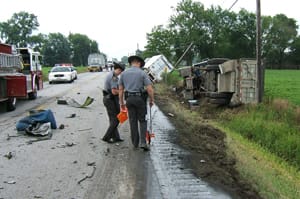
One of the issues brought up at the hearing by the trucking industry was crash accountability. (Photo by Ohio State Highway Patrol)
The Federal Motor Carrier Safety Administration's new enforcement program, Comprehensive Safety Analysis 2010, got its first airing on Capitol Hill yesterday, with the agency's chief, Anne Ferro, explaining and defending the program while industry interests expressed general support and specific concerns.
No new ground was broken at the hearing by the House Highways and Transit Subcommittee. Chairman Peter DeFazio, D-Ore., supports the CSA 2010 effort, calling it "an evolutionary change for the better," but at the same time acknowledged concerns in the trucking and enforcement communities about details such as timing, data quality and funding.
One of DeFazio's top concerns is the agency's plan to roll out the program this fall, before it receives the complete analysis of the testing phase of CSA 2010 that has been conducted in a number of pilot states. That analysis, which is being prepared by the University of Michigan Transportation Research Institute, is due in December. The program had been scheduled for launch in July but the agency recently pushed the start date back until November.
Ferro explained that the agency believes that through the pilot test in nine states it has enough information to justify getting the program under way in November. The testing process has produced data that validates this approach, she said.
"We have been able to use these findings to verify the process," she said. "We have strong confidence in the system and the validity of the system, but are still working on fine tuning."
DeFazio followed up with the observation that 41 states are not fully plugged into the system yet and will face implementation challenges. "I'm not certain this is a realistic timeline," he said.
Ferro replied that the fundamental process the agency and the states use to enforce FMCSA rules is not changing. What's new is how the data will be used, and the agency has been making progress in improving the quality of its data.
That point was seconded by Steve Keppler, interim executive director of the Commercial Vehicle Safety Alliance, which represents the enforcement community. "Ninety five to 100 percent of the data is accurate," he told DeFazio. The data-gathering system has been improved through cooperative effort between FMCSA and state safety enforcement agencies, he said.
Trucking's Concern
Another issue that has been a sticking point for trucking interests was raised by Keith Klein, executive vice president and chief operating officer of Transport Corporation of America, who spoke on behalf of American Trucking Associations.
Klein showed a dramatic video clip of a tractor-trailer going over a cement median wall and overturning into the oncoming lane of traffic - a horrific accident at high speed. At first it appeared that the truck was at fault but a closer look, he explained, shows that the truck is being forced out of the lane by an automobile.
Under FMCSA's current CSA 2010 system, this accident would enter the system without recognition that it was not the carrier's fault. ATA has been pressing the agency to come up with a way to recognize the difference between preventable and non-preventable accidents in its performance measurement system.
Ferro repeated the agency's longstanding assertion that crash data, irrespective of fault, are a legitimate indicator of safety performance in the future. But at the same time, she said, the agency recognizes the problem of crash accountability and will analyze a carrier's data for fault if the carrier's safety fitness rating comes into question.
In response to a question from Rep. John Duncan, R-Tenn., Klein said that 26 percent of TCA's accidents last year were preventable.
Funding Issues
DeFazio also expressed concern about whether FMCSA has the funding to implement the new program. The agency has requested money for 50 additional people in its 2011 budget, which may or may not be approved, but as Keppler of CVSA pointed out, the state enforcement agencies will inevitably incur costs that the FMCSA budget will not cover.
Ferro said the agency has been looking for more money in its federal grants under the Motor Carrier Safety Assistance Program to help with these costs.
Look for more coverage of CSA 2010, including fleets' experience with reviewing their safety data on the FMCSA website and in the next issue of HDT.
More Drivers

Truck Drivers Need More Than Another Alert
Fleets have more visibility into truck health, safety events, and driver activity than ever. The next challenge is turning all that information into useful guidance for the person who has to decide what to do next.
Read More →
FMCSA Removes 110 Truck Driver Training Schools from Certified ELDT List
Federal regulators also are targeting more than 160 additional training providers and launching a nationwide audit of third-party CDL skills testers as part of a broader crackdown on trucking fraud.
Read More →
Hours of Service Pilot Programs: FMCSA Readies for 2027 Rollout
Two pilot programs could eventually reshape hours-of-service rules, giving truck drivers options to pause their 14-hour clock or use longer split sleeper rest periods.
Read More →
Medical Cards, English Proficiency Reshape Roadcheck Violations
Medical-card violations jumped to the top of the driver out-of-service list during CVSA’s 2026 International Roadcheck, while English-language proficiency violations appeared among the leading violations for the first time.
Read More →
Driver Trust Can Make or Break the Success of Fleet Safety Technology
New Teletrac Navman research suggests that onboarding, transparency about driver data, and positive feedback can play a significant role in how commercial drivers respond to safety and coaching technology.
Read More →
EEOC Sues KLLM Over Alleged Sex Discrimination in Driver Training
KLLM is facing a federal sex-discrimination lawsuit over policies the EEOC alleges put female truck driver trainees at a disadvantage.
Read More →
FMCSA Moves to Codify English Language Requirements for Commercial Drivers
By changing regulations on English-language proficiency requirements for commercial drivers, rather than relying on a guidance memo, the FMCSA said future administrations won't be able to walk back the Trump administration's stricter enforcement with just a memo.
Read More →
Drivers Put Western Star Trucks to the Test at Star Nation Experience
Watch to get an inside look at the Western Star trucks, technology, and community behind the Star Nation Experience 2026!
Read More →
Trump Administration Looks to Put More Veterans Behind the Wheel
The Freedom Haulers program pulls together existing and expanded programs at several federal agencies to recruit veterans to drive commercial heavy-duty trucks and cut the red tape for them to get a CDL, training, and employment.
Read More →
Putting Mack’s Command Steer to the Test
A test drive of Mack’s Command Steer active steering system evaluates how it can make truck driving easier and less tiring.
Read More →