




Critic Says HHS Hair-Testing Rule Development 'Fatally Flawed'
Did the Department of Health and Human Services fail to consult its own drug-testing advisory board when developing new hair-testing guidelines that are expected to be published imminently?

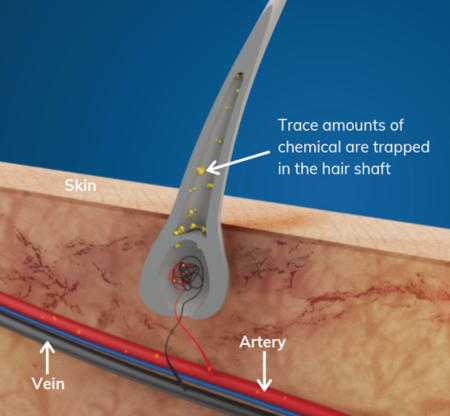
Both a drug and its metabolites in the bloodstream are deposited in the follicle of the growing hair.
Photo: Psychemedics
UPDATED – One hair-testing expert accused the Department of Health and Human Services of failing to consult its own drug-testing advisory board when developing new hair-testing guidelines that are expected to be published imminently – a charge the HHS' Substance Abuse and Mental Health Services Administration says is not true.
Michael Schaffer is an outgoing board member on the Department of Health and Human Services’ Drug Testing Advisory Board. He is vice president of laboratory operations for Psychemedics Corp., a major hair-testing laboratory, and previously was chief toxicologist at the Cook County Medical Examiner’s Office in Chicago.
In a public statement read aloud at the Sept. 1 meeting of the HHS Drug Testing Advisory Board, Schaffer said he wanted to go on record to address the “fatally flawed process which was used to develop the hair testing guidelines which are about to be published in the Federal Register.”
DTAB has always played a key role in the drafting and revising of federal workplace drug testing guidelines, according to Schaffer, “but that is not what happened with the new hair testing guidelines. DTAB has been cut out of the process entirely. The proposed hair testing guidelines are about to be published and yet I have not even seen a draft of them, much less been asked to provide scientific comment on these guidelines. I believe this is true for the other members of DTAB as well.
“This means that these proposed guidelines were developed without the expertise needed to ensure that they are scientifically accurate and defensible. I fear that these proposed guidelines are going to unnecessarily restrict the use of hair drug testing, an incredibly effective tool at detecting drug use, for reasons which have no scientific basis. If this is the case, it is the health and safety of the public which will suffer.”
He urged the HHS’ Substance Abuse and Mental Health Services Administration to not publish the guidelines until they have undergone DTAB scientific review.
However, Ron Flegel, director of the Division of Workplace Programs and chair of the Drug Testing Advisory Board, said in response to our request for a comment on Schaffer's statement, "While we cannot divulge specific information discussed in closed sessions of DTAB meetings, board members, including Dr. Schaffer, were given multiple opportunities to review, discuss, offer revisions, and provide scientific references in connection with the draft HMG."
Flegel said the publicly released agendas for DTAB closed sessions on Dec. 7, 2016, and Aug. 8, 2018 (in which Mr. Schaffer was a participant) included discussion of HMG proposals.
"We will not address each of the many inaccuracies found in Mr. Schaffer’s statements, but note that the proposed HMG are pending publishing in the Federal Register," Flegel told HDT. "Once published, HHS will be requesting public comment and information on all aspects of the proposed guidelines. We also anticipate that the department’s process for developing the proposed HMG, and its scientific underpinnings, will be made clear once the department’s proposal is published, which we hope is imminent."
Hair Testing and Trucking Safety
The HHS guidelines are a necessary first step in getting Department of Transportation drug-testing rules for safety-sensitive transportation employees changed to make hair testing an approved method for testing. Currently, only urine testing may be used to meet DOT-required pre-employment, random, and after-crash drug and alcohol testing. The Department of Transportation must formally adopt the HHS hair-testing guidelines before that can change.
SAMHSA has been working on the rule since 2015; Congress ordered HHS to have the rule in place by December 2016.
A report sent to Congress in the summer of 2019 said the reason for a nearly three-year delay was caused by “unresolved scientific issues” such as hair color and potential external contamination of hair that could adversely affect drug test outcomes.
“Addressing the scientific and legal issues associated with hair testing has taken a significant amount of time and is the reason why HHS [Department of Health and Human Services] has not issued hair testing,” the report said.
In response to a query from HDT, the agency responded: “SAMHSA is committed to a rigorous and thorough guideline development process, in which the scientific, litigation, federal agency, and Office of Management and Budget review issues must be concluded prior to the proposed guidelines being issued. The length of time to resolve these types of issues varies with each set of guidelines.”
According to published reports, a proposed rule authorizing the use of hair samples to test truck drivers and other federal workers has been forwarded to the Federal Register for publication soon.
Proponents of hair testing say urine testing misses as many as nine out of 10 “lifestyle” drug users.
The Alliance for Driver Safety & Security, known as The Trucking Alliance, is a major proponent of hair testing and called Schaffer’s “alarming, because it indicates the Trump Administration may propose hair drug test guidelines that discourage employers from using that method, even though it's 14 times more effective than the DOT urine test for identifying illegal drug abusers,” said Managing Director Lane Kidd.
Updated 5:15 EDT Sept. 4, 2020, to add comment from HHS' SAMHSA.
Updated 12:45 p.m. EDT Sept. 11, 2020, to add additional comment from HHS' SAMHSA.
More Safety & Compliance

ZF Expands Commercial Vehicle Push in North America
ZF is expanding its North American commercial-vehicle presence with new transmission applications, electrification, trailer technology and autonomous-driving systems.
Read More →
Truck Drivers Need More Than Another Alert
Fleets have more visibility into truck health, safety events, and driver activity than ever. The next challenge is turning all that information into useful guidance for the person who has to decide what to do next.
Read More →
Tesla Wants a Self-Driving Semi. Are Cameras Enough?
Could Tesla’s camera-only autonomous driving technology work on an 80,000-pound Semi? In this commentary, HDT's Deborah Lockridge takes a look at Tesla, Cybercab, and how autonomous trucks see the road.
Read More →
What DOT’s Automated Vehicle Strategy Means for Trucking
The U.S. Department of Transportation issued a new automated-vehicle strategy that outlines plans for driverless-truck regulations, cross-state freight corridors, and federal safety standards.
Read More →
NYC Expands Speed, Pedestrian Safety Tech Across Fleet
New York City is expanding intelligent speed assistance and pedestrian-alert systems across its municipal fleet, moving the technologies from pilot programs into vehicle procurement and retrofit requirements.
Read More →
FMCSA Removes 110 Truck Driver Training Schools from Certified ELDT List
Federal regulators also are targeting more than 160 additional training providers and launching a nationwide audit of third-party CDL skills testers as part of a broader crackdown on trucking fraud.
Read More →
Beyond DOT Compliance: What Makes a Trucking Fleet Truly Safe?
A trucking fleet can follow every rule and still make unsafe decisions. The real test comes when safety conflicts with freight, productivity, or cost.
Read More →
Hours of Service Pilot Programs: FMCSA Readies for 2027 Rollout
Two pilot programs could eventually reshape hours-of-service rules, giving truck drivers options to pause their 14-hour clock or use longer split sleeper rest periods.
Read More →
New Guide Offers Pet Safety Tips for Truck Drivers
Hundreds of thousands of pets travel in truck cabs. A new safety guide from Volvo Trucks and the Center for Pet Safety offers practical advice for truck drivers who bring dogs and cats along for the ride.
Read More →
Medical Cards, English Proficiency Reshape Roadcheck Violations
Medical-card violations jumped to the top of the driver out-of-service list during CVSA’s 2026 International Roadcheck, while English-language proficiency violations appeared among the leading violations for the first time.
Read More →