




Court Denies Petition For Review of California's TRU Rules
A U.S. Court of Appeals for the District of Columbia Circuit denied a request by the American Trucking Associations and the Truckload Carriers Association to reconsider a waiver granted by the Environmental Protection Agency
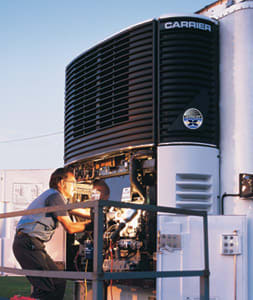
Friday's court decision gives CARB free reign to enforce its TRU regulations.
A U.S. Court of Appeals for the District of Columbia Circuit denied a request by the American Trucking Associations and the Truckload Carriers Association to reconsider a waiver granted by the Environmental Protection Agency.
The EPA granted the waiver to the California Air Resources Board in January 2009, giving the agency the authority to enforce regulations related to Transport Refrigeration Units, or TRUs. The court decision was made Friday.
The rules, which were adopted in February 2004, requires that TRUs equipped with diesel engines seven years or older be replaced or retrofit with new engines. This applies only to TRUs operating in California. While the rules were scheduled to take effect in December 2004, CARB had to get the EPA waiver to enforce them. The rules were effective Dec. 31, 2009.
According to the court, the ATA argued that "EPA misinterpreted and unreasonably applied the statutory criteria when approving the California rule." Specifically, the ATA felt the rules did not "meet compelling and extraordinary conditions." But the EPA said this refers to the factors that tend to cause pollution - the "geographical and climatic conditions that, when combined with large numbers and high concentrations of automobiles, create serious air pollution problems."
While the ATA argued that California doesn't need the rule, the EPA said that California suffers from "some of the worst air quality in the nation."
ATA also took issue with the fact that the rule applies to all carriers that operate in California, calling it "a de facto national rule because many trucks pass through California and will be subject to the rule." The court responded by saying that ATA's argument was weak.
"The California rule does not require any other state to adopt California's approach," the court said. "If ATA's members operate trucks in California, they must comply while operating in California. If they do not operate in California, they need not comply."
ATA also said the EPA did not consider the cost of compliance to the rule, but the court argued that the EPA did adequately consider the costs, which are about $2,000 to $5,000 per unit. In addition, the court said the phased implementation of the rule would minimize costs.
With the denial of the associations' request, CARB is now free to enforce the regulation, which has already hit many carriers who failed to register equipment and meet the standards.
More Drivers

Truck Drivers Need More Than Another Alert
Fleets have more visibility into truck health, safety events, and driver activity than ever. The next challenge is turning all that information into useful guidance for the person who has to decide what to do next.
Read More →
FMCSA Removes 110 Truck Driver Training Schools from Certified ELDT List
Federal regulators also are targeting more than 160 additional training providers and launching a nationwide audit of third-party CDL skills testers as part of a broader crackdown on trucking fraud.
Read More →
Hours of Service Pilot Programs: FMCSA Readies for 2027 Rollout
Two pilot programs could eventually reshape hours-of-service rules, giving truck drivers options to pause their 14-hour clock or use longer split sleeper rest periods.
Read More →
Medical Cards, English Proficiency Reshape Roadcheck Violations
Medical-card violations jumped to the top of the driver out-of-service list during CVSA’s 2026 International Roadcheck, while English-language proficiency violations appeared among the leading violations for the first time.
Read More →
Driver Trust Can Make or Break the Success of Fleet Safety Technology
New Teletrac Navman research suggests that onboarding, transparency about driver data, and positive feedback can play a significant role in how commercial drivers respond to safety and coaching technology.
Read More →
EEOC Sues KLLM Over Alleged Sex Discrimination in Driver Training
KLLM is facing a federal sex-discrimination lawsuit over policies the EEOC alleges put female truck driver trainees at a disadvantage.
Read More →
FMCSA Moves to Codify English Language Requirements for Commercial Drivers
By changing regulations on English-language proficiency requirements for commercial drivers, rather than relying on a guidance memo, the FMCSA said future administrations won't be able to walk back the Trump administration's stricter enforcement with just a memo.
Read More →
Drivers Put Western Star Trucks to the Test at Star Nation Experience
Watch to get an inside look at the Western Star trucks, technology, and community behind the Star Nation Experience 2026!
Read More →
Trump Administration Looks to Put More Veterans Behind the Wheel
The Freedom Haulers program pulls together existing and expanded programs at several federal agencies to recruit veterans to drive commercial heavy-duty trucks and cut the red tape for them to get a CDL, training, and employment.
Read More →
Putting Mack’s Command Steer to the Test
A test drive of Mack’s Command Steer active steering system evaluates how it can make truck driving easier and less tiring.
Read More →