




Corridor Coalition Meets to Plot the Future of Interstate 81
The Interstate 81 Corridor Coalition met in Hagerstown, Md., earlier this month to discuss daily operations along the 855-mile highway, and to shape its future
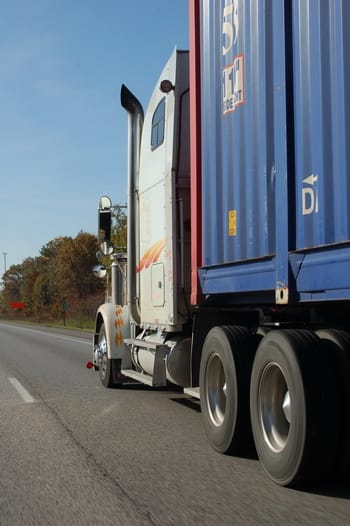
Intermodal service along the I-80 corridor could help reduce highway congestion railroads say. -- photo by Jim Park
The Interstate 81 Corridor Coalition met in Hagerstown, Md., earlier this month to discuss daily operations along the 855-mile highway, and to shape its future.
The group is comprised of transportation officials, representatives from industry, local governments, metropolitan planning organizations, and politicians from the six states along the route, including New York, Pennsylvania, Maryland, West Virginia, Virginia, and Tennessee. The group was formed three years ago to help deal with common safety and congestion issues.
Among the themes discussed at the fall conference were efforts to secure federal funding for the Coalition so that it may operate like the Interstate 95 Coalition. That one has been around since the early 1990s, and is operating in part on federal funding.
According to published reports, Washington County, Md. Commissioner James Kercheval -- representing Washington County on the coalition -- said that regional efforts make the best use of available tax dollars when it comes to the distribution of funds.
"They can look at the whole corridor and not distribute funds state by state. I think that is the way funding is going," he said.
The Big Picture
Nobody doubts that traffic is going to increase exponentially along the route. More trucks and more trains will be needed to meet future demand, but the infrastructure is already past its design capacity in some locations. More cooperation between road and rail is what's needed, says James E. Ward Jr., president and CEO of D.M. Bowman Ltd. of Hagerstown.
"Neither trucks nor trains can meet the projected services needed in 2025," Ward told the gathering. "We're in it together, or it's going to be a mess. We have to work together. It doesn't happen by one single mode. If we're going to keep America moving every single day we're going to have to work together."
Representatives from Norfolk Southern and CSX -- both have rail-truck yards in the southern Pennsylvania region -- explained their plans to attendees for improving intermodal service along the corridor. Both railroads have made recent investments in the region.
Norfolk Southern broke ground last month on its $95 million Franklin County Regional Intermodal Facility in Greencastle, Pa. When it becomes operational in 2012, it will form part of the railroad's multi-state Crescent Corridor initiative to establish an efficient, high-capacity intermodal route between the Gulf Coast and the Northeast.
CSX is working on its National Gateway corridor linking East Coast ports and markets with the Midwest.
Both talked of increased rail capacity as a way to reduce congestion on highways amid a growing demand for freight transportation.
While intermodal facilities are expected to reduce the number of long-haul trucks on the highway, what happens to the number of short-haul trucks remains to be seen. There are already a staggering number of trucks using the I-81 corridor, and adding intermodal facilities in the region could increase the number of trucks using the highway to access the terminals.
Where to Park?
Truck parking was also discussed at the two-day gathering. There are an estimated 5,200 truck parking spaces along the corridor, but Virginia Tech Transportation Institute Fellow, Ray Pethtel, pointed out that many drivers still resort to parking along highway shoulders and on- and off-ramps.
Among other proposed projects, the I-81 Corridor Coalition would like to develop a system that could indicate to drivers where parking is available.
Last year, the Virginia Department of Transportation said overall, trucks account for one in four vehicles using the highway, but noted there can be nearly as many trucks as passenger cars along any given stretch of road.
"Trucks are not a major cause of congestion on I-81," Ward said. "Trucks deliver 68 percent of total freight and 100 percent of all consumer products. I don't see that changing."
As driver shortages threaten trucking's productivity, Ward noted more productive trucks hauling heavier payloads on six axles at 97,000 pounds could mitigate labor shortages by improving hauling capacity.
"Big trucks are not bad trucks," Ward told the group.
The I-81 Corridor Transportation Network supports both freight and passenger movement in a safe, efficient, environmentally sensitive, manner. It encourages intermodal development, supports economic development, and encourages coordinated land use policy. It will be meeting again in the spring of 2011.
More info: Interstate 81 Corridor Coalition
More Drivers

Truck Drivers Need More Than Another Alert
Fleets have more visibility into truck health, safety events, and driver activity than ever. The next challenge is turning all that information into useful guidance for the person who has to decide what to do next.
Read More →
FMCSA Removes 110 Truck Driver Training Schools from Certified ELDT List
Federal regulators also are targeting more than 160 additional training providers and launching a nationwide audit of third-party CDL skills testers as part of a broader crackdown on trucking fraud.
Read More →
Hours of Service Pilot Programs: FMCSA Readies for 2027 Rollout
Two pilot programs could eventually reshape hours-of-service rules, giving truck drivers options to pause their 14-hour clock or use longer split sleeper rest periods.
Read More →
Medical Cards, English Proficiency Reshape Roadcheck Violations
Medical-card violations jumped to the top of the driver out-of-service list during CVSA’s 2026 International Roadcheck, while English-language proficiency violations appeared among the leading violations for the first time.
Read More →
Driver Trust Can Make or Break the Success of Fleet Safety Technology
New Teletrac Navman research suggests that onboarding, transparency about driver data, and positive feedback can play a significant role in how commercial drivers respond to safety and coaching technology.
Read More →
EEOC Sues KLLM Over Alleged Sex Discrimination in Driver Training
KLLM is facing a federal sex-discrimination lawsuit over policies the EEOC alleges put female truck driver trainees at a disadvantage.
Read More →
FMCSA Moves to Codify English Language Requirements for Commercial Drivers
By changing regulations on English-language proficiency requirements for commercial drivers, rather than relying on a guidance memo, the FMCSA said future administrations won't be able to walk back the Trump administration's stricter enforcement with just a memo.
Read More →
Drivers Put Western Star Trucks to the Test at Star Nation Experience
Watch to get an inside look at the Western Star trucks, technology, and community behind the Star Nation Experience 2026!
Read More →
Trump Administration Looks to Put More Veterans Behind the Wheel
The Freedom Haulers program pulls together existing and expanded programs at several federal agencies to recruit veterans to drive commercial heavy-duty trucks and cut the red tape for them to get a CDL, training, and employment.
Read More →
Putting Mack’s Command Steer to the Test
A test drive of Mack’s Command Steer active steering system evaluates how it can make truck driving easier and less tiring.
Read More →