




Connecting Vehicles to Cut Congestion, Improve Safety
Congress is not going to vote for reinvestment in highway infrastructure any time soon, so the next best thing is to get more out of what already is there, says Xerox chairman and CEO Ursula Burns
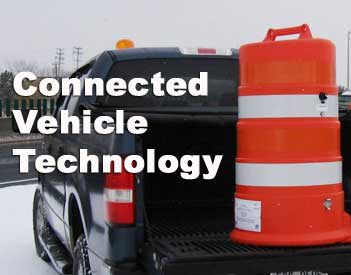
The iCone is equipped with radar and cellular and satellite communications to send information about work-zone traffic to message boards upstream from the zone. All the road crew has to do is put it in place and turn it on.
Congress is not going to vote for reinvestment in highway infrastructure any time soon, so the next best thing is to get more out of what already is there, says Xerox chairman and CEO Ursula Burns.
"I don't believe we can use lack of funding as excuse not to get things done," Burns told information technology specialists gathered near Washington, D.C., last week for the annual meeting of ITS America. "There is huge opportunity in getting more out of less."
The three-day meeting offered a rundown of programs, some close to fruition and some on the horizon, that can improve safety, reduce congestion and make the national transportation system more efficient.
The programs are being built around "connected vehicle technology" - systems that link vehicles to each other and to the infrastructure itself.
Some connected vehicle applications already are in widespread use, such as PrePass weigh-in-motion, but others still are being tested for future deployment.
The Department of Transportation says the technology can lead to significant safety improvements. It could help drivers avoid more than 70% of all truck crashes, and 83% of light-vehicle crashes, DOT says.
The National Highway Traffic Safety Administration is taking a keen interest and aims to make a decision on regulatory standards for heavy trucks by 2014.
The agency has a pilot project under way that uses dedicated short-range communications (DSRC) in the 5.9 Gigahertz frequency range for a variety of warning systems.
The applications being tested sound warnings when there is a vehicle in the driver's blind spot, when a forward collision is imminent, if an upcoming intersection is blocked, if it is not safe to pass or if a nearby vehicle has lost control.
The University of Michigan Transportation Research Institute is almost a year into a 30-month field test involving some 2,800 connected vehicles.
The vehicles are equipped with wireless devices that transmit and receive speed and location. They also have systems to collect data on how drivers respond to the information.
Con-way Freight is one of the fleets involved in the UMTRI test, said safety director Gregory Pawelski.
The company's participation arises from its commitment to world-class safety, Pawelski said.
"We expect everyone to return home safely," he said.
Besides pre-hire screening, driver schools and training, the company invests in safety technology, he said.
Its suite of onboard technologies includes collision warning, adaptive cruise control and collision mitigation - the Meritor Wabco OnGuard collision safety system - plus roll stabilization.
The benefits are eye-opening. Pawelski said lane departure crashes are down 42%, improper lane changes down 72%, front-end collisions down 82%, unsafe speed crashes down 64% and rollovers down 58%.
Pawelski said Con-way drivers participate in the technology and look forward to new developments, even the company's current test of in-cab cameras to measure driver distraction.
"Most safety benefits come from layering technologies together," he said. "The camera will tie it together to help change driver behavior."
While 5.9 GHz appears to be the frequency of choice for connected vehicles at this stage of their development, one trucking official is not convinced that it should be the only answer.
Dan Murray, vice president of research at the American Transportation Research Institute, an arm of American Trucking Associations, said 5.9 lends itself to urban applications but may not be the best technology for other settings.
There needs to be more research on costs and use of the data that is collected, he said.
Truck Parking
A number of states are undertaking research aimed at improving the truck parking situation.
Collin Castle of the Michigan DOT described a project that will gather data on parking availability from public and private rest areas and transmit it to drivers.
The project, funded by the Federal Highway Administration, will use sensing technology and CCTV cameras at rest areas and input from truck stops to determine where space is available along sections of I-94.
The data will be integrated through the state's traffic management system and disseminated through roadside signs, the DOT website, smartphone apps and DSRC-connected vehicles.
Castle said work is under way and the infrastructure for the test should be in place by next year.
The District of Columbia is working on a system to improve parking conditions for trucks that are delivering or picking up freight in the city.
Eulois Cleckley of the DC Transportation Department said the city wants to make better use of curbside space by making sure loading zones are correctly situated and putting in place a pricing system that is easy to use.
Among the choices for payment might be a smartphone ap, a permitting system or pay-by-phone.
The city also is considering a variable pricing scheme to create incentives for off-peak delivery hours, he said.
In California, a private company, ParkingCarma, is working on expanding its car parking solution to trucks using the I-5 corridor.
In cooperation with Caltrans, the state DOT, ParkingCarma is putting together a test involving two public rest areas and six truck stops, said CEO Frederick Warner.
Information about available space will be gathered through in-road loops, radio frequency identification, video cameras and manual counting. The data will be distributed through a website as well as a cellphone ap.
Warner said he hopes to be able to offer a space reservation service, as well. His research shows that drivers will be willing to pay up to $2 a month for the service.
He said he expects the test to go live in August.
Minnesota Tests Intersection System
Sometimes simplest is best. The Minnesota DOT has been testing a system that uses loop detectors buried in the road to regulate intersection lights and improve traffic flow.
Ken Hansen, ITS project manager at MinnDOT, described a project aimed at reducing the "platooning" that occurs when car traffic piles up behind trucks as they slow for an upcoming red light.
With detectors installed 700 feet from the intersection, the agency was able to extend the light's green time so traffic could proceed safely.
Trucks involved in the test saved 158 hours a year in delay time, and up to $50,000 in operating costs, Hansen said.
More Drivers

Truck Drivers Need More Than Another Alert
Fleets have more visibility into truck health, safety events, and driver activity than ever. The next challenge is turning all that information into useful guidance for the person who has to decide what to do next.
Read More →
FMCSA Removes 110 Truck Driver Training Schools from Certified ELDT List
Federal regulators also are targeting more than 160 additional training providers and launching a nationwide audit of third-party CDL skills testers as part of a broader crackdown on trucking fraud.
Read More →
Hours of Service Pilot Programs: FMCSA Readies for 2027 Rollout
Two pilot programs could eventually reshape hours-of-service rules, giving truck drivers options to pause their 14-hour clock or use longer split sleeper rest periods.
Read More →
Medical Cards, English Proficiency Reshape Roadcheck Violations
Medical-card violations jumped to the top of the driver out-of-service list during CVSA’s 2026 International Roadcheck, while English-language proficiency violations appeared among the leading violations for the first time.
Read More →
Driver Trust Can Make or Break the Success of Fleet Safety Technology
New Teletrac Navman research suggests that onboarding, transparency about driver data, and positive feedback can play a significant role in how commercial drivers respond to safety and coaching technology.
Read More →
EEOC Sues KLLM Over Alleged Sex Discrimination in Driver Training
KLLM is facing a federal sex-discrimination lawsuit over policies the EEOC alleges put female truck driver trainees at a disadvantage.
Read More →
FMCSA Moves to Codify English Language Requirements for Commercial Drivers
By changing regulations on English-language proficiency requirements for commercial drivers, rather than relying on a guidance memo, the FMCSA said future administrations won't be able to walk back the Trump administration's stricter enforcement with just a memo.
Read More →
Drivers Put Western Star Trucks to the Test at Star Nation Experience
Watch to get an inside look at the Western Star trucks, technology, and community behind the Star Nation Experience 2026!
Read More →
Trump Administration Looks to Put More Veterans Behind the Wheel
The Freedom Haulers program pulls together existing and expanded programs at several federal agencies to recruit veterans to drive commercial heavy-duty trucks and cut the red tape for them to get a CDL, training, and employment.
Read More →
Putting Mack’s Command Steer to the Test
A test drive of Mack’s Command Steer active steering system evaluates how it can make truck driving easier and less tiring.
Read More →