




Congress Joins Fight Over Control of Port Truck Drivers
The fight over control of port truck drivers spilled out of the courtroom into Congress last week when Rep. Jerrold Nadler, D-N.Y., offered a bill that would give ports more authority over drayage operations. Under current law, states and local authorities such as ports are barred from regulating truck prices, routes or service. Nadler's Clean Ports Act would create an exemption to let these entities set requirement
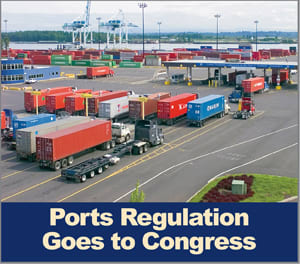
(Photo courtesy of the Port of Portland)
The fight over control of port truck drivers spilled out of the courtroom into Congress last week when Rep. Jerrold Nadler, D-N.Y., offered a bill that would give ports more authority over drayage operations.
Under current law, states and local authorities such as ports are barred from regulating truck prices, routes or service. Nadler's Clean Ports Act would create an exemption to let these entities set requirements
"reasonably related" to improving pollution, congestion, and safety operations at ports.
This change could give the Port of Los Angeles the green light to proceed with its concession plan under which owner-operators would be banned from providing drayage service and all drivers would have to be employees of companies.
Currently the LA Port is temporarily barred from implementing the concession plan by order of the U.S. District Court for the Central District of California, as a result of a suit brought by American Trucking Associations. ATA successfully argued that the LA Port does not have the legal authority to implement a concession plan that in effect institutes economic regulation of the drayage business. Oral arguments in the suit were held last April and a final ruling is expected at any time.
Nadler's bill, introduced with the support of 57 co-sponsors, was referred to the House Transportation and Infrastructure Committee. The chairman of that committee, Rep. James Oberstar, D-Minn., has not taken a position on the measure, said spokesman Jim Berard.
"We are looking at the bill, but most likely would address this issue in the comprehensive surface transportation bill instead of separate legislation," Berard said.
Cleaning the Air
Nadler said his bill is aimed at giving ports the authority to set environmental standards.
"The Clean Ports Act will update federal environmental law to allow forward-thinking ports, like the Port of Los Angeles, to implement clean truck programs that will improve the air, empower truckers, and reduce the incidence of illnesses exacerbated by pollution," he said in a statement.
Opponents of the bill, including ATA and other transportation interests, point out that current law does not prevent ports from enacting clean truck programs.
In fact, the clean truck programs at LA and the Port of Long Beach have been remarkably successful.
"The Port of Long Beach estimates that it has already achieved its goal of reducing pollution from port trucks by 80 percent by 2010, two years ahead of schedule," Rep. Oberstar said at a hearing on the issue in May. "The Port of Los Angeles estimates that to date, port truck air emissions have been reduced over 70 percent compared to 2007 levels."
Nadler himself noted in his statement announcing his bill that the LA Clean Truck Program has replaced almost 6,000 older trucks with either clean diesel or alternative fuel units.
The Owner-Operator Model
He does not believe, however, that the LA Port will be able to sustain that effort unless it can force drayage companies to stop using owner-operators. Echoing the position of the Teamsters union, he argues that under current business practices at the port, drivers are improperly designated as independent contractors in order to shift the cost burden of environmental compliance away from companies.
"This (concession) requirement was determined to be the best way to ensure that the cost of compliance with environmental regulations was borne by trucking companies instead of drivers," Nadler said in a letter to the leadership of the House T&I Committee last April.
"The consequence has been devastating on workers who are seeing their incomes fall by nearly half because trucking companies continue to misclassify their drivers as 'independent contractors' and require them to pay for the operation and maintenance of new vehicles," he wrote. "This in turn threatens the efficacy of the regulations and the tremendous environmental progress made by the Clean Truck Program."
Nadler's legislation represents the view of John Holmes, deputy executive director of operations of the LA Port, who last May told Congress that the owner-operator business model simply cannot produce enough revenue to ensure that the truck owner will be able to afford a modern engine that meets federal clean air standards without ongoing financial assistance.
"We believe that asset based trucking companies are a sustainable model that will provide these companies with the ability to replace current trucks without public money," Holmes told the House T&I Committee. "The employee requirement is key to the port's ability to manage transportation."
A Different Perspective
That is not the view of other ports, however.
The Port of Long Beach operates with a registration plan that permits owner-operators as well as drayage companies, and it has seen no difference in performance between the two, said Deputy Executive Director Christopher Lytle.
"We believe that we have a very effective program that gives us a tremendous amount of flexibility and control over issues of safety, security and environmental," Lytle said.
"Under existing law we have what we need to make sure that trucks are both safe and environmentally compliant. I don't see that passage of the Nadler Bill would change our program at all."
The national port community feels the same way. Aaron Ellis, spokesman for the American Association of Port Authorities, said the group does not take a position on Nadler's bill but does oppose changing the law.
"Individual ports are free to act in their best interest," he said. "Early indications are that port clean truck programs can be highly successful. Ports can address environmental and congestion issues through variety of mechanisms, including tariff provisions, truck registration programs and/or concession agreements, so the association does not believe there is a need at this time to amend the (law)."
Nadler has the support of a broad coalition of labor and environmental groups, including the Teamsters, the Sierra Club, the National Resources Defense Council and the Blue Green Alliance.
Opposition is equally broad. The Clean and Sustainable Transportation Coalition, whose membership includes ATA, the National Industrial Transportation League and a range of other transportation and shipping interests, is urging House members to oppose the Nadler bill.
"We strongly support and have invested in efforts to improve air quality and port security in and around America's ports," the Coalition wrote. "However, the effort to undermine the preemption of state and local interference in interstate commerce is an attempt to overturn losses in the federal courts restricting local regulation of truck drayage services."
The Coalition says in its letter that Nadler is inaccurate in arguing that the ports do not have the ability to enforce the Clean Trucks Program. "Both the Ports of Los Angeles and Long Beach have the ability to enforce the plan and are currently preventing the older, dirtier trucks from entering the port facilities. A concession plan is not required to enforce this ban."
Given the uncertain status of the comprehensive transportation reauthorization bill, it is not likely that the T&I Committee will actively consider Nadler's proposal any time soon - certainly not before the end of the year.
More Drivers

Truck Drivers Need More Than Another Alert
Fleets have more visibility into truck health, safety events, and driver activity than ever. The next challenge is turning all that information into useful guidance for the person who has to decide what to do next.
Read More →
FMCSA Removes 110 Truck Driver Training Schools from Certified ELDT List
Federal regulators also are targeting more than 160 additional training providers and launching a nationwide audit of third-party CDL skills testers as part of a broader crackdown on trucking fraud.
Read More →
Hours of Service Pilot Programs: FMCSA Readies for 2027 Rollout
Two pilot programs could eventually reshape hours-of-service rules, giving truck drivers options to pause their 14-hour clock or use longer split sleeper rest periods.
Read More →
Medical Cards, English Proficiency Reshape Roadcheck Violations
Medical-card violations jumped to the top of the driver out-of-service list during CVSA’s 2026 International Roadcheck, while English-language proficiency violations appeared among the leading violations for the first time.
Read More →
Driver Trust Can Make or Break the Success of Fleet Safety Technology
New Teletrac Navman research suggests that onboarding, transparency about driver data, and positive feedback can play a significant role in how commercial drivers respond to safety and coaching technology.
Read More →
EEOC Sues KLLM Over Alleged Sex Discrimination in Driver Training
KLLM is facing a federal sex-discrimination lawsuit over policies the EEOC alleges put female truck driver trainees at a disadvantage.
Read More →
FMCSA Moves to Codify English Language Requirements for Commercial Drivers
By changing regulations on English-language proficiency requirements for commercial drivers, rather than relying on a guidance memo, the FMCSA said future administrations won't be able to walk back the Trump administration's stricter enforcement with just a memo.
Read More →
Drivers Put Western Star Trucks to the Test at Star Nation Experience
Watch to get an inside look at the Western Star trucks, technology, and community behind the Star Nation Experience 2026!
Read More →
Trump Administration Looks to Put More Veterans Behind the Wheel
The Freedom Haulers program pulls together existing and expanded programs at several federal agencies to recruit veterans to drive commercial heavy-duty trucks and cut the red tape for them to get a CDL, training, and employment.
Read More →
Putting Mack’s Command Steer to the Test
A test drive of Mack’s Command Steer active steering system evaluates how it can make truck driving easier and less tiring.
Read More →