




Related: Preparing for Autonomous Vehicles
Colo. DOT Debuts Self-Driving Work Zone Vehicle
The Colorado Department of Transportation (CDOT) unveiled the world's first self-driving work zone vehicle designed to improve safety for road maintenance crews. The vehicle is positioned behind road construction crews to protect workers from the traveling public.
by Staff
August 21, 2017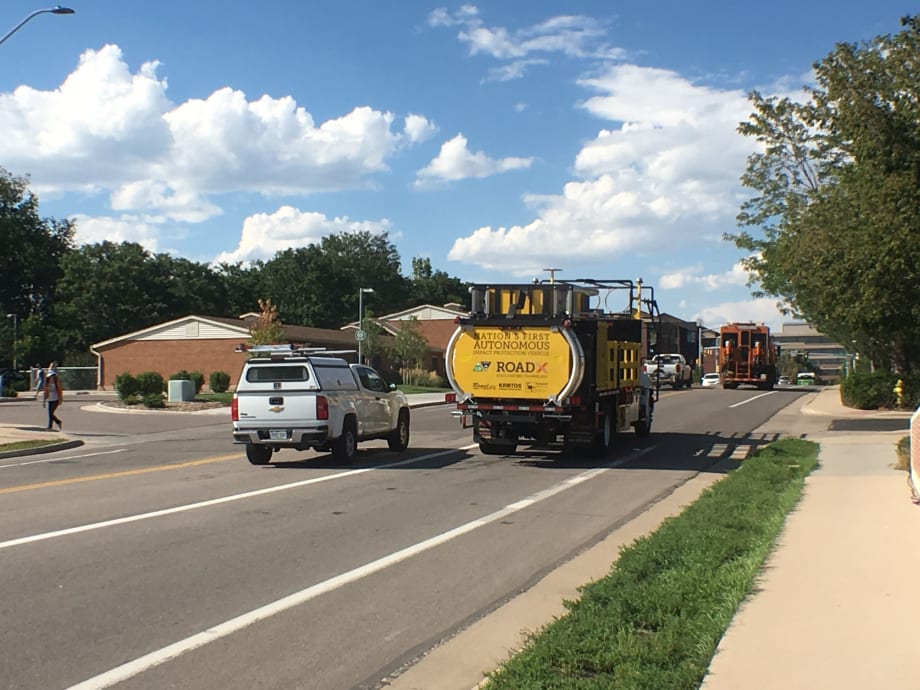
Photo courtesy of Colorado DOT
2 min to read
The Colorado Department of Transportation (CDOT) unveiled a self-driving work zone vehicle designed to advance safety for roadway maintenance crews. Customarily positioned behind road construction crews in order to protect workers from the traveling public, the Autonomous Impact Protection Vehicle (AIPV) increases work zone safety by removing the driver from a truck that is actually designed to be hit.
“Just in the last four years, there have been 26 incidents where a member of the traveling public struck a CDOT impact protection vehicle — that’s almost seven per year,” said Shailen Bhatt, CDOT executive director. “This is a dangerously high number when you consider that in some instances, a CDOT employee is sitting in the driver’s seat of the vehicle that was hit. By using self-driving technology, we’re able to take the driver out of harm’s way while still effectively shielding roadside workers.”
The AIPV uses technology to mimic the position, speed, and direction of a lead vehicle that transmits a signal to the trailing driverless vehicle, ensuring the AIPV is always correctly positioned between roadway workers and live traffic.
CDOT and a host of partners showcased the AIPV in action without a driver behind the wheel during a live roadway striping operation in Fort Collins, Colo. As part of its RoadX program, CDOT and its partners adapted military technology for use in the AIPV that uses a rear-mounted attenuator (or crash cushion) to absorb or deflect vehicles that cross into work zones.
Prior to the August 18 live roadway operation, CDOT conducted extensive testing of the AIPV’s emergency stopping and obstacle detection systems. Testing also confirmed the vehicle’s ability to stay in its lane and make tight turns.
CDOT’s partnership with Colas UK, Royal Truck & Equipment, and Kratos Defense was pivotal in deploying this technology. Colas, a private company that provides civil engineering, maintenance, and construction services in the United Kingdom, is testing the same technology for use in work zones, and is sharing test methods and lessons learned with CDOT. Royal Truck & Equipment built the AIPV using the latest technology, including the industry’s largest variable message board mounted to the truck. Kratos Defense designed the hardware and software needed to provide the driverless capability to the AIPV.
CDOT will continue testing and plans to begin using the vehicle by the end of the year.
More Fleet Management

Sponsored•September 16, 2026
Color Match Smarter: Tools That Restore & Perform
For fleet managers and collision repair professionals keeping heavy-duty trucks on the road, getting the color right the first time isn't just about appearance — it's about efficiency, turnaround time, and bottom-line results. Discover how today's digital color tools are transforming the repair process from guesswork to precision.
Read More →
FMCSA Pauses Biennial-Update Enforcement Amid Motus Transition
Carriers whose updates were due on or after June 1 have more time, while FMCSA works to stabilize its new registration system and warns of phishing sites impersonating its new carrier registration system, Motus.
Read More →
Sponsored•September 14, 2026
2026 Blueprint for Countering Smarter Supply Chain Theft
Cargo theft is no longer just the cost of doing business. It's a multi-billion-dollar criminal enterprise exploiting vulnerabilities across your fleet, drivers, and supply chain.
Read More →


Sponsored•September 1, 2026
How Telematics Improves Visibility, Control, and Performance in Refrigerated Fleets
Explore how telematics help refrigerated fleets improve visibility, uptime, efficiency, compliance, and cargo protection across connected cold chain operations.
Read More →
What the U.S.-Canada Trade War Means for Trucking
Escalating U.S.-Canada tariffs could disrupt cross-border freight, reduce truck volumes, raise costs, and create new uncertainty for carriers on both sides of the border.
Read More →
What Are Trucking’s Top Concerns for 2026?
The American Transportation Research Institute wants to know what's worrying trucking fleet managers, drivers, and other stakeholders in its annual Industry Issues survey.
Read More →
American Trucking Associations Looks for a New Leader
ATA President and CEO Chris Spear abruptly left his job at the association on August 21, at a pivotal time for the trucking industry.
Read More →
Public Wi-Fi Cybersecurity Risks: How Truck Drivers and Fleets Can Protect Their Data
Public Wi-Fi can expose truck drivers and fleets to credential theft, malware, and other cyber threats. Here’s how to reduce the risk on the road.
Read More →
For Nicky Cupp, Fleet Innovation Starts With Frustration
HDT Truck Fleet Innovator Nicky Cupp turns everyday pain points at Fraley & Schilling into opportunities for better technology and smarter processes.
Read More →
Adam Buttgenbach’s Approach to Electric Trucks: Start With Where They Fit
HDT Truck Fleet Innovator Adam Buttgenbach helped PepsiCo build one of North America’s largest EV fleets by focusing on where electric trucks make operational sense.
Read More →