




Class 8 Production Dampened by Component Shortages
While significantly more trucks are needed to handle freight growth, truck production continues to be limited by shortages of semiconductors and various other components, FTR reports.

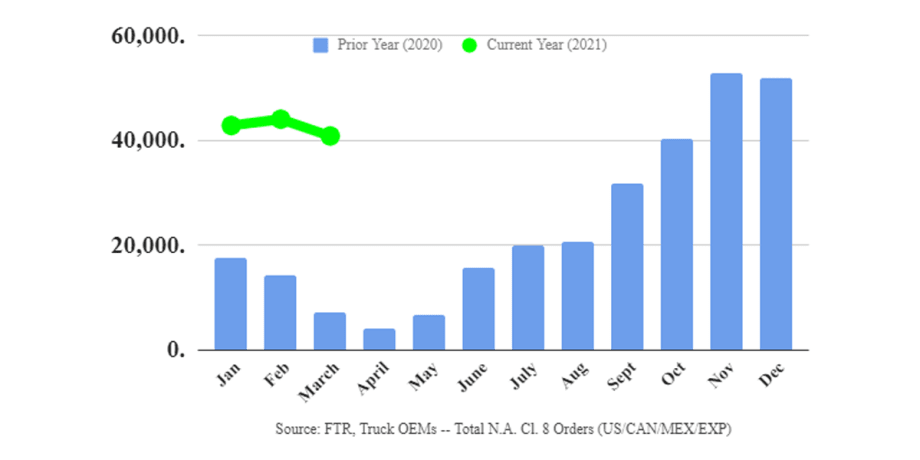
Preliminary North American Class 8 net orders for March were down 9% to 40,800 units, compared with February numbers.
Graph: FTR
While significantly more trucks are needed to handle the freight growth generated by the economic recovery and government stimulus, truck production continues to be substantially limited by shortages of semiconductors and various other components, FTR reports.
One such shortage is that of microchips, which has hobbled North American truck production over the past few weeks, Kenworth General Manager Kevin Baney told industry journalists during an April 1 press event in Phoenix, Arizona.
“This chip shortage is primarily centered in Taiwan, where the bulk of microchips are manufactured, as a result of the pandemic,” Baney said. “However, it was water damage at shipping facilities in Austin, Texas, coming in through Mexico, which ruined entire shipments of chips already shipped to the U.S. from overseas that created the short-term supply issue we’re facing now.”
There are no clear indications of when the supply-chain issues will be resolved, FTR officials said in a press release. For the next few months, computer chips will be in short supply and ports will be backed up, FTR’s Don Ake, vice president of commercial vehicles, predicts.
Meanwhile, fleets continue to order in large quantities to secure trucks for future needs.
While preliminary North American Class 8 net orders for March were down about 10% compared with February numbers, March orders (about 40,000 units) were still up more than 33,000 units compared with March 2020, which was impacted by the pandemic, FTR officials said. Class 8 orders were 424% higher than March 2020, ACT officials said.
March was the sixth consecutive month exceeding the 40,000-unit threshold, a record. Class 8 orders now total 372,000 units for the past 12 months.
“There is tremendous pent-up demand being generated due to the constrictions on supply. The pressure in the market is building, as orders continue to flow into OEMs at a record pace. To have this level of orders roll in for half a year is impressive and unprecedented,” Don Ake, vice president of commercial vehicles for FTR, said in a press release.
Ake added: “It appears the industry will be playing catch-up well into the first half of next year,” Ake said.
Meanwhile, demand for Class 5-7 vehicles is up 19% from February numbers to 31,400 units.
More Equipment

How Volvo Updated Its D13 for EPA 2027 [Watch]
Volvo’s updated D13 promises lower emissions without sacrificing performance or fuel economy. Take a closer look at what changed inside the engine in this HDT Spotlight video.
Read More →
Michelin Tire Improves Efficiency and Durability for Regional Fleets
The Michelin X Multi Energy D2 is a regional haul drive tire engineered to help fleets improve fuel efficiency, durability and traction in demanding stop-and-go operations.
Read More →
ZF Expands Commercial Vehicle Push in North America
ZF is expanding its North American commercial-vehicle presence with new transmission applications, electrification, trailer technology and autonomous-driving systems.
Read More →
Tesla Wants a Self-Driving Semi. Are Cameras Enough?
Could Tesla’s camera-only autonomous driving technology work on an 80,000-pound Semi? In this commentary, HDT's Deborah Lockridge takes a look at Tesla, Cybercab, and how autonomous trucks see the road.
Read More →
Kodiak: Driverless Long-Haul Truck Launch on Track for 2026
Kodiak AI says its driverless long-haul safety case is 93% complete and it remains on track to begin commercial operations by year-end 2026.
Read More →
What DOT’s Automated Vehicle Strategy Means for Trucking
The U.S. Department of Transportation issued a new automated-vehicle strategy that outlines plans for driverless-truck regulations, cross-state freight corridors, and federal safety standards.
Read More →
East Coast Port Launches $45M Electric Truck Push
The Port Authority of New York and New Jersey announced millions in incentives for zero-emission drayage trucks, yard tractors, and new charging hubs near the port.
Read More →
PlusAI Going Public to Fund Autonomous Truck Launch
A SPAC deal could provide PlusAI with up to $300 million as it works toward a 2027 commercial launch of factory-built autonomous trucks.
Read More →
NHTSA Moves to Rewrite Truck Fuel-Economy Rules
The National Highway Traffic Safety Administration says it lacks authority to regulate medium- and heavy-duty truck engines separately from complete vehicles, but the existing standards have not yet been eliminated.
Read More →
Detroit Opens Orders for EPA 2027 Engines
Detroit isn’t starting from scratch to meet EPA 2027 diesel emissions standards. Its Gen 6 DD13 and DD15 engines keep much of today’s platform while updating the fuel and aftertreatment systems.
Read More →