




Capacity Growth An Inevitable Result of Lowered Utilization
The fourth-quarter Transport Capital Partners survey finds a large majority of carriers expecting to grow capacity, and many moving to replace their aging vehicles.
The fourth-quarter Transport Capital Partners survey finds a large majority of carriers expecting to grow capacity, and many moving to replace their aging vehicles.
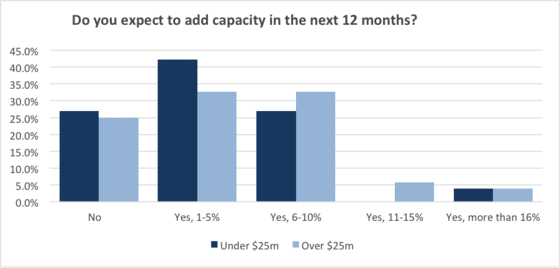
New hours-of-service rules have led to fewer hours per day utilization of equipment. As a result, carriers are being pushed to increase capacity and raise driver pay. The number of carriers indicating they are not going to add capacity has been trending down, and is now at its lowest level yet for this survey (27%).
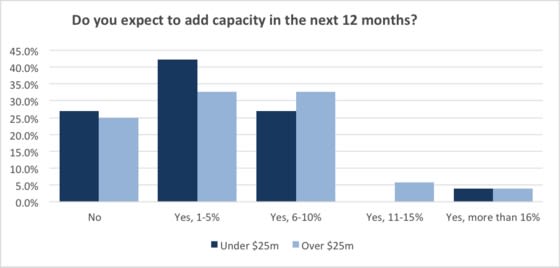
For the first time ever, 30% of carriers expect to add between 6% to 10% capacity. These results are not surprising given that 78% of the carriers this quarter indicated they had lost productivity due to hours-of-service changes.
Larger carriers expect to be more aggressive in adding equipment than smaller carriers. Thirty-nine percent of larger carriers expect to add between 5% to 15% compared with only 27% of smaller carriers.
Among those intending to add capacity, the percentage of carriers planning to add capacity through the use of independent contractors has jumped 63% (from 16% to 26%). The most commonly reported method for adding capacity is through company equipment that is either financed or purchased on a Trac Lease - 35%, up from 26% last quarter. Carriers adding capacity by purchasing other carriers has increased from 0% three quarters ago to 6%.
Aging Tractors Being Traded Out
As carriers increase capacity, they are also more likely to replace their older vehicles. Almost 40% expect to replace 11% to 25% of their fleet this year. The difference between smaller and larger carriers is striking. Seventy-seven percent of smaller carriers plan to replace less than 10% of their fleet compared with 40% of larger carriers (still a high number). Conversely, almost three times as many larger carriers expect to add 11% to 25% (50% vs. 15%).
“We suspect that all the 2007 pre-buy tractors are being traded out. If smaller carriers are not able to replace older, less fuel-efficient equipment (and their higher maintenance costs), those carriers will not be well positioned to benefit from looming good times,” observed Richard Mikes, a TCP partner.
More Fleet Management

Why Private Fleets Are Taking More Freight
Private fleets are putting their own trucks on demanding customers and high-cost lanes as companies seek greater control over service, costs, and capacity.
Read More →
Color Match Smarter: Tools That Restore & Perform
For fleet managers and collision repair professionals keeping heavy-duty trucks on the road, getting the color right the first time isn't just about appearance — it's about efficiency, turnaround time, and bottom-line results. Discover how today's digital color tools are transforming the repair process from guesswork to precision.
Read More →
FMCSA Pauses Biennial-Update Enforcement Amid Motus Transition
Carriers whose updates were due on or after June 1 have more time, while FMCSA works to stabilize its new registration system and warns of phishing sites impersonating its new carrier registration system, Motus.
Read More →


2026 Blueprint for Countering Smarter Supply Chain Theft
Cargo theft is no longer just the cost of doing business. It's a multi-billion-dollar criminal enterprise exploiting vulnerabilities across your fleet, drivers, and supply chain.
Read More →
How Telematics Improves Visibility, Control, and Performance in Refrigerated Fleets
Explore how telematics help refrigerated fleets improve visibility, uptime, efficiency, compliance, and cargo protection across connected cold chain operations.
Read More →
What the U.S.-Canada Trade War Means for Trucking
Escalating U.S.-Canada tariffs could disrupt cross-border freight, reduce truck volumes, raise costs, and create new uncertainty for carriers on both sides of the border.
Read More →
What Are Trucking’s Top Concerns for 2026?
The American Transportation Research Institute wants to know what's worrying trucking fleet managers, drivers, and other stakeholders in its annual Industry Issues survey.
Read More →
American Trucking Associations Looks for a New Leader
ATA President and CEO Chris Spear abruptly left his job at the association on August 21, at a pivotal time for the trucking industry.
Read More →
Public Wi-Fi Cybersecurity Risks: How Truck Drivers and Fleets Can Protect Their Data
Public Wi-Fi can expose truck drivers and fleets to credential theft, malware, and other cyber threats. Here’s how to reduce the risk on the road.
Read More →
For Nicky Cupp, Fleet Innovation Starts With Frustration
HDT Truck Fleet Innovator Nicky Cupp turns everyday pain points at Fraley & Schilling into opportunities for better technology and smarter processes.
Read More →